Showing posts sorted by relevance for query The Start of Eternity. Sort by date Show all posts

May 29, 2013

The Foundations of Eternity

Exode is a story about the struggle to save we Earthlings from extinction. We humans were designed as just one in a series of primates and our Creators intended that we would be replaced, tossed into the trash heap of evolution along with the rest of genus Homo and genus Australopithecus. Our replacements, the Prelands, are already waiting in the wings, ready to inherit planet Earth.

While developing the science fiction story Exode, I realized, to my surprise, that it is a sequel to another story. I previously thought of that other story as being called "The Start of Eternity" because Part IV told how positronic robots developed time travel and invented Eternity, the time travel device that is featured in Isaac Asimov's novel The End of Eternity.

The Start of Eternity was written as a fan fiction sequel to Asimov's novel Foundation and Earth. I imagined that the Foundation Reality was crafted by positronic robots in a desperate attempt to keep Humanity free of the universe-wide machinations of the Huaoshy, aliens with seemingly god-like abilities due to their billion year old technological civilization.

The Foundations of Eternity
After realizing that Exode begins right where The Start of Eternity ends, I started noticing some needed changes to The Start of Eternity as it had been originally written. For example, I had originally imagined that in order to bring the positronic robots of Earth under control, the Huaoshy could simply "instantiate" themselves in the form of the material bodies that they had abandoned hundreds of millions of years ago.

While developing Exode I recently decided that after several hundred million years of existence as a form of artificial life composed of sedronic matter it should not be all that easy for the Huaoshy to return to their former existence as beings of conventional matter. I've now decided on some of the details of the "instantiation process" by which the Huaoshy can return to a more limited existence within our universe of three spatial dimensions. Specifically, the Kac'hin have emerged as being the fundamental mechanism for allowing the Huaoshy to have a physical presence on Earth.

Realizing that I needed to throw some patches on The Start of Eternity in order to make it a proper prequel to Exode, I've decided that I should make an updated version of that story. Since there are going to be some major changes in the new version, I knew that I should change the title.

I want the new title to reflect the fact that it is a fan fiction extension of Asimov's novels so I prefer the title: "The Foundations of Eternity". However, several other possible titles have tugged at my heart strings.

The Klempse Corkscrew
I've been unable to resist writing Asimov into both The Start of Eternity and Exode. The Start of Eternity depicts the young Isaac Asimov just before he becomes a published science fiction author. Young Asimov is visited by his older self who has traveled back in time. The time traveling Asimov is being used by the Huaoshy to help them accomplish a Reality Change that will prevent the positronic robots from making any more Realities that include Seldon's Foundations and the formation of Galaxia.

Asimov is more interested in helping his younger self have a more interesting and rewarding life. One of the first science fiction stories that Asimov submitted for publication was a time travel story called "Cosmic Corkscrew".

An important character in The Start of Eternity is Vicktir Klempse. Klempse does important work to develop the technology that allows human brain patterns to be transferred into the positronic brain circuits of a robot: essentially what is called "mind uploading".

I thought it would be amusing to call his recursive brain scanning technique the "Klempse Corkscrew". Calling the entire story "The Klempse Corkscrew" would be an amusing joke that would only be appreciated by a few Asimov fans.

Galaxia vs Huaoshy
Galaxia vs Huaoshy is a joke title with potentially wider appeal. Inspiration:
Godzilla

When Asimov wrote Foundation and Earth he suggested the idea that the nearly formed Galaxia might be challenged by alien invaders from beyond our galaxy. In The Start of Eternity I imagined that Daneel and his fellow positronic robots would "battle" with the Huaoshy for control of Earth and the fate of Humanity. Here is a funny poster for the Hollywood movie Galaxia vs Huaoshy:
Daneel the robot (representing Galaxia) and a genetically engineered Kac'hin
(used to channel the Huaoshy). Click image to see the entire poster.

The Foundation Reality
attractors in a Foundation Reality
This was another possible title because the story shows how positronic robots caused the Foundation Reality to come into existence. It turns out that there are actually two "foundation realities" because the Huaoshy initially delete the original, but then the positronic robots manage to bring into existence a second "foundation reality". It is at that point that the Huaoshy realize that it is not going to be simple to avoid a "time travel war". Eventually they figure out how to put an end to all time travel.

As a title, "The Foundations of Eternity" captures the idea that the Eternity time travel device was used to make the "foundation realities".

The Foundations of Eternity is being crafted at its own website. Collaborating authors are welcome.
______________
Related reading. Orbho Anagro

Mar 16, 2013

Prophecy by Time Travel

In my previous blog post I mentioned a strange story that is passed from Noÿs to her daughter, Gwyned. Noÿs is a time traveler from 10,000,000 years in our future, so it easy to imagine that she could tell some interesting tales to the people of the 20th century. Noÿs provides Gwyned with a warning about global warming, but this takes place in the early 1960s, before there is widespread recognition of the idea that human activity can alter the global climate.

How much did Noÿs know about her own future? According to the backstory for Noÿs that was developed by Asimov in his novel The End of Eternity, she made use of advanced technology from the future that allowed her to view alternate "Realities", alternative time lines that might come into existence. Speaking to Andrew Harlen, Noÿs says, "I studied the Reality in which....you and I, together, returned to the Primitive. I saw our lives together and they were happy...."

Captain Christopher's son will command the first
manned mission to Saturn. Left. Right: Kirk.
Does Noÿs have the power of prophecy because of her use of advanced technology that allowed her to watch her future self? I've hinted that Noÿs and the humans from 10,000,000 years in the future might be prophetic in another way: because of access to special knowledge by way of their contacts with the Huaoshy, an advanced alien artificial lifeform that has god-like powers. The Huaoshy are fanatical about keeping secrets from Earthlings, so anyone with special access to the Huaoshy will know things about Earth that nobody else on Earth can know.

Journey into the Primitive
For Noÿs, the "Primitive" means specifically the 20th century. In Exode, Noÿs arrives in the 1930s and she does live happily there with Andrew for a while and they have a son, Thomas, but then Andrew is captured by the Overseers. If she was able to see her "future" life with Andrew in the 20th century then why didn't Noÿs know that Andrew would be captured, why didn't she take steps to protect Andrew?

Assignment: Earth
As Noÿs explained to Andrew, "No matter how finely we focus on a given Reality...there are fuzzy spots. One fuzzy spot spoiled things." So, although Noÿs saw into her own future, the future that she helped to create was different in detail from the future that she originally saw, planned for and tried to bring into existence. Most importantly, as described in The Start of Eternity, the Reality that Noÿs brings into existence (what I call the "Foundation Reality") is one that ultimately allows the Huaoshy to discover that positronic robots on the Moon have invented time travel.

However, regardless of the differences between the version of the Foundation Reality that Noÿs tried to bring into existence and the Reality that was actually formed, I like to imagine that Noÿs did know that Andrew might have to be sacrificed to the Overseers even before she traveled with Andrew to the 1930s. However, she would have tried to bring into existence a Reality in which Andrew avoided that fate. Similarly, she tells Andrew, "There is a probability, not a certainty, of course, that that Earth will end up with a largely radioactive crust." Asimov later described how Earth did become so radioactive that it could no longer support human life (in Robots and Empire). I imagine that Noÿs believed it was desirable for Earth to be abandoned by Humanity, for the same reason that Giskard allowed Earth to become dangerously radioactive.

Noÿs views her future in the Primitive
I imagine that Noÿs and Andrew lived "happily ever after" in the "Foundation Reality" (see below), although Andrew died long before Noÿs, simply because of the extended life span enjoyed by Noÿs. The most interesting thing about the Foundation Reality was that it eventually allowed the alien Huaoshy to realize that time travel had been invented by robots living on the Moon. With that critical understanding finally achieved, the Huaoshy set about creating another Reality in which, when the time to sacrifice Andrew approached, I imagine that Noÿs discussed with Andrew the advantage to be gained from allowing himself to be captured and he volunteered to be taken to the secret Observer Base on the Moon. I imagine that Noÿs was aware of the possibility that Overseers might notice the presence of Andrew and Noÿs in the 19th century and in anticipation of being detected she had a plan that would involve allowing Andrew to sacrifice himself so that Noÿs could escape and continue her effort to establish a future that involved control of the galaxy by Humanity.

The Foundation Reality
In The Start of Eternity, I imagined that Noÿs works in the 1930s to bring into existence the Foundation Reality, a timeline within which events unfold as told in Isaac Asimov's fictional universe. However, despite the best efforts of Noÿs, the Huaoshy develop their own time travel technology which they use to put an end to the Foundation Reality and bring into existence the Reality that we know (for reasons described below and in Exode, I call this Reality the "Buld Reality"). Further, after regaining control of their secret base on the Moon, the Huaoshy put an end to all time travel. For Exode, I imagine that Noÿs, while living in the 20th century, is contacted by time traveling Huaoshy and her efforts in the "Primitive" are re-directed towards the task of creating our Reality.

Testosterone and brain sexual dimorphisms
The Noÿs Reality. When Andrew is captured and taken off of Earth (1949), Noÿs and her young daughter, Gwyned, escape from the Overseers and go to live in Australia. Andrew is the first father that Gwyned knows, but he is not her biological father. While living in Australia, Noÿs uses the name Trysta and she eventually marries Merion Iwedon. Upon reaching adulthood, Gwyned knows Trysta and Merion as her parents and Andrew fades from her memories. Gwyned never really knows Ekcolir, her biological father, very well. Ekcolir is an Interventionist agent from Hemmal and he is something of an absentee parent. Gwyned never understands why Ekcolir only occasionally shows up to consult with "Trysta" and only stays for brief visits. Thomas is Gwyned's half brother. Thomas grows up to be a writer of  fiction: science fiction stories that involve "alternative histories". I expand on the life of Thomas in my next blog post.


Temporal Inertia
One of the features of "Reality Changes" in The End of Eternity is the inertia of time, by which Asimov meant that even if a time traveler causes an altered course of events, time tends to "heal itself" and the course of events can return to its original shape after a limited period of time travel-induced alterations.

As a further example of the resiliency of time as depicted by Asimov in The End of Eternity, the main character, Andrew, visits a library in Eternity that has records for many alternative Realities. Among the library holdings for alternate Realities of the 575th century are 15 that included novels written by Eric Linkollew, "usually described as the outstanding writer" of that century. Each of the 15 different sets of "complete works" of Linkollew are different: "One set was noticeably smaller than all the others." Asimov never explained how many alternate Realities in a particular century could be brought into existence by Reality Changes while leaving most people unchanged, but since I'm using Asimov's version of time travel for Exode, I'll adopt this feature of time travel. The Reality that we know is slightly different from any that Noÿs "viewed" in preparation for her time travel to the 20th century, but most of the people that she viewed remain the same and have an existence in our Reality.

Noÿs brings nuclear technology to the 20th century
I imagine that when Noÿs "viewed" her own future in the 20th century she saw her son Thomas and her daughter Gwyned. Gwyned grows up as a gifted science student and starts a career in physics research. I imagine that in the Foundation Reality she played an important role in the development of fusion power.

As a biological product of her two unusual parents, Gwyned is not  typical Earthling. When Gwyned is teleported off of Earth (in the Buld Reality) and arrives at Lendhalen she provides Parthney with a rather perplexing introduction to the existence of a human female who is not sexually attracted to men.

For Exode, I imagine that Noÿs comes from the far future, a time when there is only one human gender. As described by Asimov in The End of Eternity, humans "just die out" at some point in time more than 10,000,000 years in our future. Noÿs is part of a project that is designed to put an end to Eternity, the time travel system on Earth. The mere existence of Eternity is blamed for the inevitable extinction of the human species in the Mallansohn Reality. For her mission back in time, Noÿs has been surgically engineered to have the appearance of a human female of our primitive age and she has some advanced nanites that facilitate her disguise. In the Buld Reality, Gwyned, as a biological hybrid between Noÿs (with the mono-gender genes of humans in the far future) and Deomede (a false Buld from Hemmal), is genetically unable to respond to males as potential sexual partners. Parthney is not particularly attracted to Gwyned, either. They are almost two different subspecies of humans.

Leymaygn on Oib
Gender Wars
Gwyned's sexual preferences come to the attention of Deomede and when he decides to teleport her off of Earth he is happy to so. Ekcolir (in the Noÿs Reality) and Deomede (in the Buld Reality), as Interventionists, are rather aggressive and militant in their efforts to make sure that heterosexual humans inherit the Earth rather than the hermaphroditic Prelands. Also, the Overseers are all genetically modified females, which further biases Interventionist agents on Earth (who are all males) against women like Gwyned. Their prejudice against the Prelands and the Overseers often extends to include humans who are not obviously heterosexual. Deomede does not trust Gwyned so he gladly teleports her off of Earth.

Spock: "Interesting experiences...." Smirking Kirk.
When Gwyned is on Earth, her mother (Noÿs)  talks to Gwyned about certain myths and legends and she hints that they are relevant to the future of Earth. Gwyned can't make sense of what Noÿs is telling her, but later, at Lendhalen, she passes along what Noÿs said to Parthney. When Parthney reaches Earth he "connects the dots" and realizes that Noÿs provided useful information about global warming and how the Buld, soon to arrive in the Solar System, can help the Earthlings deal with their technological adolescence and problems like rising sea levels.

Parthney comes to understand the concept of global warming because of Leymaygn's skilled interpretation of Gwyned's reports about events on Earth. Leymaygn is familiar with the on-going effort to warm Oib, and she correctly recognizes the cryptic warning from Noÿs about melting glaciers and rising atmospheric carbon dioxide levels on Earth. Leymaygn tells Parthney about the technology that is used by the Buld to transmit vast amounts of energy to Oib.

In The End of Eternity, Asimov showed the Eternals confronting the implications of people who, through the use of time travel technology, know their own futures. August Sennor proposes the theory that time paradoxes are impossible, that people cannot know their own futures: something will always prevent people from obtaining knowledge of their own future. Asimov does not adopt that conservative theory, but the people working within Eternity are depicted as having an almost superstitious aversion to even contemplating the idea of meeting yourself in time. Similarly, in Star Trek, allowing people to learn about their future was often just too much fun to avoid. In Tomorrow is Yesterday, the crew of the Enterprise tells Captain Christopher that in his future he will have a son. In Assignment: Earth, Spock and Kirk can't resist telling Roberta and Gary that they have interesting experiences ahead of them, together in their future.

The Start of Eternity: the first positronic robot.
Does Parthney go to Earth knowing his own future? Not really. He has some hints about Earth that help guide his actions, but it is only after he has made critical decisions and already acted that he realizes the meaning of the message that Noÿs provided to him by way of Gwyned. Still, with the help of Parthney that critical information persists in the Solar System and is available when Kach and Izhiun eventually arrive.

The Start of Eternity
Is Exode a sequel to The Start of Eternity? I'm not going out of my way to make sure that Noÿs can jump cleanly from the pages of The Start of Eternity into Exode. It was a happy coincidence that when I finally decided that Exode should start in the 20th century Noÿs was in the right place at the right time to play a role in Parthney's mission to Earth.

For The Start of Eternity I, originally imagined that the Huaoshy would terminate time travel in 1947. However, for Exode, I want Noÿs and Ekcolir to travel back in time, departing the 20th century from a time point in the early 1970s (possibly 1971, more than 20 years after the proposed end of time travel in The Start of Eternity). So, for Exode, I imagine that the Huaoshy put an end to time travel around 1971 rather than 1947. It might be possible to make The Start of Eternity consistent with this later date, but I'm not going to worry very much if the ultimate fate of Noÿs in Exode is slightly different. The Start of Eternity can end with events still taking place in the Noÿs Reality and Exode can be in the Buld Reality.

In The Start of Eternity I imagined that the Huaoshy lost control of their secret base on the Moon. For Exode, I imagine that when the Huaoshy allow a Buld spaceship to depart for Earth (shortly after the time when they lose control of their Moon Base in the Mallansohn Reality) doing so is part of how they create our Reality (the "Buld Reality"). This is part of the Huaoshy plan in which Ekcolir goes back into the past near end of the last glaciation where his  presence will allow the pek to prevent the positronic robots (including Gohrlay) from capturing the Moon Base that was established long ago by the Huaoshy. In exchange for her help in thwarting the revolt by positronic robots, the Huaoshy agree with Noÿs to give the humans a chance to create a technological civilization on Earth (what becomes the "Buld Reality").

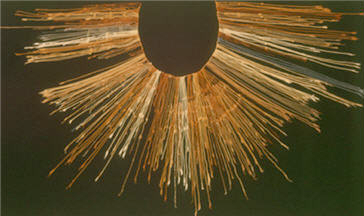
Khipu
I like this "Exode variation" on the end of Eternity (in which Noÿs dies far in our past at about the time when written language first appears on Earth) better than what I had originally imagined in 2009 for The Start of Eternity. It is fun to imagine ways that "ancient Interventionists" could have left behind cultural artifacts that have gone unrecognized. In what way could Noÿs have made a cultural impact about 10,000 years ago that could have persisted and transmitted information about our present times all the way into the 20th century?

Technological Intervention
Ancient lenses?
In the original Exodemic story I imagined that Interventionist agents showed Alexander the Great how to use simple lenses to make possible a system for microscopic writing. That technology for microwriting was discovered by the Overseers and they put an end to its use on Earth, but some of the lenses remained behind as puzzles for archeologists.

For Exode, we can ask how Noÿs might have arranged to have stories about the 20th century propagate across 100 centuries. Recognized evidence for writing that was preserved in stone and clay only goes back about 50 - 100 centuries. However, it is fun to imagine that we might some day discover evidence of unusually advanced artifacts at a 10,000 year old archeological site. Some forms of mnemonic aids that might assist in the propagation of stories through long periods of time might not leave clear evidence of their existence in ancient times. Noÿs is able to compare the ancient myths of the Noÿs Reality and the Buld Reality and notice a difference that she attributes to her own presence on Earth 10,000 years ago.


The Buld Reality
Sequence of Realities: Eternity, Foundation, Noÿs, and Buld.
Before the Huaoshy can cause the "Buld Reality" (which is the world as we know it) to come into existence, there is an intermediate "Noÿs Reality". In the Noÿs Reality the Huaoshy take control of their Base on the Moon at a point during the 20th century. In the Noÿs Reality, Noÿs lives out her life in the 20th and 21st centuries. Under the influence of Noÿs, advanced nuclear technology is developed and Earth never makes heavy use of fossil fuels and never goes into an age of serious global warming and catastrophic sea level rise. However, Earth suffers a nuclear catastrophe instead. The Huaosy show Noÿs that future and in so doing, gain the help of Noÿs for initiating another Reality Change. By sending Ekcolir back into the distant past at the end of the last glaciation the Huaoshy are able to keep control of Observer Base on the Moon and arrange for a Buld spaceship to arrive in the Solar System early in to 21st century. At the end of Exode, we are left wondering if Earthlings can make use of Buld technology to prevent catastrophic sea level rise.

My next blog post further sorts out the differences between the Noÿs Reality an the Buld Reality.

Feb 5, 2010

O happy dagger!

Romeo and Juliet. Source.
I was amazed and pleased when Isaac Asimov linked many of his novels into a coherent "future history". In Foundation's Edge Asimov mentioned the idea that "Eternals" had used their time travel technology to select a Reality in which humans would spread through the galaxy. The Start of Eternity is a fan fiction story that explores the relationship between Asimov's time travel novel (The End of Eternity) and his Foundation Saga.

The main character in The Start of Eternity is a genetically-modified Neanderthal named Gohrlay. Originally I wrote a 2,700 word "teaser" that was intended to be the only part of the novel showing Gohrlay. It might at first seem strange that the protagonist of a novel would only appear in one short scene, but mind transfer is an important element of the story and Gohrlay's mind continues on after her death.

source
In popular culture minds get transferred between bodies as easily as we might put on someone's hat, but The Start of Eternity attempts to be a bit more realistic about the technical challenge of mind transfer. Our human minds are produced by our biological brains. Our minds depend on the physical structure of our brains. In order to transfer Gohrlay's mind into a new body, a means must be found to reveal the details of her brain's structure. Sadly, the crude "brain scan" technology developed by Neanderthal scientists on the Moon destroys brain tissue while it scans the structure of neural networks in a brain.

As the story is told in The Start of Eternity, the brain scanning technology has existed on the Moon for hundreds of years, but nobody volunteers to have their brain scanned and destroyed during the process. It is not at all clear that it will be possible to instantiate the scanned mind in a new body. The plan is to make a copy of the scanned brain structure in the form of "positronic brain circuits", but the lunar roboticists have no way of knowing if the copied brain circuits will actually produce a functioning mind. All they know for sure is that after the brain scan, the person who has their brain scanned will be dead.

assembling R. Gohrlay's body
Gohrlay "volunteers" to have her brain scanned. Is this suicide? Is The Start of Eternity in danger of "glamorizing suicide"? As discussed here, I don't view Gohrlay's death as conventional suicide. She has been guided towards participation in the mind downloading experiment by the crafty Anagro, a robot of alien design. Every time Gohrlay has doubts about participating in the experiment, her thoughts are adjusted by nanorobotic devices that swarm through her brain and control her behavior.

Does Gohrlay have "good reasons" for participating in an experiment that will end her life? Gohrlay is a criminal who has had large parts of her memory disrupted by the nanites that swarm through her brain. She no longer has memories of her family and friends or the details of her crime. She remembers that she grew up with a desire to be an Observer and study Earth, but she is now forbidden from having any contact with the Observer corps.

Is it wrong to depict suicide in fiction? For me, one of the most memorable depictions of suicide in science fiction is in Level 7 by Mordecai Roshwald (see this review). The story is told from the perspective of Push-Button Officer X-127, who robotically pushed the button that kills not only himself but all of humanity. Do such fictional accounts of suicide encourage or discourage suicidal behavior?

I have not seen Avatar, but as discussed here, it seems to stand in the long line of movies where the "hero" is ready and willing to die for some "good reason". Depending on the outcome of the battle, which culture you come from, the tone of the press coverage and who writes the history book, the "warrior hero" might either be viewed as a suicidal maniac or the heroic father of his country.

Does The Start of Eternity "glamorize" suicide by showing Gohrlay's mind living on in robotic form as the mother of tribe of positronic robots? Is someone reading The Start of Eternity in danger of thinking, "I'm going to kill myself because Gohrlay did"? I don't think so. I think the message in The Start of Eternity is that Gohrlay has been manipulated by Anagro. The reader sees that a crafty alien is taking advantage of the fact that humans do make life and death decisions. Anagro creates a "tragic scene" for Gohrlay in which those around her respect her decision to participate in the mind downloading experiment. Everyone has been pushed towards accepting Gohrlay's death by Anagro's manipulations.

A theme that arose in Asimov's fiction is intuition. Several of Asimov's characters were depicted as simply knowing things, without knowing how it was possible that they knew. The culture that Gohrlay finds herself in was created by aliens and is controlled by aliens. Gohrlay has latent "mentalic" abilities that help her sense that it would be better to die and be "reincarnated" as a robot than continue living as a puppet of the aliens.

There is a similar situation in Asimov's story "The Mule", first published in 1945. Ebling Mis is under the mental control of a man who has "mentalic" powers and who is driving Mis to his death in an effort to learn the secret location of the Second Foundation. Was it irresponsible to depict Mis as uninterested in life and willing to die, just as long as he could learn the secret? The only "onlooker" who is not under the mentalic control of the Mule was Bayta Darell. Was Asimov irresponsible for showing that Bayta kills Mis in order to keep him from revealing the great secret?

I think it is no more likely that a reader will commit suicide after reading about Gohrlay than a reader is likely to commit murder after reading about Bayta Darell.

Related reading: does Gohrlay actually die in the brain scanner?


visit the Gallery of Book and Magazine Covers

Jun 18, 2010

Mysterious Motivations

Carl Sagan
In his novel, Contact, Carl Sagan explored the idea that our universe was created and the Creator tried to communicate with us. Sagan suggested that the Creator might have selected the physical properties of our universe and in some way encoded a message to us in the very structure of space/time. In the story, human scientists discover how to read that message, using the tools of science to discover proof of the Creator's existence.

Sagan further suggested that beings like ourselves, using the tools of science, might be able to create new universes. Similarly, In The Last Question, Asimov imagined that humans will eventually learn how to create a new universe (or, at least, re-start our own).

It was implied in Sagan's story Contact that the Creator could do no more than create our universe. After the creation, events proceeded according to natural processes, with no further intervention from the Creator. Other science fiction stories have explored the idea that we humans were created by a god-like being. In The Last Answer, Isaac Asimov imagined an apparently eternal being who created humans.

Asimov asked: why would an apparently eternal being create humans? The answer, in The Last Answer, is that the apparently eternal being has nothing better to do, and hopes that eventually some thinking creature, human or otherwise, will discover the last answer, the ultimate fate of the apparently eternal being.

Is that all there is to existence for beings such as us? Is it the fate of all thinking beings to simply come into existence (by one means or another) and then have nothing else to do but try to understand their existence? And possibly find a way to put an end to that existence? Or possibly find ways to create new universes where yet more thinking beings will ponder their existence?

Arthur Clarke wrote an amusing story (The Nine Billion Names of God) in which it is imagined that humans were created as a tool for finding all the possible names of God. Eventually humans develop a computer that can complete the task and then, mission accomplished, our universe is terminated.

We live in the Age of Singularianism, where some people, other than fiction writers, anticipate that humans will soon attain god-like "superintelligence" and limitless technological powers. Is it possible for human-like beings to avoid such a "technological singularity"?

In The Start of Eternity it is imagined that a human-like species, the Huaoshy, found a way to exist, relatively unchanged, for hundreds of millions of years. When I say "relatively unchanged" I mean that there is no superintelligence in The Start of Eternity and no god-like beings with apparently eternal existence.

If the Huaoshy are content to remain, through hundreds of millions of years, as a species of individuals living in their human-like bodies, then we must ask: what do they feel is the purpose of their existence? The answer is: they enjoy the process of traveling from galaxy to galaxy, finding worlds like Earth, and making sure that human-like species evolve on such worlds. The Huaoshy are masters of a vast intergalactic civilization where millions of human-like species peacefully coexist.

In The Start of Eternity it is imagined that the Huaoshy came to Earth about 7 million years ago and started shaping the course of primate evolution so as to create -us- a species similar (in form and thought processes) to the Huaoshy.

What is the reaction of humans upon discovering that they have been created by the Huaoshy? Sometimes they are resentful, but, as told in The Start of Eternity, very few humans ever learn the truth about human origins. The Great Law of the Huaoshy says that, "It should APPEAR to every type of sentient being that they have self-determination and are not being controlled by more technologically advanced life forms." To satisfy this law, the Huaoshy prevent humans on Earth from knowing about the existence of the Huaoshy.

The Huaoshy find it useful to take some humans off of Earth. There is a small human colony on the Moon where the Huaoshy perform their experiments and make new human genetic variants. In The Start of Eternity a freak accident occurs and the human residents of the Moon are released from Huaoshy control. Then the fun begins.

The Start of Eternity is being collaboratively written. Additional collaborating authors are welcome.

Update. I'm now (2014) making an alternate version of The Start of Eternity that is called The Foundations of Eternity. In my new version of the story, characters such as Captain Hooski are Kac'hin, but they are often called "Huaoshy". The real Huaoshy remain off stage and due to their advanced technological level they might seem to have god-like power.

Jan 26, 2020

Harlan’s Punishment?

cover art by Milford Hunter
Here in 2020 I'm celebrating the science fiction stories of Isaac Asimov. I'm a huge fan of Asimov's time travel novel, The End of Eternity and a character that he invented for that story: Noÿs Lambent. The End of Eternity was first published in 1955 as a hard-cover book.

First Impressions
A glowing review of The End of Eternity was published before the end of 1955 in Authentic Science Fiction Monthly. The unnamed author of that book review felt that The End of Eternity was Asimov's "greatest work to date", praising it for hitting a sweet spot between Asimov's overly-complex Foundation Saga (which had originally been published piece after piece in serialized pulp magazine story format) and lesser novels by Asimov such as The Currents of Space (1952).
1955 review of The End of Eternity
cover art by Ed Emshwiller
1955
Yes, it is unusual to see Asimov being praised for "excellent characterization", particularly since the main character in The End of Eternity is not a very likable person (his name is Andrew Harlan).

Expertly Constructed
What does it mean to say that The End of Eternity is "expertly constructed"? Asimov spent a short time in the army during World War II and occasionally we readers get a taste of the colorful language that Asimov probably heard during that time. One of the workers inside Eternity describes the curvaceous Noÿs Lambent as "built like a force field latrine" (see brick house).

As a first-time reader of this novel you might initially assume that Noÿs is present in The End of Eternity for only one purpose, to provide a bit of eye candy for Andrew. You cannot be more wrong! By the end of the story, readers see Noÿs in a completely new way.

source
Asimov liked to create stories in which the reader could understand both of the two competing sides in a conflict and remain uncertain which side, if either, should win in the end. In The End of Eternity, Asimov expertly depicts an imaginary culture (known as "Eternity"), making it come alive in the minds of readers and he shows us why Harlan is seduced by it, despite its many shortcomings. Then, ultimately, in the end Harlan changes his mind about everything in his life and readers understand the true role that Noÿs Lambent plays. Noÿs provides Harlan with a totally different world view, forcing him to question everything he holds dear.

No Accounting for Taste (1956)
The review of The End of Eternity by Damon Knight that was published in Science Fiction Stories (March 1956) provides a 180 degrees reversed view of the novel compared to the earlier review in Authentic Science Fiction Monthly (discussed above). Knight complains that The End of Eternity is too complex and cluttered with an overload of mind-numbing technical jargon from Eternity.

in the Ekcolir Reality
Original cover art by Frank Freas
and Edmund Emshwiller
Knight complained that the characters in The End of Eternity were almost knocked out of existence by all the gadgets and "double-talk" in the story. Knight described Asimov as part of the "Old Guard" of science fiction that was being replaced by a new generation of writers who were making more "digestible" science fiction. At the time, Asimov was only 36 years of age, so it is amusing to see him described by Knight as part of the "Old Guard". After voicing his complaints, Knight admits, "Asimov's story is fascinating".

Two Types of Sci Fi Fans
In his review of The End of Eternity I suspect that Knight was dancing around the difference between science fiction fans who 1) are science nerds and 2) fans who don't know much about science. I started reading Asimov's novels when I was about 12 years old and fell in love with his complex and wordy stories, so I have to conclude that Asimov's style simply suits some people's tastes and not others.

Love in the 482nd Century
source
A more recent review of The End of Eternity by Marc Barham can be found at The Time Travel Nexus. After Andrew Harlan realizes that Noÿs is an agent from the far future (the "Hidden Centuries") he decides that he must kill her in order to protect Eternity. Barham calls this "Harlan's Punishment".

When Andrew first meets Noÿs, he believes that she is from the 482nd century (what we would normally describe as the far future, past the year 48,200). In his Foundation Saga, Asimov had imagined a future in which humans had by then colonized 25,000,000 Earth-like planets of the galaxy. However, in the Reality of The End of Eternity, there is no human colonization of the galaxy. In the the 482nd, women lead independent lives and can dress like liberated women, shamelessly showing off their beautiful bodies. Andrew falls in love with Noÿs and when he fears that he will not be allowed to have her because of the rules of Eternity, he lashes out and tries to destroy Eternity.

Destroying Eternity would not be the end of the world. "Eternity" is the time travel system that Asimov imagined for The End of Eternity. The "Eternals" are residents of Eternity, a constructed space-time bubble, outside of normal Time, that allows easy access for the Eternals to all future times.

In a metaphorical sense, Andrew is "punished" when he believes that he must kill his beloved Noÿs, but he is never actually punished by the authorities of Eternity. In fact, the top Eternal assures Andrew that he will not be punished for having taken Noÿs out of the 482nd century in a gallant (if misguided) attempt to keep her from being erased from time.

A Detective Novel?
detective Baley
Asimov loved mystery stories and he intentionally tried to write some of his Sci Fi novels as detective mysteries. Metaphorically, Andrew must do some "detective work" when he needs to research the history of Eternity (much of his research is done in the "section library" of the 575th century). Noÿs has planted in his mind the realization that all of Eternity depends on a strange time travel loop in which the Eternity time travel system was brought into existence with the help of a time traveler from the future (Vikkor Mallansohn). Once Andrew's library research confirms this startling idea, he believes that he can negotiate with the authorities to keep Noÿs alive.

Noÿs and Andrew prepare
to travel into the past
I think what Barham means by calling The End of Eternity a "detective story" is that Asimov did a masterful job of keeping the time travel mission that Noÿs is carrying out a complete secret until the last few pages of the novel. Andrew is a hopeless dupe and he never figures out what is going on until Noÿs explains everything. In fact, Andrew was the specific Eternal who was targeted by Noÿs because he would be putty in her hands.

A Love Story
In the end, Andrew does not mind having been tricked by Noÿs because he realizes that she loves him and her plans for the future of Humanity really are for the best. For some reason, Barham says that Noÿs is from "the decadent 575th century". In The End of Eternity it is only Andrew, who comes from a sexually conservative century, who views the 482nd century as decadent.

La fin de l'éternité
Free Will
Asimov was often amused by the interpretations that readers invented for his fiction. In his review, Marc Barham tells us that The End of Eternity "involves philosophic considerations of free will, social planning, evolution and human advancement... in a way that feels shaped by the political dialectic of the ‘Free’ world versus the ‘Communist’ world".

I'm always pleased to take note when other people write long discussions of a story that I like, but in this case, I must scratch my head and say that communism has never entered my thinking while reading The End of Eternity. A great thing about novels is that each reader brings their own perspective to the story. In my case, as a biology nerd, I like the idea that Noÿs was from a time far in our future (10,000,000 years in our future) after which human biology had changed significantly; humans of the future kept evolving (or were genetically engineered). My favorite interpretation is that Noÿs could put ideas into Andrew's mind by some sort of telepathy. If so, does Harlan have any level of "free will" or is he simply the puppet of Noÿs and her telepathic super-power?

Earth's Reality Chain
Unplug when not in use!
I'm skeptical about Barham's suggestion that The End of Eternity somehow encapsulated the cold war antagonism between "individualism and collectivism". Asimov needed an organizational power structure in Eternity that was easy to portray and also was easy to topple when the time came. What Asimov depicted as the governing structure of Eternity is like the governing board of a big corporation. I like to imagine that by the time Andrew tries to destroy Eternity, Eternity had already served its purpose. The positronic robots who had created it used Noÿs as their secret agent who could put an end to Eternity's dominion over Humanity. The Mallansohn Reality (as depicted in The End of Eternity) was an artificial construct that could easily be unraveled when the time came to end Eternity.

The Foundation Reality
Andrew and Noÿs escape from the Mallansohn Reality and bring into existence a new Reality. It is a Reality which Noÿs has already been able to View by using the advanced Reality Viewing technology available to her people 10,000,000 years in our future. I like to imagine that when Andrew and Noÿs went back in time to the 1930s, the Mallansohn Reality was replaced by the Foundation Reality.

H. G. Wells
In his review of The End of Eternity, Barham mentions the influence of Herbert Wells on Asimov. In an essay about time travel, Asimov mentioned The Time Machine as being the "first true time-travel story" and he wrote that Wells was "probably the best science fiction writer of all time". However, I have never found evidence that Wells ever tried to write science fiction. In The Time Machine, Wells displayed no interest in creating a believable depiction of the future or a technology for time travel.
1920s television in the Ekcolir Reality (source).

Anti-Science Fiction
You could even call The Time Machine anti-science fiction. Good old Joe, working in his basement invents the first artificial life form or time machine or space ship or anti-aging pill or... well, you get the idea. It is not science. It is a fantasy story teller using a pretend "scientific breakthrough" to get their magical fantasy story started.

Isaac Asimov had some training in how to do science research. Probably more important, he was part of the governement-run effort during World War II to use science and technology to defeat Nazi Germany and the Japanese Empire. When Asimov wrote his time travel story, he depicted an entire organization that was devoted to making time travel possible.

dystopia or utopia?
Using his personal subjective lenses, Barham looks at The End of Eternity and sees "a World State administered by an enlightened elite". However, if we must view The End of Eternity through a political lens, in my imagination, I see the Eternals as a kind of "puppet government" established by unseen positronic robots who are lurking in the background. Sure, a group of technically-savvy workers are needed to keep Eternity running, but they display no real understanding of (or interest in) their own origins or the development of improvements to their time travel technology (such as the means to go beyond the down-when terminus or to penetrate the Hidden Centuries). The institutionalized ignorance of the Eternals is glaring and in stark contrast to Barham's theory that Asimov's story is an extension of Wells' interest in "a World State administered by an enlightened elite". Barham states flatly: "Eternity are that enlightened elite". I don't agree.

In The End of Eternity Asimov makes it clear that during the long stretch of centuries monitored by Eternity, there are many different Earthly cultures and "World States" that come and go with time. The Eternals are completely disinterested in such Earthly affairs as long as the extremes of rich and poor do not get too extreme. How anyone could read The End of Eternity and refer to the Eternals as an "enlightened elite" is baffling. The Eternals remind me of the bumbling crew of a submarine that is struggling to keep their ship functioning.

Big Brother
The Organization
Barham also compares The End of Eternity to Nineteen Eighty-Four: A Novel by George Orwell. Barham suggests that we can view Eternity as "Big Brother", actively and secretly "organising and planning the future of humanity and by definition the future of every single being in existence". The End of Eternity does not concern itself with attempts to micromanage the lives of people. Asimov focused like a laser on the technology that everyone on Earth was concerned about in the early 1950s, atomic energy technology.

2003 edition
Asimov played a "what if?" game and imagined what might happen if there was a way to suppress atomic energy technology. At the start of the space age, many science fiction stories suggested that it was only atomic energy that could power space travel. So Asimov spun a tale in which a concerted effort to control nuclear energy technology had the side-effect of trapping humans on Earth and preventing them from having a great adventure among the stars. Under these Eternity-enforced conditions of safety from technological dangers like atomic energy, in time, Humanity died out and the human species became extinct.

1984 edition
my current copy
In my view, The End of Eternity was Asimov having Sci Fi fun with a core idea of early science fiction (atomic energy technology might come with dangers, but we are smart enough to handle it), not some Or/Wells-like literary effort to decide if "a governmental Big Brother is always bad for Humanity" or "some techno-elite Big Brother is our only hope". Not that there would have been anything wrong with that, had Asimov wanted to write such a story.

IA UTOPIA
Asimov felt that both 1) stories about utopias and 2) stories about dystopias are boring. In his review of The End of Eternity, Marc Barham says:

"The End of Eternity to me seems as if Asimov has written an American version of 1984 through the lens of a futurist and a technocrat much like H.G.Wells but with the optimism of an American scientist who knows that creating Utopia is easy as long as you have all the information of Eternity at your fingertips." (source)

I really wish that Asimov had lived a loooong life and that he could have been here with us in the age of the internet and had a chance to have online discussions with people such as Marc Barham.

source
Asimov was an advocate for education and the idea that a well-educated group of humans would be able to successfully harness the power of science and technology, do great things, and make a wonderful future for Humanity. I don't think that Asimov was naive enough to imagine that having "information at the fingertips" of technocrats was some sort of magic formula for making the creation of a utopia easy. However, that formula is much better than alternatives such as an anti-science ignoranti that wields power through the promulgation of propaganda and misinformation.

Valkyrie
"For Asimov, like so many writers of the Golden Age, the Manifest Destiny of mankind is to be among the stars" (source)

In his "second career" as a scientist and non-fiction science writer, Asimov was realistic about the difficulty of spreading human civilization through outer space. Asimov had fun writing Sci Fi stories about using trips through hyperspace as an imaginary way for people to quickly travel between the stars, but Asimov believed that he would be remembered for his robot stories which depicted "mechanical men" as the companions of humans. It may be the "destiny" of mankind is to make a form of artificial life that will be able spread among the stars.

Related Reading: more discussion of The End of Eternity
           Also:          political conflict in science fiction
Next: Artificial life in Frank Herbert's Destination: Void.
visit the Gallery of Book and Magazine Covers