Showing posts with label biology. Show all posts

Oct 9, 2021

Human Variants

in the Ekcolir Reality

I just discovered that Michael Anthony Foster died last year. I remember M. A. Foster for his imagined human variant, the Ler. I read Foster's three novels about the Ler and two of his other novels (The Morphodite and Waves) in the late 1970s and early 1980s. 

Given my interests in biology, I greatly enjoyed Foster's fictional concept of a new human species (the Ler) that had been created by genetic engineering. Foster's story took place several hundred years in our future. Since the Ler could not get along with regular humans, they had to go off into outer space and find their own place to live.

I've long wished that Foster might have written a sequel to his 1970s Ler books, but I have to content myself with imagining that in another Reality, the analogue of Foster might have written more stories -or different stories- about the Ler.

selling Heinlein
A few years before I discovered Foster, I had read The Past Through Tomorrow, a collection of stories by Robert A. Heinlein. The last story in The Past Through Tomorrow was "Methuselah's Children", another story about a human variant that was forced to abandon Earth.

Sadly for Heinlein, he wrote "Methuselah's Children" before the molecular basis of heredity was known. Unable to imagine genetic engineering, Heinlein imagined that it could be possible to selectively breed humans for a long lifespan. Of course, humans have been selectively breeding animals for thousands of years. Imagine a sheep that could live for 200 years and produce wool for many decades. That's right, there is no such thing and you are just as likely to breed humans who live to be 200 years old, but that did not stop Heinlein from writing "Methuselah's Children" nor did it stop John Campbell from buying and publishing the story.

bio-electricity in 1939
Isaac Asimov praised Heinlein for bringing the mind-set of an engineer to his science fiction stories. However, an engineer will seldom have anything useful to say about biology. This was quickly made evident in Heinlein's story "Life-Line" in which he imagined being able to measure a person's lifespan in much the same way that an engineer might measure the length of a trans-Atlantic cable.

Heinlien's Foundation. I got in my time machine and went back to 1941 and read "Methuselah's Children" as originally published in Astounding. The story begins with Heinlein playing a trick on his readers who are told that Mary Risling appears to be about 30 years old. Then, on the next page, readers are told that Mary is actually 183 years old. What's going on here? Lucky for readers, they were immediately provided with a snippet of backstory in which Heinlein explained the origins of a secret human breeding project carried out by the Howard Foundation.

Ralph the psychometrician
Starting in 1874, the Howard Foundation selectively (and secretly) bred humans for long lives. Finally, in 2125, it was decided that the time had come to reveal the existence of the resulting 200-year-old humans to the people of the world. If you do the math, Heinlein is telling us that in just a few generations of selective breeding, it was possible to more than double the human lifespan.

Asimov was among the first to use the term "robotics". In "Methuselah's Children", Heinlein used the term "genes group", missing a prime opportunity to instead say "genetic group". In 1942, Asimov began writing his stories about the Encyclopedia Foundation and Hari Seldon, the first great psychohistorian. As shown in the passage to the left on this page, Heinlein's psychometrician, Ralph Schiltz, admits to having failed to predict the course of events in the future. 

future science of symbiotics
Heinlein's story has the "Speaker Trustee" Zaccur Barstow; in time, Asimov would create "First Speaker" Preem Palver of the Second Foundation.

For his story of the future, Heinlein invented the "law of psychological trends" and told his readers that in the future "symbiotics" began to allow psychometricians to better predict social trends. Heinlein was engaged in a bold act of handwavium, but he seemed to suggest that it was only by understanding intestinal bacteria that accurate predictions of human behavior would become possible.

I wonder if Heinlein's imaginary science of symbiotics was a tip of his hat to Olaf Stapledon's 1937 science fiction story Star Maker, which featured some telepathic symbiotic aliens called the "symbiotics". 

more images
In Stapledon's story about the alien symbiotics, there as a symbiotic relationship between a fish-like species and a crab-like species. For the Exode Saga, I imagine that humans are host to nanoscopic endosymbionts

In Heinlein's case, we can only wonder how "colloidal theory" contributed to progress for the struggling psychometricians of the Howard Foundation. In the real world, "colloidal theory" in biology developed in the late 1800s before scientists understood the molecular and organelle components of our cells. Miss Risling assures dubious readers that due to "symbiosis and gland theory" she will long retain her youthful appearance and active mind. The state of medical science has reached the point where she anticipates having a mere three months of senility at the end of her long life.

interior art by H. Rogers
This is all good news for Mary's new friend, Woodrow Smith who enthusiastically refers to her as 'girl' and assures her that she does not look old, although she has had dozens of children. Smith hatches a plan to use an interstellar spacecraft (the second one ever built) for the purpose evacuating the Howard Families from Earth. Tune in next month to find out if that plan will be implemented.

Heinlein spent many pages using his psychometricians's mumbo jumbo to explain why it would be impossible for people of the future to understand and accept that members of the Howard Families lived a long time because of their unique genes. And in the absence of genetic engineering in Heinlein's imaginary future, there is no discussion of identifying the longevity genes and providing them to anyone who wants them. If not genes, then what? A sciensy mystery!

Interstellar spaceship: New Frontiers.
Sadly for the Howard Families, none of the planets in Earth's star system would be a hospitable home. Heinlein imagined that there was a native species on Venus, but that planet was uncomfortably hot for humans. So, it was off into the galaxy in search of a new Earth-like planet. Since Heinlein could not imagine how to detect planets across interstellar distances, the New Frontiers would simply have to go visit another star and hope for a good planet. So that the trip does not take 100,000 years, Heinlein provides an "inertia-less spaceship drive".

Part 2. August 1941. After a 10 year trip, they find an Earth-like planet populated by a humanoid alien species (Zhachera) that has telepathic contact with one of the Earthlings. 

Friday
In Part 1, Heinlein introduced telepathic ability among a minority subset of the Howard Families and made use of it to send a warning to the family members when their secret (amazing longevity) was discovered.

My advice: skip part 2 of "Methuselah's Children" and read the summary provided at the start of part 3.

Part 3. September 1941. The members of the Howard Families are kicked off of the first habitable exoplanet that they found, but that is something of a blessing because in the process they learn that faster-than-light travel is possible. On the second planet that they visit, the telepathic residents help the Earthlings perfect a form of spaceship drive that allows them to return home to Earth in 3 weeks. Back on Earth, the secret of longevity has been found. Heinlein tells us that a big part of living hundreds of years is just believing that you will live a long life. He throws in some additional hand waving about: "the radioactive qualities of vitamins".

in the Ekcolir Reality
I suppose I should confess that when I finished reading The Past Through Tomorrow as a teenager (possibly in 1976), I did not read any more Heinlein until 1983 when I read Friday. Last year I read "Have Spaceship - Will Travel" and now having read "Methuselah's Children" again, I feel like I'm full up with Heinlein and it should be at least 2065 before I again feel the desire to try reading any more of his stories. In my case, I started reading Isaac Asimov before Heinlein and by 1977 I had discovered Jack Vance and dozens of other writers such as Michael Anthony Foster. I had no use for Heinlein.

in the Ekcolir Reality
I enjoy fantasizing about books that might have been written in another Reality by writers such as Vance, Asimov and Foster. Heinlein wrote about a fictional future in which President Nehemiah Scudder became the dictator of the United States in 2016. Instead, we got Trump.

Related Reading: "The Ultra-Elixir of Youth" by A. Hyatt Verrill - the fictional science of radiogens -and- discussion of Heinlein at BlackGate.

Next: The Last Evolution by John Campbell

May 9, 2020

Meth of Maetho

Magnus (left) and Fiamella (right)
The final Magnus Ridolph story, "Worlds of Origin", was first published in the February 1958 issue of Super-Science Fiction. Ridolph was a fan of mathematics and he could have quickly calculated that 10 years passed between publication of the first story in the series and publication of "Worlds of Origin".

In this blog post, I want to explore the roles that women had in Jack Vance's Magnus Ridolph stories. I want to pay full respect the realities of the culture that Vance existed in. He lived in a time that was not quite ready for stories about women having adventures in space as equal partners with the male story characters. However, it is worth asking: to what extent was Vance pushing for change and seeking opportunities to give females more interesting roles in his stories?

cover by Gene Szafran
I got hooked on Jack Vance's writing when I read Trullion, which was published in 1973. Before I began reading Vance's short stories, the oldest works of his that I had read were his 1958 The Languages of Pao and the 1964 Star King. There were huge changes in the nature of Sci Fi story telling between the 1950s and the 1970s.

Isaac Asimov, writing in 1983 about "women and science fiction" (in the January issue of Isaac Asimov's Science Fiction Magazine) said, "Prior to public recognition in the United States that babies are not brought by the stork, there was simply no sex in the  science fiction magazines."

Trullion, first printing
I'm not sure when the stork went out of style, but I still have my faded yellow copy of Trullion that was published in 1973, and we can take it to be a data point midway along the continuum from the "no sex" era of science fiction to the later works of Vance, particularly Ecce and Old Earth which stars Wayness Tamm. Jack Vance lived through the entire transformation of the science fiction genre from its "no sex" origins to the current age when women can now routinely play important roles in Sci Fi stories (even in Hollywood).

Traditional roles in science fiction. You
always needed a few women around to wash
 dishes or be the daughter of the mad scientist.
Vance depicted Magnus Ridolph as being very interested in applied mathematics. Ridolph could have put together a statistical analysis of how women were written into both
1) the stories of the Bible
   and
2) golden age science fiction tales. My guess is that such a statistical analysis would reveal a close match between how women were portrayed in the Bible and the roles that they played in early science fiction stories.

Cultural momentum is a powerful force. Vance's Magnus Ridolph stories such as "Worlds of Origin" depict humans from various planets as having their behavior determined by the customs of their world of origin. Science fiction story tellers were no different: they also struggled to break away from traditional depictions of murderous robots, evil aliens and domestic women always one step behind the male hero or maybe fluffing his pillow.

In the Ekcolir Reality.
In our Reality, "Worlds of Origin" was written right at an inflection point, a time when some writers were finding inventive ways to provide larger and more interesting roles for women in science fiction stories. "Worlds of Origin" features the anthropologist Lester Bonfils and his miserable destiny of failure and defeat... and, yes, there is a woman lurking behind the sagging and nervous figure of Mr. Bonfils.

Poor Bonfils tells Magnus Ridolph, "I am harassed by a woman. She is busily engaged in killing me." Then, after provoking some sad compassion from Magnus, Bonfils rushes off, busy with his anthropological endevors.

In the Ekcolir Reality.
I like to imagine that in an alternate Reality, women had a more active role in the development of science fiction as a literary genre. In such an alternate timeline, there could have been a female analogue of Jack Vance, and some of the Magnus Ridolph stories might have been written somewhat differently, possibly with larger roles for women.

And why should the anthropologist in a story be a man? Yes, in the 1950s, women were very under-represented in scientific professions, but I like to think of science fiction story tellers as being among the first to shift away from traditions and stereotypes. For example, in the 1970s we could finally get a science fiction story like Assignment: Nor'Dyren by Sydney Van Scyoc which has a female anthropologist.

In the Ekcolir Reality. Vance depicted
the Hub as being a space station
composed of many modular bubbles.
An idea that Vance incorporated into several of his stories is that for some cultures it is normal for women select the man of her choice and ask him to marry. This is the type of situation that Lester Bonfils ran into while he was on the planet Journey's End. A common feature of Magnus Ridolph stories is that some of the most interesting action takes place off stage, before the events of the story begin. Sadly, we never learn any details about Bonfil's nontraditional courtship at south Kharesmon on Journey's End.

Ridolph and Bonfils meet at a space station called the Hub, a place where folks (including aliens) from both near and far worlds of the galaxy come and go, arriving aboard passing spaceships. In particular, while relaxing in the lobby of the Hub, Ridolph takes note of a woman who Vance describes as having "miraculous beauty". The description continues: "She was dark and slight, with a complexion the color of clean desert sand; she carried herself with a self-awareness that was immensely provoking."

In the Ekcolir Reality.
The proprietor of the Hub, Pan Pascoglu, informs Ridolph that this dazzling woman claims to be the wife of Bonfils, but strangely, Bonfils and the woman are never seen together. That night, Bonfils dies and in the morning, Pascoglu admits that there is no security force at the Hub and he asks Ridolph to help figure out who killed Bonfils. How can Ridolph refuse?

Pascoglu provides Ridolph with a list of everyone at the Hub who arrived on the same spaceship with Bonfils. On that list is "Fiamella of Thousand Candles", the immediately obvious suspect. Ridolph is not satisfied with the list of suspects; he demands that Pascoglu provide information about their worlds of origin. Pascoglu is useless, so Ridolph spends a few hours doing research in the Hub's library, investigating the diverse cultures of the suspects.

Ridolph interviews suspects in the library.
When interviewed by Ridolph, Fiamella is pleased that Bonfils is dead, but she denies having blasted a hole in his head. Ridolph soon learns that Fiamella selected Bonfils as her husband and then threatened to kill him when he tried to leave her behind on her home world, Journey's End. When Fiamella explains that her preferred method of killing is to "kill by love", Ridolph is intrigued. He and Fiamella flirt for a bit, but they both agree that the gray-haired Magnus is too old for the spunky Fiamella.

In the Ekcolir Reality
Sadly, Vance could go no further in his exploration of Fiamella's special talents (what Vance calls her ability to inflict "death by means of amorous attrition"); it was 1958 and the science fiction genre was still emerging from its era of self-censorship. I suspect that Vance was trying to imply that in order to regain her honor, Fiamella was prepared to stalk and harass Bonfils across the vast expanses of interstellar space until either he relented and accepted her as wife and companion or until he died. Fiamella seems pleased that Bonfils died so quickly: now she can return home, her honor regained.

Solving crimes by telepathy
In the Ekcolir Reality.
You'll have to read the story to discover who killed Bonfils and why at the end of the story Pascoglu fears that he will be the next victim. The alien who appears on the list of suspects as (no name) is a Meth of Maetho, who has a somewhat human appearance but a totally different internal biology. Vance hints that this creature from the planet Hecate has telepathic powers and seems to know who killed Bonfils. However, the alien says, "... the person involved wishes his deed to pass unnoticed, and why should I disoblige him?" This attitude infuriates Pascoglu. Pascoglu and the alien trade threats. The alien claims to be able to unleash a plague of alien spores upon the Hub and Pascoglu can do nothing but insist the alien depart on the next spaceship and never return to the Hub.

Related Reading: celebrating Jack Vance in 2020

Next: I read my 10th Magnus Ridolph story

visit the Gallery of Book and Magazine Covers

May 4, 2020

Monopoly

A night-time raid by the the howling Bounders.
Interior art by Virgil Finlay
I've previously complained about science fiction stories built around the idea that there is only one planet in the galaxy where some valuable resource can be obtained. The short story "The Howling Bounders" by Jack Vance is another such story (Startling Stories, March 1949). We are told that ticholama can only be grown on the sixth planet of the Naos star system. Ticholama is a valuable crop because it is the source of resilian molecules, prized for their "tremendous elasticity and tensile strength".

Ticholama on Naos VI
Magnus Ridolph
"The Howling Bounders" is a Magnus Ridolph story, so we must expect Mr. Ridolph to turn adversity into profit when he buys a ticholama plantation. Almost immediately upon taking ownership of his land on Naos VI, Magnus is dismayed to hear the haunting sound of a horde of howling Bounders invading the fields of his plantation. The problem that disrupts Ridolph's latest get-rich-quick scheme is that part of his ripening ticholama crop is being plundered each night by the howling Bounders, native humanoid creatures who feed on ticholama.

Strangely, nobody else has ever been able to capture and study a Bounder, but Magnus quickly captures thousands of them and he discovers that they are also composed of resilian. Magnus makes a handsome profit by selling the bounty of resilian that he obtains from the bodies of the many Bounders that he captures and kills.

Flexo, 1940. An artificial lifeform?
You are what you eat
I'm imagining that resilian is something like rubber. Many plants use latex for protection against insects and other animals that would otherwise eat the plant. Latex usually contains many toxic molecules while the rubber content might act to seal wounds.

On Earth, there are some microbes that can metabolize rubber, but as far as I know there are no animals that incorporate ingested rubber into the tissues of their own body. Animals such as we humans make their own elastic protein molecules such as elastin.

One Word: Plastics
Rubber shortages were a major concern during World War II. When he was starting his career as a science fiction story teller, Vance's thoughts apparently turned to an exotic alien source that could serve as a rubber substitute.

rubberman vs IRON ACE (1943)
The Rampage of Rubberman
In 1940, a comics magazine robot named Flexo appeared. Flexo was "made out of live rubber", but was called "the rubber man". Originally equipped with remote controls, Flexo later got an upgrade and became a completely self-propelled robot.

In 1943 there was a new "rubberman", Herr Riktor, a man who suffered an industrial accident that replace his skin with a synthetic rubber-like material which could deflect bullets.

In the Ekcolir Reality.
Original cover art by
Earle Bergey, Wojtek Siudmak and
also see this french cover.
After that promising beginning, the Nazi rubberman seems to have had a short career, bouncing off of IRON ACE and landing in heated vat that killed the rubbery Riktor. Since this was during World War II, nobody in the world of American comics was sad to see the demise of Herr Riktor.

Chil Con Carne
I like to imagine that in an alternate Reality there might have been slightly different versions of some of the science fiction stories that we have here in our Reality. "The Howling Bounders" is the 4th Magnus Ridolph story that I've read, and as I keep reading more of these old stories I'm waiting impatiently for Magnus to become involved with a female character.

Magnus Ridolph seemed to enjoy the life of a drifter, free to travel on a whim and try his hand at any odd job or adventure that came his way. Maybe part of his great wisdom was that he had a total commitment to avoiding entanglements with women.

Vance tells us that Chook is "dwarfish".
The planet Naos Six seems like a frontier world, although the ticholama grower who sells land to Magnus claims to have a wife and a school-age daughter. "The Howling Bounders" centers on one particular native tribe, the Bounders, but Vance tells readers that the sixth planet of Naos has at least one additional tribe of natives.

Alternative adventures for Magnus
Ridolph in the Ekcolir Reality.
A tall, female Chook from Naos 6.
Arriving on Naos Six, Magnus takes up residence on his plantation, living in its modest cottage. He hires a native servant (named Chook) who sweeps the cottage floors and cooks Ridolph's meals.

Ridolph's cook is a much less violent type of native than the wild, howling, ticholama-consuming Bounders depicted by Vance throughout most of the story. Given Chook's "boneless rope-like arms", it is easy to imagine an alternative version of "The Howling Bounders" in which Magnus learns how to protect his precious ticholama crop by learning from Chook everything he needs to know about the Bounders.

Fiamella
Sadly, in Vance's tale, Chook is male and has nothing useful to tell Magnus. Chook only knows how to cook either stew or chili, which makes for little excitement during the time that Magnus spends in the cottage on his ticholama plantation.

Related Reading: 2020 celebration of Jack Vance
                     more Magnus Ridolph

Next: the Men-men of Moritaba
visit the Gallery of Book and Magazine Covers

May 1, 2020

Druids vs Mangs

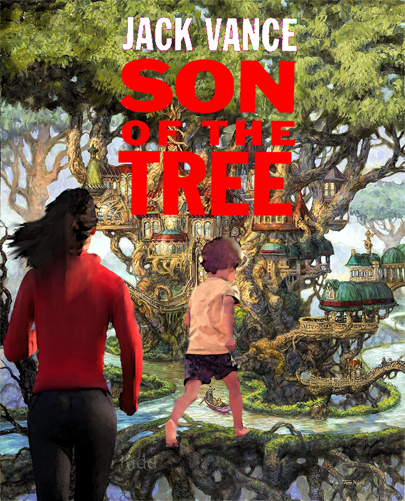
See Grand Crusades.
Original tree art by Tom Kid
Jack Vance's novel Trullion centers on the efforts of Glinnes to earn enough money to buy back part of his family's land. Jack Vance's novel Wyst includes an amusing section in which Jantiff works to earn enough money to buy transport back to his home planet. Jack Vance's novel Marune begins with "Pardero" trying to earn enough money to buy transport to Numenes, the Capitol planet of Alastor Cluster. Vance's 1951 story "Son of the Tree" begins with Joe (an Earthman) trying to earn enough money to get off of the planet Kyril so he can continue his travels across the galaxy.

Jack Vance's writing career was the story of a gifted writer who tried to earn enough money from his imaginative stories about fantasy worlds so that he could spend his whole life writing more stories about imaginary worlds. I read the version of "Son of the Tree" that was published in Thrilling Wonder Stories, in the June 1951 issue.
This scene comes 25 pages into the
story when Joe has departed from Kyril.
interior art, 1951

The interior art that accompanied Vance's story is not attributed to anyone. The image shown to the left on this page might at first seem to have been inspired by the beginning of Vance's story. Joe is inside a space cruiser, newly arrived on the planet Kyril. Based on the illustration, one might have imagined that you were about to read a story about first class travel to the stars with Joe in the middle of a shave and asking for more towels from a stewardess. Think again.

During his trip to Kyril, Joe does not travel in first class accommodations. He has gone from star to star shipped in the hold, like cargo, in some sort of suspended animation. Arriving on Kyril, his only objective is to get a job and earn enough money to move on to another planet.

Elfane
But then he meets the Druidess Elfane and Joe gets side-tracked by the political intrigue that is on-going between the Druids of Kyril and the Mangs, who live on a nearby planet. Two weeks into his stay on Kyril, Elfane asks Joe for help in disposing of the body of a dead Mang ambassador.

I find imaginary politics to be mind-numbing. Vance introduces the idea that there are multiple factions of the Mang. Joe ends up "working with" Hableyat, a member of the Bluewater Faction of the Mangs. The Druids have evolved a weird religion on Kyril with a bloated hierarchy of rulers who include Hierophants, Theoarchs, Presbytes and Ecclesiarchs.

two warriors
There are many similarities between "Son of the Tree" and Vance's novel "The Languages of Pao". Joe has traveled so far across the galaxy that the planet Earth is little more than legend on Kyril. The Druids know very little about technology, and Hableyat, who is from a more industrialized world, can play a few tricks on the Druids.

Isaac Asimov also included the idea that Earth would become little more than a legend in his future Galactic Empire. However, the Asimov's Galactic Imperials of the future galaxy are all pretty similar in appearance. Not so in Vance's imagined galaxy.

original cover art by Earle Bergey
and Edmund Emshwiller
In Vance's future galaxy, enough time has passed for the human residents of far worlds to evolve into new distinct human variants. The Mang have "yellow blood" and we meet another human sub-type (the Belands) with green eyes and white hair.

In Asimov's fictional version of the galaxy, there were no alien creatures of significance. However, Vance included some interesting natives on various exoplanets for his stories such as the alien Star Kings of the planet Ghnarumen. For "Son of the Tree" there is a strange native creature on Kyril that becomes central to the plot of the story.

The version of "Son of the Tree" that I read, as published Thrilling Wonder Stories, has problems and plot holes. I suspect that editor Sam Merwin cut out part of Vance's story in order to fit everything into one issue. 😢

Ifness' aircar, The Asutra
As early Vance, "Son of the Tree" has its fun parts, but it also has rough spots. Both Joe and Elfane are not as well-developed as the other characters that would later be included in the novels written by Vance, but they do end up together; if not in a happy ending, maybe a bitter-sweet ending. The most interesting character is the scheming Hableyat, who has similarities to Ifness, a character who would eventually flow from Vance's pen 20 years later.

Fictional Biology
Weird Tales
In the Ekcolir Reality
Vance had a limited scientific education which was both a blessing and a curse for his fiction writing. Vance grew up reading Weird Tales, and he never let scientific implausibility get in the way of a story. The ever-growing sentient (telepathic?) "tree" imagined by Vance provides the basis for an interesting story, but it degenerates into absurd pseudo-biology. I wonder if Lem ever read "Son of the Tree" before writing Solaris.  

Son of the Tree
Vance often toyed with a type of pan-psychism in his stories. I like the idea that entire planets might have a type of consciousness and display goal-directed behavior. There might be a type of "cosmic justice" that can protect planets from being "spoiled" by bumbling colonists from Earth. If planets can protect themselves, was Joe impelled to travel across the galaxy in order to be at the right place and right time to suggest a chemical solution to the problem posed by a man-killing Tree?
The Sacred Shin
by Anney Fersoni

Cosmopolis
Related Reading: the genetics of luck

More VanceAugust 2019
                        May 2019.
                         August 2018.
                            August 2017.
                                  May 2017.
                                      August 2016.
August 2020
Next: the Vance speed limit

In the Ekcolir Reality. Visit the Gallery of Book and Magazine Covers

Dec 7, 2019

Investigation 901

Five years ago, back in 2014, I blogged about Investigative Science Fiction. At that time, I described Gohrlay as the first sleuth of the Exode Saga. The original Gohrlay lived back in Deep Time, in the First Reality, before the invention of time travel technology. Gohrlay discovered that a mysterious Interventionist force was keeping the human species alive and resisting the inevitable dominance of the Prelands.

Before her untimely {staged} death, Gohrlay lived for a time with the First Reality analogues of Isaac Asimov, Jack Vance and Arthur Clarke. After Gohrlay's mind pattern was used as the template for positronic brains, the replicoid system for temporal momentum was used to ensure that analogues of Asimov, Vance and Clarke would exist in every Reality.

The Trysta Truce
In 2016, in a blog post called "Investigation 601", I described how Alpha Gohrlay revealed to me the existence of the Trysta Truce. During the Trysta Truce, efforts were made to create humans with sophisticated telepathic abilities. That research and development program utilized existing Asterothrope gene combinations. The Asterothropes had been crafted by R. Gohrlay as a telepathic human variant, but the Asterothropes were a new species, unable to breed with humans.

The tryp'At were a human variant that was crafted (using Asterothrope and Preland gene combinations) so as to have a form of technology-assisted telepathy that depends on the Bimanoid Interface. The Bimanoid Interface was originally used to link together replicoids in the Hierion Domain to Earthlings, providing the mechanistc basis of the temporal momentum.

Priscilla the pek
Clones of Gohrlay
Here in the Final Reality, several clones of Gohrlay were created and used to satisfy R. Gohrlay's desire that Gohrlay have descendants on Earth who could participate in the great adventure of humans spreading through space to distant exoplanets.

2019
Here in 2019, I have realized that the tryp'At played an important role in creating the Mind Clone Network. The tryp'At are barely human. In fact, maybe only some tryp'At meet the technical definition of being human. For example, if there are tryp'At hermaphrodites then they probably should not be listed as humans.

source
Are there such things as tryp'At hermaphrodites? I've long wondered about that possibility and it recently became a revived topic for discussion when I became aware of Lakum, a tryp'At (apparently from Deep Time) who has the remarkable ability to move in and out of the ER Simulator.

The Agonist and the Editor (Part 2 of The Lakum Intervention)

Three sub-networks: MC1, MC2 and MC3.
I've recently been recovering old suppressed memories and trying to integrate them into my current thinking. After a long session of trying to reconstruct Rylla's account of Lakum's recent activities at Observer Base, it was late and I knew that Zeta was expecting me in her bed.

However, I had alerted Rylla to my new blog post and I was reading through what I had just written, checking for logical errors and flights of fancy. As far as I could tell, my account of how Rylla had become aware that Lakum is a tryp'At was consistent with everything that I could remember from the future.

Zeta (source)
Zeta plopped herself down in my lap. After a hot kiss, she saw my eyes return to the computer screen and she could see what I was thinking about in my mind. She asked, There is an hermaphrodite at Observer Base?

I had my arms lightly around Zeta and I looked over her shoulder at the screen. She was scrolling quickly down the webpage. "I've never been able to confirm that the tryp'At have that Asterothrope feature, but why shouldn't there be tryp'At hermaphrodites?" In my mind, I was thinking that right then was the perfect time to contact Rylla on the other side of the planet.

Zeta complained: I've been waiting for you to come make love to me. However, she was also intrigued by the idea that a Replicoid might soon appear at Observer Base. She wondered: Lakum has the mind of a tryp'At hermaphrodite inside a replicoid body?

Asterothropes have more than two nipples.
It was a cold winter night, but Zeta had been confident that she could quickly pull me into her warm bed so she had not bothered to put on any clothing when she came hunting for me. Now she tucked her feet under my legs for warmth. I was wearing two shirts, so I took off one and put it on Zeta. Speaking out loud, I replied to her question: "I don't know. Remember, this idea that Lakum is tryp'At derives from one of my strange memories of the future. If Rylla does not yet know Lakum then there is no way that she can confirm or deny the possibility that Lakum is a tryp'At hermaphrodite. I'm more concerned about Rylla's plans for the future."

Zeta activated the video chat application and after a short delay Rylla appeared on the screen. It was summertime for Rylla and she had not bothered to put on a shirt before activating her camera. She said, "Hi Gramma. Have you read this new message from the future?"

Zeta shook her head, "No, but I have the main idea. Has Lakum arrived and started... showing an interest in Stacy?"

source
Rylla replied, "Not that I know of, but if grampa's account of events is correct, then Lakum must have already been at work inside Observer Base. I hate the idea that she could have secretly impregnated Georgy and Stacy."

Zeta asked, "Are you bothered by the idea that your daughter might be an artificial life form constructed by Lakum?"

Rylla laughed. "I've always known that Marda is a mystery girl. I'm puzzled not bothered." Rylla's eyes shifted to me. "What is the evidence that there are tryp'At hermaphrodites?"

source
I explained, "I'm not sure we can speak of evidence. Anney told me that most tryp'At are hermaphrodites and encouraged me to think about the fact that I am male in the same way that we think about Ekcolir. Ekcolir was designed as a means to allow Trysta to have children during her mission on Earth."

the tryp'At blastipositor
Rylla added, "Just as you were designed to be the father of Alpha Gohrlay's children, but given what you know now about the tryp'At blastipositor, maybe you are not actually a male."

Zeta assured Rylla, "Your grandfather has testes. Do you want him to have his body scanned to look for ovaries?"

I suggested, "Maybe we have been misled by terminology. This might not be a matter of the classical human definition of 'hermaphrodite'. It has been suggested that tryp'At can't reproduce by conventional means and that they must be artificially constructed. To make sense of this, I may need to become a laboratory animal, subjected to careful study of tryp'At biological processes."

Rylla chuckled nervously, "Until about half an hour ago, I never imagined becoming a biologist, but I understand the logic of me taking that career path. There is a very real possibility that the only physical evidence on Earth for alien visitors to Earth is present in the molecular details of our bodies."

Artist's depiction of
Ivory when she was
about 25 years old
"Exactly." I reminded Zeta and Rylla, "This is the path that Ivory Fersoni went down. As a biologist, she was able to sequence her own DNA and demonstrate her unique genotype. Like you Rylla, Ivory grew up knowing that she had unusual anatomical features."

Zeta had another idea: "Why not just send tissue samples to biology labs and pay them to do the bio-molecular analyses? Rylla is not really interested in becoming a biologist."

I replied, "No, there is no way that we could keep secret the test results if we involve other people in the work of analyzing our genes and proteins. If we tried going down that route, we could be removed from Earth just as Ivory was."

An Earth Overseer
Zeta was still reading my blog post. I could sense in her mind that she was listening to Rylla and I and that Zeta did not agree with me. She voiced her objection, "There is no evidence that any Earth Overseers remain. I bet we could do anything we like and there will be no consequences from outside. The only problem I can foresee is that obtaining physical evidence for alien Interventionism might shatter the whole state of balance that was the goal of the Pact. If Earthlings started to truly believe in the idea that humans were created and crafted by aliens then it might stimulate a series of rapid technological advancements which would endanger the species."

The Trysta-Grean Pact
I nodded. "And besides, none of us wants to risk becoming the objects of study by the world's scientists."

Rylla smiled cheerfully. "While I never thought about studying biology, the idea does not upset me. Particularly since it appears that I actually will take that career path. I wonder... would it create a paradox in time if I decided not to become a biologist?"

I laughed and then told Rylla, "This is your opportunity to explore the mechanics of temporal paradox. However, in the interests of preserving the structure of the space-time continuum, I suggest that you simply position yourself so that you can test your... bodily secretions for Asterothrope hormones like oxypathin and frenchkissin. The role of those Asterothrope hormones in shaping the Mind Clone Network is the key biological fact that I learned from my memory of the future."

asteroglands produce
oxypathin and frenchkissin
Rylla shrugged. "I'm sure I would enjoy studying molecular biology and eventually doing laboratory research. I have burning curiosity to discover if my body is producing molecules designed to shape the brain and mind of my daughter, so I am comfortable with the idea that I need to obtain training as a biologist. This is also a matter of self-discovery for me; was my mind also shaped by the oxypathin and frenchkissin that I received from my mother?" Rylla paused and looked over her shoulder. Turning her gaze back to the camera, she continued, "What bothers me is a larger issue. Do I... do any of us... do we have free will. Are we simply puppets, acting out our designated role's in Grean's master plan for the future of Earth?"

I hate philosophical debates about free will and I still had one last favor to ask Rylla. I changed the subject: "Please tell Georgy to start suggesting to Colleen that she be on the lookout for someone moving from inside the ER Simulator into Reality."

"Very well, grampa, but I don't feel comfortable telling Colleen too much about her future. It is going to take me a while to adjust to the prospect of all the Lakum-related sexcapades that you described as taking palce in the future at Observer Base."

Colleen
"I agree that you should move with caution. You need not provide Georgy and Colleen with any details from my dream vision of the future. Simply let Georgy know that I have recovered what seems to be an odd future memory about Lakum. You certainly need provide no details about a future sexual relationship between Colleen and Lakum."

Zeta muttered, "Why not warn the poor girl? If Colleen knew that Lakum will dump her and fall in love with Stacy..." Zeta fell silent then shook her head. "No, you are right. If Rylla admits to having any detailed information about the future then Georgy will become relentless and not stop badgering Rylla until the full truth is known."

Returning to the other problem that was on Rylla's mind I said, "Listen, Rylla... I've puzzled over the question of my own free will for many years. I was particularly concerned about my replicoid, Irhit, and his ability to control my thoughts. Now that the replicoids are gone, I do believe that we are in control of our own fate."

Irhit the replicoid
Rylla was struggling to believe in her own freedom and agency. "Yet, now you think a tryp'At hermaphrodite has been lurking, unseen, inside Observer Base for more than a year."

Zeta tried to mollify Rylla's qualms. "Don't rush to make any major life decisions today. We should all think this through carefully. This dream memory might only create a fruitless wild goose chase. You should take it as a good sign that you have doubts." Zeta asked Rylla, "Doesn't that indicate that you have the power to make your own choices in how to live your life?"

Rylla reached for the disconnect button. "I'll think about that and I'll also consult with Nora." The video call ended.

Nora
Zeta shut off my computer and pulled me by the hand towards the bedroom. "Now that you have successfully thrown the poor girl into a quandary of self-doubt, I want you undivided attention."

With a degree of snarkiness that surprised Zeta, I asked, "Don't I have any choice in the matter?"

Investigation 901
Zeta looked into my thoughts and could see that I was joking. She told me: None at all. When you told me that I am your wife you surrendered all rights to withhold yourself from me when I'm in a state of lust and desire. She took off the shirt that I had given her earlier, jumped into bed and pushed her feet under the electric blanket. Zeta gave me a direct order: "Hurry up and get undressed."

source
For the next hour I was perfectly content to have no free will and do exactly what Zeta asked of me. I had little doubt that Rylla would eventually come to have a similar kind of relationship with Lakum, even if she only ever had contact with Lakum by way of the Mind Clone Network and telepathy.

The story, above, is Part 2 of "The Lakum Intervention". Continue to Part 3, "Status Update".

Next: The 2019 SIHA

visit the Gallery of Book and Magazine Covers