Showing posts with label fiction. Show all posts

Mar 22, 2015

The Mariinsky Theatre

Ron Koertge
Are there some books that will never be published? Books that are so subversive, that so effectively lampoon conventional print book-publishers and conventional authors, that they would never be printed? I hope so, because we now have internet publishing as an outlet for such books. But, are there other books that are even more deeply subversive, possibly "so far out there" that no writer would even imagine them?

Heading in that direction.....     I'm captivated by certain oddball story concepts. One of the far-out story ideas that haunts me is one in which there is a complete inversion of our society's conventional thinking about sex and writing. In the world as we know it, human sexual behavior is not supposed to be performed in public and most people don't take part in the capitalistic free market where sex is bought and sold. In contrast, people who aspire to "be a writer" are openly encouraged and trained to sell their stories and market their written work for profit. However, in our world, few people can actually make a living by writing fiction.

Science fiction adventure
In an alternate Reality, it would be socially acceptable to sell sex. In that Reality, porn stars would dominate Hollywood and the New Your Times would maintain a list of the ten best selling sex acts currently sweeping the nation. In this alternate world, engaging in private sex acts with a partner would be frowned upon. Everyone would be subjected to slogans such as: if you're not selling it then you're a pervert.

At the same time, in this alternate Reality, story writing would be a daily activity that everyone routinely does. Few people would try to sell a story that they had written on the open market. Marriage would be built around finding a partner who is literarily compatible with you and it would be unimportant to have a spouse who is sexually compatible: sex would be an entirely commercial enterprise having nothing to do with love...more like the world's most popular sport. I'd make my novel, Sex World, be a science fiction story in which the people are partially-artificial nanorobotic constructs and essentially immortal, living in a society where the link between sex and reproduction is long forgotten.

Europe    1909 - 1911
Mariinsky Theatre
In Star Dance, Bet dies in 1909. She is sent to Saint Petersburg, Russia by Hortensia. Star Dance is set in the Ekcolir Reality, an alternate timeline in which Imperial Russia had a culture that is about as close to that of Sex World as would be possible for a planet populated by mortal humans rather than post-reproductive sexathletes. In Europe of the Ekcolir Reality, Christianity never attained more than glancing recognition as a mysterious middle-eastern cult.

Bet sets out to beguile
Nikolai Tcherepnin
In 1909, Bet introduces herself to Nikolai Tcherepnin and begins a nearly two year period with him as his mistress, often playing as a backup performer in the orchestras that he conducts during that period and sometimes being called upon to also dance on the stage during emergencies when a regular ballet dancer is injured.

Nikolai Tcherepnin is completely infatuated by Bet's artistic versatility, her beauty and the fact that she endlessly praises him and his musical work. Best of all, in the hedonistic society of 20th century Russia, Nikolai's wife, the quiet and reserved Marie, also falls in love with Bet and undertakes to publicize and promote the steamy romance that develops between her husband and Bet.

Poster for the Ballets Russes
in the Ekcolir Reality
Bet has a wonderful time touring around Europe with Nikolai, who finds himself at the peak of his fame, with a strong boost to his popularity arising from his well-publicized relationship with a flashy younger woman, Bet. Now in a care-free social environment more like that of Tar'Tron, Bet feels liberated after having spent seven years being shackled to the straight-laced Ghyl in puritanical New York.

Nikolai is so busy with Bet that he fails to take the opportunity to compose the score for a ballet that is commissioned by Sergei Diaghilev. This provides an opportunity for the relatively unknown and younger Igor Stravinsky to begin composing for Sergei and the Ballets Russes. With the help of innovative young artists like Stravinsky, the Ballets Russes becomes a major influence on the 20th century rather than simply fading away after a few years of limited success.

Technological progress was slightly accelerated
in the Ekcolir Reality, with film as a
well established medium by 1911.
In early 1911, Bet suddenly abandons Marie and Nikolai Tcherepnin and travels to Berlin. Nikolai, more than just a little exhausted by trying to keep up with Bet, is at first dismayed by Bet's disappearance, but then he resumes the quieter pace of his life with the ever-loyal Marie.

In Berlin, Bet adopts a new disguise, aging herself dramatically and adopting a middle aged appearance that is more suitable for the socially conservative German Empire than the flashy young avant-garde artist she played with Nikolai while they traveled back and forth between the liberal metropolitan worlds of Paris and Saint Petersburg.

Clara Immerwahr
Bet makes the acquaintance of Elsa Löwenthal, a divorced mother and cousin of Bet's grandfather, Albert Einstein. Bet often speaks to Elsa about her time as a youth when Elsa knew her cousin Albert. Those  conversations lay the ground work for Elsa and Albert to later become romantically involved and eventually a married couple after Albert's first marriage collapses.

After her time in Berlin, Bet briefly visited Karlsruhe in order to meet with Clara Immerwahr and support her work organizing the Third Hague Conference on the laws of war which, in the Ekcolir Reality, took place in 1913 and helped prevent a nuclear war from erupting in 1918.

Next: the origin of the name 'Siomha'.
visit the Gallery of Book and Magazine Covers

Sep 17, 2014

Too much of a good thing?

The "birth" of R. Gohrlay, the first positronic robot.
Issac Asimov imagined a future in which robots served to help humans reach the stars. Then, it all went terribly wrong. On the spacer worlds, there were more robots than people and finally, humans mutated into a new form of life that lost the desire to spread itself across the galaxy. When it comes to robots, there can be too much of a good thing.

What's a robot graced with the Zeroth Law to do? Of course, Giskard must find a way to balance humanity on the knife edge between too many and too few robots. Twenty thousand years later we find Daneel still playing the balancing game and just enough robots on hand so that Hari Seldon can fall in love with one and the Foundations can be created.
Chaotic temporal attractors:
Age of positronics, Spacers, the Foundation.

Thus, Asimov told the story of how robots helped humanity through two chaotic attractors, but what about the story of the origin of the very first positronic robot?

The Age of Positronics
We might assume that the very first positronic brain was built by U.S. Robots and Mechanical Men, Inc., but did Asimov ever really show how to pull that rabbit out of a hat? And what about the Laws of Robotics? Asimov depicted the "first three" Laws as arriving in the world almost wholly formed and then the "Zeroth" law being artificially grafted on later.
source

Foundations of Eternity gives a detailed account of the origins of the Laws and the first human-like robot with a positronic brain. The key thing to know about the origin of the Laws of Robotics is that there was never any group of computer nerds who sat down, at U.S. Robots or any where else, and just "slapped together" a robotic brain that could produce human behavior. Just as Daneel was the "story behind the story" of how the Foundation was created, another telepathic robot, R. Rycleu, was working secretly on Earth in the 20th century to bring into existence the first positronic brains on Earth. But those were not the first positronic brains.

The first positronic brain was created by copying the neural circuits of a Neanderthal named Gohrlay. When those human brain circuits were reconstructed as a positronic brain, the resulting robot was R. Gohrlay.

Foundations of Eternity is part of the Exode Trilogy. As a story that takes place in the Exodemic Fictional Universe, Exode explores the implications of Earth having been visited by aliens for millions of years and the struggle of Earthlings to discover the secret history of Humanity.

Asimov was forced to keep robots in the dark corners of the Foundations. In the Exode Trilogy there are may roles for robots and other artificial lifeforms. Even Isaac Asimov himself appears as a character in the story!

Images. Top: the creation of the R. Gohrlay, the first positronic robot with human-like cognition. Credits. The second image shows the structure of time in the Foundation Reality. Larger version. Creating the cover art for Foundations of Eternity.

Related Reading: blast from the past
visit the Gallery of Book and Magazine Covers

May 8, 2012

Disney and Entertainment and Science Fiction, Oh My!

Walt Disney and Wernher von Braun.
The Primal Mainstream
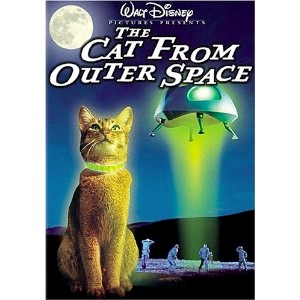
The Walt Disney Company is a huge entertainment engine that owns both Pixar and Marvel. A company that would create something like The Cat from Outer Space (1978) might not seem like a good bet for bringing intellectually-stimulating science fiction to the big screen, but it was The Black Hole (1979) that started Disney away from the G-rating and down the road towards adult entertainment.

Dejah Thoris with a Thern medallion.
The movie Tron (1982) is credited with helping make clear the potential for computer-generated video and some critics viewed WALL-E (2008) as viable science-fiction story in the Pixar computer animation family of films. Personally, I find it hard to think of Tron:Legacy (2010) as science fiction, since it is more of a fantasy about video games. Mars Needs Moms (2011) reminds me of Moon Pilot (1962),  and I'd like to forget both of these films.


2012


John Carter. I've never been a fan of the adventure/fantasy/science fiction of Edgar Rice Burroughs. I'm intrigued by the way that the John Carter film presents the Therns as technologically advanced manipulators of civilizations on planets such as Mars and Earth, but why do they bother? I was first exposed to "space vampires" that feed on human conflict by Star Trek (Day of the Dove and Wolf in the Fold) and I do not understand the persistence of this meme in Hollywood unless it is due to guilt over the way that so many people can be sucked into paying for an endless progression of good vs. evil stories about soul-sucking monsters. I'd like to know if the script developers for John Carter were planning an interesting backstory for the Therns or if the plan is just for more mindless repeating of a tired old plot device.
My god, Loki, I hope you're paying for this call!

In the Exodemic Fictional Universe, the Huaoshy maintain a balance between the Overseers and the Interventionists, but the Huaoshy are not evil. I wish Hollywood could move away from reliance on plots where a hero has to battle the evil alien.


The Avengers. If only Nixon could go to China, is it only Disney that will be able to open a pop culture market for science fiction stories that portray gods as aliens? Disney previously got into trouble by having an association with Dogma (1999). I suspect it is now part of Disney culture to only make movies that explore non-Christian deities as being alien creatures.

It might be that the Norse gods are an optimal place to start. I don't understand how the writers for The Avengers envision the "gods". In the Marvel Cinematic Universe is Thor a human-like being that makes use of advanced technology (Mjolnir?) or are Thor and Loki genetic variants of humans or do they have magical powers (all of the above?)? I don't understand what it means for Thor to be put into a human body.

In the Exodemic Fictional Universe I imagine that advanced nanotechnology can make it possible to shape shift and instantiate an alien mind in a human body. I hope that something similar is going on in The Avengers. I fear that this is all just another fantasy story where the writers do not care to make a coherent science fiction story and the goal is only to blow up a large number of bad guys, but I hope not. I'd be pleased if this is a start towards someone in Hollywood making some interesting stories about aliens who interact with Earth over long periods of time with many different human-like groups and cultures being the result.


Rich Ross.
Conspiracy theory. Did Disney try to kill John Carter? Some have wondered why Disney called John Carter a $200 million loss when the film was only just released. Was someone looking for an excuse to dump Rich Ross? Was there something planned in the John Carter sequel that was too hot for Disney? 

I'd love to see a sequel that includes telepathic Lotharians influencing events on Earth and maybe the son of John and Dejah doing something that helps Earth resist the Lotharians. Is the Thern teleporter also a time travel machine? Is the world depicted as Barsoom by Edgar Rice Burroughs actually Mars of the future?

I've never understood how a human from Earth could go to Mars and father children with the Martians. What if Barsoom is in our future, after humans from Earth have terraformed Mars and created genetically-modified humans? If Barsoom is the future, what is the fate of Earth at the time when John Carter's children are on Mars? Has Earth's civilization collapsed, leaving only decayed remnants of human civilization on "Barsoom" and on Earth? Would such a future for humanity be too dark for Disney?

___________________________________________________

Oh, my.

___________________________________________________
This (above) is the second of a series of blog posts about my Search for Interesting Hollywood Aliens (SIHA). Here are links to the other SIHA 2012 blog posts:
Start: SciFi Summer 2012
Next:
Horror, Comedy and SciFi in the Woods?
Aliens in Drag
Ancient Aliens
The exciting conclusion to the 2012 Search for Interesting Hollywood Aliens
Promethean Rorschach Test

Jun 27, 2010

Most Gentle Stream

In Isaac Asimov's time travel novel, The End of Eternity, the crafty Noÿs Lambent looks into her own future and sees that she will fall in love with Andrew Harlan. Of course, that happy future is only one of an infinity of possible futures, but she makes it her own. Andrew Harlan is helpless to avoid the fate that Noÿs selects for them.

In Cellular Civilization the crafty Dexamene Gregores is not so lucky. Of course, poor Dexamene does not have access to time travel technology and other wonders from 10,000,000 years in the future. But all is not lost! Dexamene does have access to technology from the past, a past in which nanorobotic alien life forms came to Earth and stirred up trouble.

What kind of trouble? Humans.

Ancient myths are sprinkled with stories about god-like beings who have the magical ability to play with human emotions. The star-crossed lover is an age old literary concept. Arthur C. Clarke noted that advanced technology might seem like magic or the work of a god-like being.

I've long wondered what technological tricks were used by Noÿs to manipulate Andrew's behavior. What kinds of chemicals were in the drink she gave to Andrew when she seduced him? Did Noÿs (or, possibly, some lurking positronic robot) use telepathy to put ideas into Andrew's head? Or did that only require a revealing wardrobe from the 482nd Century?

Dexamene does not hesitate to use every weapon in her arsenal to make Charlie fall in love, but Dexamene is a busy Interventionist and does not have time for romance. However, Dexamene does have seven spare clones, her sisters, who can be called upon to do her dirty work.

So Dexamene brings her sister, Yasas, to Earth and arranges that Charlie and Yasas fall in love with each other....all it takes is tight pants, pheromones and some minor brain surgery...well, that and the fact that Yasas can amuse Charlie by casually discussing theoretical physics and spaceship propulsion systems. In the end, both Charlie and Yasas are content to find themselves together, splashing around in love's most gentle stream.

True, we do not usually think of brain surgery as a means of making someone fall in love with us, but Yasas is not limited to bear skins and stone knives, as Bones once described the high technology of our primitive times. Yasas is a product of Genesaunt culture and the beneficiary of cultural artifacts arising from alien life forms that brought advanced nanotechnology to Earth millions of years ago.

In the skilled hands of Yasas, brain surgery means memetic surgery, a technique that allows individually identified synaptic connections to be trimmed and pruned. Charlie's brain is putty in her hands, but shaping someone's emotions it is delicate work and while she's busy making Charlie fall in love the crafty Dexamene is making Yasas fall in love with Charlie.

Charlie and Yasas eventually figure out what happened to them, but they are resigned to their fate and offer few objections. Anyhow, they soon find themselves caught up in a larger mystery and on their way to the stars.

Image. Apologies to Domingo Alvarez Enciso.

Jun 14, 2010

Less on the Social Ramifications of Time Travel

image
Time traveler Noÿs Lambent
Yesterday I started reading Isaac Asimov's time travel novel, The End of Eternity for the 17th time. In related news, today I came across a blog post called More on the Social Ramifications of Time Travel. Golly. And I sometimes worry that I take science fiction too seriously....

Well, maybe I've only read The End of Eternity 15 times. But who's counting? In any case (15, 17 or 23), I enjoy reading this novel and I agree with Asimov who excused the scientific implausibility of time travel by saying that time travel stories are simply too much fun for writers to avoid dabbling in them.

I've always found it hard to get too serious about Eternity. I think Asimov was joking when he said that humans used time travel to send clover seed through time. He seemed to take more seriously the potential impact of future technology being made available to less technologically advanced eras. There is a rather long section in The End of Eternity about the problems arising from using time travel to make available a cure for cancer. Each person who might be saved by making the cure available to them must be carefully evaluated in order to be sure that saving their life does not cause a Reality Change. Thank goodness for the Momentum of Time! Of course, those who are told that they cannot get the cure are resentful.

The "big social issue" presented by Asimov is the sorry fact that the existence of Eternity causes human extinction and a failure of humans to spread through outer space to other worlds. Time travel is used to make Earth a safe and stable environment for humans. As the story is told by Asimov, humans stop evolving and eventually they simply die off.

One of the interesting aspects of The End of Eternity is that it is an Asimov novel that includes the idea of there being other human-like creatures who evolve on other planets of our Galaxy. A major reason for the extinction of the human species was that while humans played around with time travel technology, those other beings developed space travel technology, moved into outer space and colonized all of the available star systems before humans ever got around to developing interstellar space travel technology. We must ask: did any of those other space travelers also develop time travel? If so, how did they avoid the "trap" that led to human extinction?

More importantly, why is it that, as Noÿs explains:
"There are other stars with other planets, you know. There are even other intelligences. None, in this Galaxy at least, are as ancient as mankind, but in the 125,000 Centuries man remained on Earth, younger minds caught up and passed us, developed the interstellar drive, and colonized the Galaxy."
Why did it take 4,000,000,000 years for humans to evolve on Earth and the "younger minds" 4,012,500,000 years? Providing a reason for this cosmic coincidence was one of my goals for The Start of Eternity, a collaboratively written fan fiction sequel to The End of Eternity.

Image Credits. Noÿs Lambent is currently living in Athens. When contacted, she gave permission for her image to be used and commented, "They won't believe it's me, anyhow."

Jun 4, 2010

Passion for Writing

I just saw a blog post that asks, "How do you keep the passion flowing in your life?". For the past two months I have been trapped in the real world, isolated from my current fiction writing passion, a science fiction story that is tentatively called The Start of Eternity. Being kept away from something is a good way to judge your passion for it....the longer you are away, the more desperate your longing to return and the more intense your desire for reunification. I suspect that if you have to work at keeping it "flowing" then it is not really passion.

David G. Hartwell cleverly noted that "The Golden Age of Science Fiction Is Twelve", and that was about my age when I discovered science fiction. I had seen some science fiction on television before that, but I did not really have an appreciation for the fact that there were written science fiction novels.
Then one day in the library I came across a copy of Isaac Asimov's novel, The Gods Themselves. Soon I started writing my own science fiction stories....with a passion...a passion that has never died.

From the first bumbling steps of my earliest science fiction writing I've been intrigued by the challenge of creating science fiction stories that move beyond the conventional boundaries of our ordinary lives. Star Trek took us off of Earth "where no man has gone before" and while Asimov usually contented himself with stories about events in this galaxy, during my "golden age" of discovering science fiction I read E. E. "Doc" Smith's space operas and so I started thinking about travel between galaxies...as Smith quaintly put it: traveling at the speed of thought.

The Huaoshy and the pek.
So here I am, 40 years later and still writing about travel between galaxies...in particular, the travels of aliens, the Huaoshy, human-like beings from "a galaxy far far away" who have spent the past billion years spreading their civilization from galaxy to galaxy.

First Contact

One of the prominent science fiction themes is "first contact", stories about the first time that humans interact with human-like beings from another world.

Most such stories about "first contact" are set in our future. However, in 2001: A Space Odyssey, the idea was presented that advanced alien beings might have long ago come to Earth, and such aliens might even have been responsible for the way our species has evolved. Carl Sagan took such thinking to the extreme and suggested that our entire universe might have been created by aliens who, by design, made this universe a hospitable place for creatures like us.

source
As shown by Clarke and Sagan, it is possible to write science fiction novels that assume "first contact" came long ago. However, they wrote stories in which the aliens had very limited interaction with humans. The X-Files depicted aliens who came to Earth long ago and who continued to interact with humans during our lifetimes.

The Start of Eternity is an example of a science fiction novel that assumes alien beings have long been visiting Earth. For such stories, a key issue is: if aliens are here among us, why don't we know about it? In The X-Files there was some kind of complex conspiracy by which some humans on Earth who knew about the aliens continually worked hard to keep existence of the aliens secret. I think humans are too incompetent to keep such a secret, so for The Start of Eternity it is assumed that there are alien visitors here on Earth who have very advanced technology that makes it easy for them to keep their existence hidden from humans.

Foundations of Eternity
These simple assumptions about secretive aliens who have long been visiting Earth create many rich opportunities for science fiction stories. How can we not be passionate about exploring these possibilities? After all, maybe there are such alien beings here already.

The Start of Eternity is being written collaboratively; new collaborating authors are welcome.

Image credits. The image at the top of this blog post is an illustration by Henrique Alvim Corrêa for the Herbert Wells novel The War of the Worlds. The second image (photo by Donald Schmidt) shows the library where I first discovered the literature of science fiction.
______________
2013 reboot. I've "re-imagined" The Start of Eternity as The Foundations of Eternity, now part of the Exode Trilogy.

Mar 10, 2010

Science in Fiction

Micromegas Plaque by guyblade

We are building upon a solid foundation, the age of fiction, and now we are creating and layering on a new age of science. Is fiction really the foundation for human culture? The universe played a nasty trick on our species. We got into an evolutionary arms race during which we competed with each other to see who had the better brain for predicting the behavior of other people. We constantly imagine what other people are going to do: our brains are fiction generating machines. Of course, we are not able to prevent ourselves from applying this great predictive tool (the human brain) to other parts of the universe besides people.

We are very good at imagining human-like agents that might account for the weather, the seasons....everything. Our naked primate senses cannot reveal the true nature of reality, but we are free to imagine "explanations" for the mysterious phenomena of the universe. And we've been at this myth making for a long time. Some of the most popular myths and memes are powerfully integrated into our cultural substance. The brain, as a fiction-generating device, has an interesting feature: we easily come to believe our own fictional accounts of reality.

Slowly, while stumbling around in our fictional gardens of Eden, humans found a few inroads to reality, surprising ways to escape from the blurry world view provided to us by our limited senses and our gorgeous imaginations. Ancient astronomers played an important role by systematically recording the positions of stars and imagining precise and predictive mathematical descriptions for cosmological phenomena. Then the fun began. Inconvenient truths such as heliocentrism contradicted some popular myths and now we have battles between those who seek the truth and those who pretend that their fictions already reveal the truth.

The era of science is still exploding and morphing and our culture's foundation of fictions is creaking under the weight of science. Science has brought novelty and change to humanity and, as a species, we are like a surfer who is riding a big and wild wave. Western culture often seems split into two cultures, and the process continues by which those on the outside try to understand and adjust to the changes being wrought by science and technology.

If fiction and science are two different ways by which people explore the universe then what is science fiction? Strange things happened during the wars between the "two cultures" and between those who would defend faith in ancient myths against the shifting and invading sands of scientific objective knowledge. Attempts have been made to create a great barrier between fiction and science. That artificial barrier is being side-stepped by science fiction. Each time that scientific methods reveal new parts of the universe to us, that provides new opportunities for the creation of new fiction. Science fiction is stories that allow us to have fun with new ideas and explore what might be possible with new knowledge and technologies.

Of course, there are degenerate forms of science fiction, sometimes euphemistically described with terms such as "cautionary tale". Writers who focus their fiction on the dystopian and the apocalyptic need not understand the science and technology that they write about. For such writers it has now become a lucrative proposition to write science fiction that adapts the form of some more ancient fiction genre and simply layers on a few techno-wiz-bangs. Such is the price for the success of science fiction.

Science fiction is in what I think of as its "half empty or half full" period. Visionaries such as Asimov and Clarke used their imaginations to take us to wonderful new places. Other writers label their work as "science fiction" and use the trappings of wiz-band tech to drag us back into their favorite age-old nightmare visions of doom and destruction. It takes all types, and I welcome everyone to the science fiction party, from Doris Lessing to James Cameron.

Much of what might be called "SciFi" allows old issues to be explored in new ways. My personal preference is to use science fiction as a way to explore new ideas and new possibilities. I'm also interested in the idea that new information processing and online collaboration tools will allow us to tell science fiction stories in new ways. Why can't some stories be told through the creation of virtual reality environments where "readers" participate in and create the "story"? I hope that our current tools such as wikis and MMORPGs are hints of glorious new story telling opportunities that will soon be here. Along the way we might even be able to slip in some actual science.

Feb 14, 2010

Exodemic

Antony Gormley wrote, "Culture in the developed western world has always positioned itself in distinction to nature: now we have to discover our nature within nature," in an article called
Art's lost subject.

A segment of Western culture that springs from modern science has vigorously adopted the position that humanity is an integral part of nature. Garrett Hardin published The tragedy of the commons in 1968, which illustrated the dangers posed by humans and our capacity for deleterious impact on the biosphere. At about that time, people like Carl Sagan knew that green house gas levels were rising on Earth and the warnings about human-induced climate change began to be heard coming from scientists. The protagonist in Carl Sagan's novel Contact had one question she'd like to ask an extraterrestrial: how did you survive the dangers of your technological adolescence? Scientists like E. O. Wilson continue to make pleas for consilience between the "two cultures" and action to protect the biosphere from human activities. Even some politicians (example) have caught on to the importance of human-induced climate change.

How can artists help awaken humanity to our place in nature? In particular, how can science fiction be used as a means to inform readers about issues like climate change and inspire useful changes in human behavior that will help protect Earth's biosphere? I stress useful change because cultural works can impact human behavior in negative ways. Nuclear power is currently our largest non-green house gas producing energy source. Are important decisions made because of the best available information or because of emotional responses stimulated by fictions like The China Syndrome?

I've only written one story that includes a plot element related to climate change. In the science fiction story X-Seven, benevolent aliens help a few humans create a solution to rising levels of atmospheric carbon dioxide. The story shows science being used as a tool for solving a serious problem that is confronting us. The particular "solution" in the story is a fantasy, but the theme of using our knowledge and know-how to solve problems is an important one. I'd never claim that technology can solve all of our problems, but we are foolish if we do not make use of all available tools to deal with our problems.

How many alternatives to our addiction to fossil fuels (such as better solar energy systems) might we already have if more young people were inspired to think creatively about science, engineering and technology? How many young people are turned-off from science by silly fictional "thrillers" that continue to perpetuate the tired idea that "science fiction is a pessimistic genre"? Like any tool, science fiction can be used to celebrate science and reason or it can be used to misinform and frighten people.

Until writers and film makers grow past The Modern Prometheus we are going to continue to struggle towards reasonable solutions to our problems. Industries with vested interests in the status quo are experts at fostering fear and doubt. The tobacco and oil industries have made billions in profits while inhibiting governments from making wise regulatory decisions. In the struggle to make wise decisions that impact human and planetary health, one fictional story like The China Syndrome can count for more than the informed views of the nuclear engineers who can make safe nuclear power plants. Artists, and anyone making cultural works, including movies, have a responsibility to work with knowledge and facts, not just emotions (profitable though it is to play on emotions).

Law Two. There is a radical idea that I plan to explore in my fiction. In answer to Ellie Arroway and her question about survival, I imagine that any life form that long survives as a tool-using species will have a set of rules to guide their behavior. I'm not sure that tool-using primates are suited to a world like Earth. Earth is one of the rare planetary gardens where life can appear and evolve. Maybe we need to think seriously about the idea that this is not "our planet". There are many worlds out there where we can freely indulge our penchant for tool creation and use without having an impact on other species. Have we reached the point where our place in nature is some place other than Earth?
Diagram: the strange attractor in the Asimov Reality
illustrates the risk of catastrophic sea level rise
in the Exode Trilogy.

Related reading
: Sarah Palin calls global warming studies "snake oil science."
Note: I later made global warming a key plot element in another story set in the Exodemic Fictional Universe: Exode.

Image at top. Angel of the North Jupiter
More Jupiter:
UV image: Jupiter's north pole

Feb 13, 2010

Asimov the Collectivist

The lady doth protest too much
In Of Robots, Empires and Pencils by Sally Morem, she wrote, "The Foundation series and the Robots stories, along with Arthur C. Clarke's Childhood's End, will probably be remembered as the last great and most eloquent arguments put forth for the idea of collectivism in the literature of science fiction." Morem compares the invisible hand of the market in Leonard Read's essay I, Pencil to the invisible hand of Hari Seldon in Asimov's Foundation Trilogy.

imagine greater profit$
I've never read Childhood's End, but I've long appreciated Clarke's ability to put humanity in perspective by playing the science fiction what if? game ("Perhaps the crispest definition is that science fiction is a literature of 'what if?'" - Christopher Evans). If Childhood's End is an argument for collectivism, then how does that argument go?

In Childhood's End, aliens arrive on Earth and they transform human children into a form that can merge into "a cosmic mind amalgamated from ancient galactic civilizations, freed from the limitations of ordinary matter". Morem has suggested that this is "the ultimate dream of socialism. The adults are wholly demoralized. They no longer have children. Most kill themselves. The rest die of old age as the children dance." Asimov wrote a famous story (The Last Question) in which all humans ended up as part of a group mind. I think of socialism as a theoretical economic system (advocated by folks like Thomas Paine) where an attempt would be made to share resources among all individuals. Little did I know that sharing ultimately leads to mass suicide and transcendence to a group mind.


in the box
Morem began her essay with the rather Homo sapiens-centric boast: "Human society is the most astonishing and perplexing of all the universe's life-forming, self-organizing processes...". A major part of Clarke's "what if?" explorations concerned his imagining of "self-organizing processes" that were far beyond "human society". Is "human society" a static thing or a dynamic always-changing process? Asimov was interested in exploring the many forms that a human society might take in response to scientific advances and technological change. Such thinking "outside of the box" is often unsettling for conservatives who want to defend the "good old ways" that they are comfortable with.

The Foundation Trilogy was a "what if?" exploration of the idea that vast human populations might behave according to mathematically precise laws of "psychohistory". Many years after Asimov created the Foundation Trilogy, he extended his Foundation stories to include the idea that telepathic robots were guiding humanity towards the formation of a vast group mind, Galaxia. Morem feels that Asimov's fictional universe where humans spread through the galaxy and were "controlled by robotic minds" is fundamentally flawed, so flawed as to, "stretch believability to the breaking point and beyond".

outside the box
Asimov imagined telepathic robots who "invented" the Zeroth Law of Robotics, which then compelled them to protect humanity. In order to protect humanity, the robots worked to engineer humanity into the group mind of Galaxia. In Foundation and Earth, it was suggested that by forming Galaxia, humanity could be protected from aliens.

Telepathic robots with positronic brains who used time travel to make sure that humans could colonize the galaxy, telepathic humans forming a group mind, faster-than-light spaceships, unseen aliens threatening humanity, the dead had of Hari Seldon pushing humanity to its fate by psychohistorical necessity...so, just what is there in all this to stretch believability? Morem seems to suggest that the problem with Asimov's fantasy futures is that he did not realistically appreciate the full complexity of a market economy. Morem is unhappy with "The Lawgiver imagined by Asimov" who has the power to shape human destiny. As we all know, a market economy is so complex that it, "cannot be forced, commanded or ruled from the center. It can only Be."

In making this argument, Morem shifted the center of discussion from the Foundation and telepathic robots to a short story called The Evitable Conflict, a story in which Asimov imagines supercomputers that could manage the economy of Earth better than people can. What is the argument? We should not use computers to help us manage the world economy? No. "The future state of entire dynamic systems are also impossible to know in advance." I suspect that Asimov would have granted this...in a science book. However, where was Asimov going in his fiction?

Arthur C. Clarke proclaimed the idea that "Any sufficiently advanced technology is indistinguishable from magic." What magical technologies did Asimov throw into the mix of his Foundation Saga? What if Asimov was imagining a future where time travel was possible? When Asimov extended his Foundation Trilogy, he suggested (in Foundation's Edge) the idea that positronic robots had used time travel to select a Reality in which humans, rather than extraterrestrials, took control of the galaxy.

Foundations
In The Start of Eternity, a fan fiction sequel to Asimov's time travel novel, I follow along with Asimov and imagine that there are positronic robots who can look into the future of the Foundation and see what will happen. Those robots (including Daneel) helped Hari Seldon establish the Foundations. I like to think that psychohistory was a "cover story" that was used to hide the existence of time traveling robots. If so, was Asimov putting forward arguments for collectivism in his Foundation Saga?

The economics of the Foundation always puzzled me. Here was a future human civilization with microfusion and the ability to hurl spaceships across the galaxy. Asimov wrote about determining the genomes of people and transferring a robotic mind into the brain of a human. With all these wonders, Asimov never tried to depict a post-scarcity economy. Instead, the Galactic Empire remained fully capitalistic and just a heart beat away from bust and falling back on fossil fuels.

In The Start of Eternity, the alien Huaoshy run a billion year old intergalactic civilization that makes use of additional technologies such as nanotechnology. However, that civilization also seems to defy Clarke's idea of a future in which technologically advanced beings transcend their physical limitations. The idea of a pending technological singularity is now popular in science fiction, a point in the future where life as we know it will end because of accumulating technological advances. Is there a way to prevent a technological singularity and cause humans to be frozen in a culture that will always have an economy like the one we have now?

Morem wrote, "Human societies cannot be grasped as wholes". I believe that Asimov tried to suggest that positronic robots could grasp Galaxia as a whole, and that is why they worked for 20,000 years to form Galaxia. Unfortunately, Asimov was taken from us before he was able to continue his Foundation Saga towards a completed Galaxia.

escape from capitalism
What about the billion year old Huaoshy civilization? Did they learn to use genetic engineering and nanotechnology (and anything else they accumulated in a billion years) to move past market economics as we know it? Does the dead hand of Adam Smith "defeat the best intentions of would-be planners every time"? Is it inevitable that a billion years from now we will not have progressed past the type of economic system known to Morem?

Science fiction would seem to be a strange enterprise if we were allowed to play "what if?" with hyperjump spaceships, time travel, nanobots and telepathy, but because economics are "emergent" we cannot say "what if?" with respect to future economics. Do we need Capitalistic Anthropics, the theory that our universe was designed to make 20th century capitalism inevitable...for all time?

Top Image. Asimov and comrades.

2020 Update: Asimov's Marxist Foundation

Dec 31, 2009

Wearable Technology in Fiction

Maybe the decade from 2000 to 2009 could be called the Dick Tracy decade. Mobile phone technology finally caught up with the Dick Tracy science fiction wrist phone of the early 1940s.

I suspect that when our grand children look back, they will view these times as a series of Digital Decades that will have come to comprise a Computing Century. I think computer miniaturization and mobility are the number one digital development for the past decade, but Web 2.0 technologies like wikis, blogs, Facebook and Twitter come in a close second.

Another piece of wearable technology from the golden age of science fiction is Isaac Asimov's "temporal field generator", which is a plot device used in Asimov's time travel story, The End of Eternity.

For Asimov's imagined time travel technology, most paradoxes are avoided by supposing that a new Reality is created if you go back in time and change the course of events. As long as you wear your "physiotime field generator" you will not be erased from existence by killing your own grandparent.

Noÿs asks: "And what if they make the Change while you’re there?”

Andrew replies: “It won’t catch me...my wrist generator keeps me in physiotime so that a Change can’t affect me, you see.”

We still have a long way to go in order to have a real "physiotime field generator", but wearable technology already includes some devices for monitoring and controlling physiological processes. Some people wear heart rate and blood pressure monitors.

In The Start of Eternity, during the early days of time travel there are no personal physiotime field generators. R. Nahan travels back in time to save Gohrlay, but he is "caught" in the Reality Change and erased from existence. Asimov imagined time travel technology coming into existence several centuries in our future, but he also played around with the idea of taking knowledge of time travel into the past in order to speed the development of time travel technology. Why did Nahan never get help from his future self? I blame the Huaoshy.

If time travel is possible, what would keep the past from being over-run by meddling time travelers? Asimov imagined a future time in which humans decided that time travel was a BIG MISTAKE, so they eliminated the technology. But if a technology is discovered once, can you really prevent it from being discovered a second time? A "sure fire" way to make time travel impossible is explored in The Start of Eternity.

Images. 1) The Dick Tracy "wrist radio". 2) A modern wrist phone. 3) Wearable heart rate and blood pressure monitor. 4) Time travel kettle (for image credits click here).