Showing posts with label military science fiction. Show all posts

Jul 7, 2022

New Aliens

Original cover art by Paul Orban
The Warp Bomb of Kiley 279

I'm going to kick off the 2022 SIHA (Search for Interesting Hollywood Aliens) by watching the first season of Star Trek: Strange New Worlds and asking: are there any new aliens and are they interesting? 🧠

Unlikely Alien Obsessions. One of the worst things about the original Star Trek was the many aliens who either looked exactly like Earthlings or who were made to look "alien" by the makeup artist simply adding a freaky latex bump on their face. Sadly, the "new" aliens in episode 1 of Star Trek: Strange New Worlds fall into this dismal category. Well, was there anything interesting about the aliens from Kiley 279? The writers for Strange New Worlds ask us to believe that right in the middle of making First Contact with aliens, the Kiley can be distracted by launching into a discussion of sports. Maybe the Kiley are even more obsessed with sports than we humans. Episode rating: 💣💣💣💣 4 warp bombs... no interesting aliens... Kiley 279 is a boring Earth clone. 👎

Can I interest you in
a "reptilian" Deleb?
 Ancient Comet (A.K.A. M'hanit). How ancient? So ancient that M'hanit has been careening through the galaxy since before the star of the Shepherds first burned in the sky. 

Strange new world? The "new world" in episode 2 is Persephone III, which sadly gets very little screen time and nary a visit from the crew of Enterprise. 😞 However, by the end of the episode, things are looking brighter for the desiccated residents of Persephone III, the "reptilian" Deleb. And not because M'hanit is going to crash into Persephone III and put the long-suffering Deleb out of their misery...

"Finally, some water!"
Celebrating Frank Kelly Freas
1922-2022 (image source)

 The Gift of H2O. A chunk of M'hanit breaks off and brings badly-needed water to the previously bone-dry and sparsely populated Persephone III. You can tell it is magical water because it begins to rain on Persephone III without the need for clouds that would otherwise obscure the expensive CGI view of the comet as seen from the planet's surface. 

How Dry I Am. Yes, I have sympathy for "poor" suffering television shows that need to quickly create a visual depiction of some Sci Fi plot element. However, I suffer when television shows seem to care more about selecting the correct color for uniforms or a character's hair style than they care about depicting actual elements of the plot in the Sci Fi show.

The Arbiter disco light and music show on M'hanit.
Sadly, we don't get to learn much about the Arbiters, but we do get to experience their light 🎇 and music 🎵 show. I love the idea of space aliens who have been kicking around the galaxy since long before the human species ever existed. Sadly, I think Mr. Q and the Q Continuum have become something of a mind virus that ruined this Sci Fi theme for the Star Trek fictional universe. Just pull out your phaser and fire. Just pull out an "ancient alien" and endow them with magical powers...

The Blues Shepherds
 Holy plot holes, Batman! It is awfully nice of the Shepherds to spend centuries guarding the comet M'hanit because who knows when some trigger-happy Federation starship captain is going to show up and blast the comet into rubble or otherwise interfere with its mission? 

They're on a mission from God. Sadly, the Shepherds have forgotten why they started guarding the comet. However, that does not matter because this episode is not about aliens, it is about Uhura and her amazing ability to learn alien languages and her nagging uncertainty about Starfleet as a career. Because on a show about New Worlds, the angst of young Earth women is more important than aliens from other planets. QED.

Captain Shepherd
 Ancient Aliens. I'm a huge fan of Sci Fi stories that feature ancient aliens who have been around for billions of years. Let's assume that the Arbiters of the comet M'hanit originated as biological entities a billion years ago and then they transformed themselves into some artificial life-form that we humans might not even recognize. Let's also assume that these Arbiters wanted to help other more primitive life-forms to grow and develop in the galaxy, so they equipped a bunch of comets with Hi Tek Arbiter Light and Music Show Jukeboxes™ and sent them cruising through the galaxy, collecting assorted religious fanatics like the Shepherds to serve as their helpers. 

Spock logically explains Pike's new
hairstyle to the Enterprise crew:
"Sometimes you just have to laugh."

 The first two automobiles in Kansas. Imagine the first two automobiles in Kansas getting into a car accident. For this Star Trek episode, we are asked to believe that a couple hundred years ago, the Shepherds were induced to guard the comet M'hanit as it followed its crash course to planet Persephone III. The Shepherds literally do not care if all life on Persephone III will be destroyed when the comet hits the planet. Fuck the reptilian Deleb! But fear not, because along comes Captain Pike and his merry crew including cadet Uhura who can sing along with the Arbiter Light and Music Show Jukebox and save the Deleb from destruction. And viewers are told that the super advanced Arbiters had predicted this rosy outcome from the beginning, including Spock's ability to magically fly a shuttle into the core of the comet where he uses magic heat rays to melt off part of the comet and provide needed water to the Delebs. Ah, yes, the Holy Arbiters work in mysterious ways... sort of like Pike's hair-stylist. Episode rating: 👎 throw-away aliens; this episode is all about Uhura.

an Illyrian
 Hetemit IX. I've been delaying discussion of aliens who are members of Starfleet because I was expecting to be dealing with swarms of more interesting aliens on New Worlds, but episode three forces my hand. Hetemit IX once had a colony of Illyrians, but now it is unpopulated, apparently because of harsh "ion storms" that periodically strike the planet. 

 Continuity. Episode 1 showed that Starfleet routinely uses genetic engineering and alters the DNA of Starfleet officers. In episode 3, we learn that Starfleet does not accept Illyrians as members because the Illyrians are dedicated genetic engineers. That makes perfect sense, right?

ion storm approaching... red alert!


 I'm fine with all the vegetable sex toys, but be careful
where you put those creepy antennae, Mr. Hemmer!
Then we find out that the second in command on the Enterprise is an Illyrian. Yes, with all of their SuperDuper™ technology, Starfleet can't recognize an alien Illyrian who joins Starfleet. Makes sense, right?

Rules are made to be broken. The story so far: Captain Pike has violated the Prime Directive and now he is ready to defy the rule against allowing Illyrians in Starfleet. Also in episode 3, we learn that the ship's doctor almost got the entire crew killed because he has been secretly keeping his terminally ill daughter inside the medical transporter's pattern buffer. Just DON'T ASK how nobody else noticed what happened to his daughter.

Spock and Pike are saved by
 the ghosts (plasma creatures)
 Telepathy. In episode 3, we get some screen time for Lieutenant Hemmer, chief engineer aboard the Enterprise. Hemmer is an Aenar from Andoria, which means he's blind, but who needs to see when you have telepathy? Even with his telepathic powers, Hemmer does not notice little things like the second in command on the Enterprise being an Illyrian or the chief medical officer secretly keeping his daughter inside the teleportation buffer: because... Aenar ethics... "they had a rule never to read the minds of others without their consent".

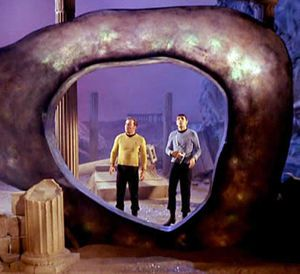
Plasma Beings. I have no idea what a Star Trek ion storm is and neither do the Strange New Worlds writers, but in episode 3, we learn that there are "plasma creatures" (are these the titular "ghosts"?) who live inside the ion storms that sometimes effect Hetemit IX. The plasma creatures save the lives of Kirk and Spock after they stupidly allow themselves to get trapped on Hetemit IX during an ion storm.

CGI light infection (image source)

 Fantasy Science. In the original Star Trek, we had water from a planet that contained a "complex chain of molecules that affect humanoids like alcohol". Viewers are told in episode 3 of Strange New Worlds that the teleporters of the Enterprise automatically screen out any such foreign material... except when... plot. In episode 3, we are told that the "contagion" from Hetemit IX travels "through light waves" when it spreads from person to person. The writers made up a convoluted plot about an energy drain causing the teleportation filters not to work when the Away Team returns to Enterprise, but even later, all the Hi Tek™ medical equipment on the ship still can't detect this magical "contagion". Eventually, a magic antidote is found (at the last possible moment), just as for the TOS episode "The Naked Time". Episode rating: ☀☀☀☀ 4 death rays... the Illyrians are not new, Una is too human to be interesting and the "science" in this episode is so absurd that it can damage young minds. 😫😡

More Gorn on the way 😖. Figure 1.

 More useless reptilians. Last year (see this blog post), I comment on Fredric Brown's 1944 story "Arena". In the Star Trek episode called "Arena", Kirk battled a Gorn. For Star Trek: Strange New Worlds, just when I was ready to celebrate the lack of Klingons and Romulans, they drag the Gorn out of retirement. Question: the show is called New Worlds, so why must we recycle old aliens? Answer: episode 4 is not about aliens, not even the Gorn... it is about Lieutenant La'an Noonien-Singh and her traumatic childhood memories of the Gorn. But are the Gorn interesting aliens? No.

Please don't turn this into a horror show.

 A Race to the Bottom? When dealing with Hollywood, one always has to wonder how long it will take a new science fiction show to sink to the bottom of the barrel. Bring together a bunch of Hollywood writers with no interesting ideas about space aliens, and soon enough they will simply trot out some Evil Alien™ species to battle against the Federation (such as the Borg or the Jem'Hadar). 

Star Trek Mired in Darkness. What about Strange New Worlds writer Davy Perez? If Perez wants to make changes to the Gorn, then why not make interesting changes? Why revert to the tired Evil Alien™ plot? If Perez wants to write horror stories and has nothing interesting for viewers then he has the power to inflict "Tribbles with teeth" on Star Trek fans. No, thank you. Episode rating: please take your sterotypical ALL EVIL™ Gorn and return to Discovery. 👎🙈🙉⛔

Figure 2. Star Trek SLT; Spock's Love Triangle... will Spock go to the Dark Side?   r Chapel(θ) + ir T'Pring(θ) = reiθ

a R'ongovian
R'ongovian solar sailship
Technically, Episode 5 ("Spock Amok") failed to deliver a new world, but it was still a breath of fresh air after the Gorn episode (Figure 1, above). Viewers are provided with a look at a R'ongovian spaceship using a solar sail, but the action takes place at Starbase 1. We never get to see R'ongovia. 👎

Don't think too much, Spock.
 Different Stripes. The R'ongovians almost get lost in this episode while Spock engages in hi-jinks: swaping bodies with T'Pring. The R'ongovian culture is somewhat interesting... almost the opposites of the Gorn, the R'ongovians are highly empathic. Captain Pike finally wins the trust of the R'ongovians by demonstrating that he can express complete sympathy for the feelings of the R'ongovians who are in a tight spot, their world inconveniently located between the parts of the galaxy controlled by the Romulans, Klingons and the Federation. 

Really delivering on that "strange new world" idea

If you were entertained by Enterprise Bingo then check out this video. Sadly, none of the cast members of Star Trek: Strange New Worlds who are shown in that video seem to be rabid fans of Star Trek. 😞 However...

Trekkie?
futuristic phone sex
New spinoff show:
Spock's Women.
I don't want to see Star Trek: Strange New Worlds turn into some sort of soap opera about Spock's sex life. Although, I might get into Vulcan sex if it is strange sex with some interesting aliens on new worlds. Episode rating: 1 brain and 1 heart 🧠💘. This episode is mostly about Spock, not the more interesting R'ongovians. 😒

If not Spock then how about the Captain? If not Spock's sex life, then how about an episode about one of the Captain's women? What are the odds that any "new world" we visit for Strange New Worlds is ruled by one of Pike's old girl friends? In the Star Trek universe, maybe 70 - 80%. Here's the setup: the most important cargo known to Majalis is being carried through space in a defenseless shuttle. The shuttle comes under attack by a space-cruiser, one with relatively weak weapons.

🧠 Brain? What is Brain? 🧠
A scene from TOS "Spock's Brain"
 The Cloud City of Majalis. Yes, it is a dangerous galaxy out there. At any given time, while the Enterprise is mapping space, you are likely to receive a distress signal from someone like Harry Mudd Pike's old Majalan flame, Alora. Why Alora is gallivanting through space with the next "First Servant" is never explained... because... plot. 

 Fantasy Medicine. The offending space-cruiser is destroyed by Enterprise, but not before the Majalan shuttle is also destroyed in the attack. However, the shuttle's passengers are safely teleported aboard Enterprise. Lest you think that Majalis is some backwoods primitive world, viewers are quickly informed that there is no disease among the Majalans. They use magical "quantum bio-implants"™ that correct any damage to a person's body at the molecular level.

Mind Control.
 Mystery. This episode keeps viewers guessing, but not in a good way. We wonder: is this Strange New Worlds episode a rehash of "The Cloud Minders" (see Trek 39) or "Spock's Brain" (see Trek 32) with maybe some of this TOS episode sprinkled in? The super technologically advanced Majalans have to use a child's brain to keep their floating city floating. This so disgusts Pike that he jumps out of Alora's bed and returns to Enterprise. But all is not lost. The ship's doctor has obtained clues for how to use "quantum bio-implants" to treat his terminally ill daughter.

Still waiting to reach the frontier...
I wonder how much Robin Wasserman had to do with the tone of both "Spock Amok" (above, Figure 2) and "Lift Us Where Suffering Cannot Reach". Wasserman has some science fiction writing experience outside of Hollywood, which is a good thing. 👍

Episode rating: 3 brains 🧠🧠🧠. I fear that episode 6 might be as close as we come this season to actually visiting a new world of the unexplored galactic frontier and meeting interesting new aliens... although Majalis did not seem all that strange given its similarity to Ardana and let's also not forget: Pike had previously made contact with Alora.  😟 The whole "we run our city with a human brain" plot was stupid in 1968 and it is even worse in zombie resurrection mode, here in 2022. 

 The Call of Duty.
Spock and Chapel demonstrate that
they have no feelings for each other

 Astounding Asteroids. In "The Serene Squall", viewers are subjected to another absurd Hollywood asteroid belt, but there is no new world and no new aliens. For Episode 7, we get a brief glimpse of Spock's brother, Sybok who is living at a criminal rehabilitation center where T'Pring is stationed. Sybok's friend, Angel the pirate, tries to spring Sybok from the rehabilitation center by engineering a swap of Spock for Sybok, but the pirate-planned prisoner swap fails when Spock kisses Chapel.

I suppose Captain Angel was designed to be a Mudd-like character for the new century. Instead of "Mudd's Women" we got "Angel's Vulcans".  The writers are struggling to deliver Strange New Worlds, so they might start a spin-off series called Strange New Pirates.

Episode 7: Angel's Vulcans.

 Pirate Perfidy. I suppose it is inevitable that both Angel and Sybok will return in future episodes of Star Trek: Strange New Worlds because the writers don't seem interested in exploring new worlds... they'd rather engineer excuses and invent contorted plots that allow the show runners to show Spock kissing someone. Episode rating: 👎, no new world, no new aliens and too much icky gruel 🥗.

new uniforms!

In Episode 8, "The Elysian Kingdom", there is no new world, but we did get one new alien. Sadly, this alien is yet another disembodied fantasy alien who resides inside a nebula. 👻 Success: Debra finally liberated Rukiya from the teleportation buffer. Episode rating: 👎, silly fantasy alien with magical telepathic powers. Poor Hemmer. 😟 Will he recover?

Buckley (right)
 Spock +1 hug, Hemmer -∞. Ever since episode 4, I've been dreading the return of the Gorn. However, I held my nose and watched the stupid Gorn episode "All Those Who Wander". In order to make this disgustingly bloody episode, they magically made the Gorn undetectable by scanners. And the Gorn are also magically shielded from Hemmer's telepathy. Poor Hemmer dies in this episode because... plot. Spock and Chapel managed to sneak in one long hug. The new alien in this episode was "Buckley" who did nothing except act as an incubator for some baby Gorn. Episode rating: 👎, I'm not interested in magical fantasy horror show Gorn. Alien body count: -1 red-shirted engineer, -1 blue disposable alien and who even counts all the dead Gorn?

"I'm Pike's number one." ... "No, I am."
 The Search for Quality. Episode 10 had no new worlds and no new aliens; rating 👎. 

I was a fool to imagine that we could get through a season of Star Trek without having to deal with either Klingons or Romulans.  😔 

I suppose the one alien (besides Spock) who we can expect to see in Season 2 of Strange New Worlds is Una, who Pike promised to protect, but who is arrested at the end of this episode. Most of the other "new" aliens from Season 1 (such as the Deleb) were as disposable as a random red-shirt. 

Maybe since the writers have no interest in new worlds and interesting aliens, this series will be all about time travel and they'll start calling it Star Trek: Dr. Who Me Too.

Mudd's mysterious time crystal
 Magic vs. Science. I've been investigating the science advisors for Star Trek: Strange New Worlds and trying to imagine how viewers are supposed to accept show elements such as time crystals as having a place in the Star Trek universe.

Alien time travel technology.

  Time Travel. How does time travel work according to the writers of Star Trek? Growing up with the original Star Trek, I got comfortable imagining that maybe time travel technology was something that only super advanced aliens would understand and use within the Star Trek universe. However, writers for Star Trek have not been able to resist the temptation to make time travel technology available to primitive humans. Are "time crystals" technology or magic?

Kellam and a research assistant.
 Science Advisors. Some of the "fact checking" for Star Trek was done by people such as Kellam de Forest (he graduated from Yale with a degree in history) and Joan Pearce. Apparently, it was either Joan (working for de Forest Research) or Pete Sloman who realized that Gene Coon's script about the Gorn was very similar to Fredrick Brown's previously published story "Arena" (Figure 1, above). 

Harvey Lynn (educated in science and engineering) was apparently the first person with a science background who was called upon by Gene Roddenberry to provide advice for Star Trek story telling.

Other folks with science backgrounds who helped shape the science content of Star Trek include Andre Bormanis and Jesco von Puttkamer.

The Crystal Invaders
 Magic Crystals in Science Fiction. Long before science fiction existed as a literary genre, some people were obsessed with crystals and through the centuries there was much written about the magical properties of crystals. My favorite author, Jack Vance, sometimes included crystals in his stories (for example, see his 1952 story "Sabotage on Sulfur Planet"). The cover art for "The Crystal Invaders" (image to the left) well illustrates how to use crystals to sell fiction.

A famous use of crystals in Hollywood is in Indiana Jones and the Kingdom of the Crystal Skull where the titular crystal skulls of aliens look cool on screen and channel amazing powers. In the Star Trek fictional universe, dilithium crystals are what make possible faster than light space travel. As a measure of the popularity of crystals in Star Trek, see this list. There is no task too small or too large for a crystal, including the enigmatic "impulse deflection crystal".

cover art by Terry Pastor
One of the "science consultants" listed here is Isaac Asimov, who was proclaimed to be a "Special Science Consultant" for Star Trek when Roddenberry was seeking support for the sentient computer theme in the first Star Trek film. I read Gregory Benford's novel Timescape, but I could not finish his novel Foundation's Fear. I often have trouble accepting the fantasy biology that is dreamed up by physicists. It often bodes well for Sci Fi television shows when they use scientists and published science fiction authors as consultants. Writing in 1996, Benford commented that Star Trek, "... now depends on writers who seem rather proud of their ignorance of written..." science fiction. I would say: it is a miracle that Roddenberry was able to go as far as he did in bringing science fiction with a hint of science to the boob tube.

sure, that makes sense
 Erin Macdonald was a science consultant for the first season of Strange New Worlds and I have to wonder what she thinks about time crystals. It would have been fun to watch Erin read the script for episode 3 of SNW. Did she shrug and say, "Oh, a disease spread by light waves... sounds good to me."

However, time crystals were introduced back in 2017, before Macdonald started working on Star Trek as an "technical consultant". Anthony Maranville was listed as both a technical consultant (or less grandly, as a "researcher") for the episode "The Red Angel" and as a writer. That season 2 episode of Discovery featured the idea that time travel had previously been developed by both Klingons and Section 31. "In an effort to ground the show's science fiction in actual science, he regularly consults with scientists and physicists."

will the Suliban return in SNW?
I have the feeling that during the time when Discovery was developed under the "guidance" of people like Kurtzman, Fuller, Harberts and Berg, there may have been essentially no consultation with science advisors. It seems that Fuller and other people associated with the show felt free to make up silly "future science" such as the "spore drive" and there was apparently nobody there with any knowledge of science to keep the show from becoming a type of science fantasy that is low on the science.

Is it possible to make sense of time travel as depicted in the Star Trek fictional universe or is trying to do so simply a fool's errand? I'm in complete sympathy with story tellers who cannot resist constructing stories about time travel, but I'd like to believe that Star Trek is science fiction where everything happens for a reason, by using future technology, not because of magical fantasy.

Time Travel? Don't ask questions...

It may be that some Star Trek writers grew up watching shows about the "Temporal Cold war" and then later felt a need to "explain" time travel using magical "time crystals". Maybe time travelers from the far future make sure that nobody in the primitive times of the star-ship Enterprise can understand and control time travel technology because primitive humans wielding time travel technology would only mess up the future. 

As depicted in "A Quality of Mercy", Pike is given a "time crystal" that allows him to magically see the future, allowing him to change his own behavior and prevent a devastating war with the Romulans. But how does time travel by means of a time crystal work?

magical fantasy

 Magic Time. I can't explain what type of time travel it is that they were trying to depict in the final episode of season 1 SNM SNW. Was the consciousness of Pike "projected" into the future and placed into his future body? Nobody in the future seemed to notice any change in Pike's physical appearance. Was Pike's "trip to the future" only an illusion or dream? None of this was made clear, so I suppose, as is usual in Hollywood, we viewers are not supposed to ask questions. This might be an application of Clarke's 3rd law: time travel seems like magic to we primitive Earthlings.

"There’s new aliens almost every week." -Henry Alonso Myers

Spoiler: the horse works for Section 31.
 New? That comment from co-show-runner Myers (above) suggests that he must count retread aliens such as Romulans as being "new". What about my hopeful search for interesting new aliens in Star Trek: Strange New Worlds? Dreaming up interesting new aliens does not seem to be a concern for the writers of this television show. 😖 However, we did get a scene in Season 1 with Pike riding a horse. Is that supposed to satisfy our desire to explore a new frontier?

Related Reading: the chemistry of time travel

Next: the "possible worlds" of pulp Sci Fi

visit the Gallery of Movies, Book and Magazine Covers

Nov 2, 2020

Short vs Long

Short story idea: Grean the Kac'hin
and Fengtol (a positronic robot) at
the ball park.         image source

Short Format Fiction. The first science fiction story that I ever read, as a hard-cover novel, was The Gods Themselves. At the time, as a young school boy in a rural community, I had no idea that science fiction short stories existed. I also had no idea that The Gods Themselves had originally been published in a serialized magazine format. Thus began my infatuation with long-format science fiction and novels. However, nobody can completely ignore short format science fiction and back in 2014 I had a blog post called "Short Stories".

In the six years since 2014, I've read more short science fiction stories than I had read in the previous 50 years of my life. The old science fiction magazines have increasingly become available to readers via the internet. I usually seek out short stories that were written by my favorite authors, but while prospecting through old Sci Fi magazines you always bump into some authors that you never knew existed. 

Nine Tomorrows
In this blog post, I discuss the short science fiction stories that were published by "Kent Casey" in 1938 and 1939.

Not long after I discovered the existence of science fiction novels, I found and read my first science fiction short story anthology. The first anthology of Sci Fi stories that I bought was either Nine Tomorrows or The Science Fiction Hall of Fame volume IIA or IIB. I don't believe that I ever bought Vol. I of The Science Fiction Hall of Fame, but I'm sure I read some of its stories while standing in bookstores.
 
Eventually, I actually saw some science fiction magazines in book stores, but I had a problem with both anthologies and magazines. While there might be a story that I enjoyed in among a collection of stories, there were always some other stories there that I did not enjoy. Why should I pay for science fiction stories that I did not enjoy reading?

cover by Robert Schulz
The most intriguing "anthology" that I ever bought was I, Robot. Asimov put some effort into linking together a set of short stories (published originally in magazines during the 1940s) about robots, creating a kind of "future history" of the development of positronic robots. This is the only "anthology" that I ever bought and still have on the shelf.

Later in life, Asimov wrote novels (such as The Robots of Dawn and Prelude to Foundation) that included robot characters and additional short stories about robots (such as "Cal"). All of those diverse robot stories by Asimov, when taken together as a whole, create an amalgamation that is vastly more satisfying than any single story, short or long. Thus, I started as a science fiction fan who enjoyed novels and grew into a lover of epic-scale fictional universes that sprawl over multiple novels. Isolated short stories seldom interest me.

My Path to Casey: Rockets, Receptors and Robots
Selling science fantasy stories.
1961
One of the short stories that I read in The Science Fiction Hall of Fame while standing in a book store was the 1938 story "Helen O'Loy" by Lester del Rey. This story has been widely anthologized, so I assume that someone once liked it and maybe some people still do. I did not like "Helen O'Loy" for several reasons. My first problem with the story is that I don't like the robot character named Helen O'Loy. I don't accept the entire fictional science premise behind how Helen was programmed and became a simulated woman. Readers are asked to believe that any human male would impulsively want to marry the robotic Helen O'Loy.
 
Problem #2. I also dislike "Helen O'Loy" for reasons that are not specific to this one story but rather, are problems inherent in the short story format. To be published in pulp science fiction magazines there were a few standard formulas for success.....
 
Phil is surprised by Helen.
interior art by Charles Schneeman
Thus, even good story ideas had to be adapted to formulaic story telling patterns in order to sell to magazine editors and be published. Short stories were expected to have some cute twist the end that would put a nice satisfying bow on the whole package. At the end of "Helen O'Loy", we are told that Phil (who narrates the story) never got married because after having know Helen ("she" is the robot who married Phil's pal, Dave) he was never interested in any other woman. Also, when Dave dies of heart disease, Helen kills herself because she is so emotionally attached and devoted to Dave. That ending is just too sappy for my tastes.
 
In the Ekcolir Reality
cover art by Edmund Emshwiller
Problem #3. I've never enjoyed the whole "I'll build it in my basement" type of science fiction story. From the "I built an artificial man" in Frankenstein to "I built a spaceship" in Skylark to "I built a time machine" in The Time Machine. I despise the science fiction story that pretends some genius can accomplish in a few days what nobody else can do. That's magic, not science and it is the basis of "Helen O'Loy".
 
Problem #4. I also despise the amazing breakthrough that becomes a one-off event, never replicated, and which does not involve itself with the social change that would come from a major scientific advance or technological break-through. Fine, if all you want is to sell a bit of fluff to a magazine, go for it. Don't expect me to view it as satisfying science fiction. 
 
fictional chemistry
The future society depicted in "Helen O'Loy" is mostly unchanged from the 1930s with nothing added except a few technologies; 1) household robots, 2) some advances in molecular medicine, and 3) a very noisy rocketport in each town rather than an airport.

Fictional Chemistry. What is the secret of making a robotic female with emotions? According to Lester del Rey, you just put in an "adrenal pack"! This reminds me of a 1934 story called "The Hormone" by Milton Kaletsky. In "The Hormone", people can be magically "accelerated" by injecting the hormone "cortin". In addition to rockets and robots, Lester del Rey's imagined future also includes medical doctors such as Phil who specialize in endocrinology. Phil knows all the hormone receptors, so if your good-for-nothing son falls in love with the maid, Phil can provide a two-week-long course of "counter-hormones" that will reverse the boy's infatuation with the cute maid. 
 
Fictional chemistry.
image source
Unlikable characters. Phil has no scruples; for a big paycheck he even chemically erases the love being experienced by the poor maid (against her will).
 
Dave is a robot repairman of the future, so in order to make an emotional robot girl, all he has to do is learn endocrinology from his buddy Phil and then spend a few hours magically adding the electrical circuit equivalent of emotions to an unemotional robot that you can buy off the store rack. 
 
All things are possible in the future era depicted in "Helen O'Loy". This is the future where you have household atomic power packs, so it is a snap for Dave to give Helen emotions. Strangely, nobody else in the whole world ever had the same idea. And when Dave marries Helen the robot, nobody in the whole world suspects that such a thing is even possible.

the role of women in Sci Fi (source)
I first read "Helen O'Loy" after having already read Asimov's I, Robot and there was not much of a chance for me, as a budding scientist, to enjoy "Helen O'Loy". I can understand why "Helen O'Loy" was eventually marketed as science fantasy. 
 
I suspect that some other writers such as Isaac Asimov learned a lesson from stories like "Helen O'Loy". For example: that they should include at least one competent professional woman in their robot stories (see Dr. Susan Calvin).

I can't stop myself from wondering if Lester del Rey wanted readers to imagine a homosexual relationship between Phil and Dave (early in the story, they stop dating women and live together). Was the robotic Helen such a sexy "woman" that she could induce Dave and Phil to abandon their homoerotic relationship?

I suppose Helen O'Loy did have a vagina.
Handy rule for writers in the 1930s: substitute
"she was a great cook" for "she was great in bed".
It is tempting to imagine how "Helen O'Loy" might have been written had the author been a woman in an alternate Reality where women were not expected to be house wives. I like to imagine that in the Ekcolir Reality, the science fiction genre was developed by liberated women. Lester del Rey told his readers that men expect their wife to cook dinner and give birth to his sons. Helen O'Loy was a really great cook, so good old Dave was willing to marry her even though they could not have children.

Letter from Kent Casey in Amazing Stories
I recently took the time to dig the original version of "Helen O'Loy" out of the December 1938 issue of Astounding Science-Fiction. In that issue was a story called "They Had Rhythm" by Kent Casey. According to ISFDB, "Casey" wrote two sets of science fiction stories. One set of stories (including "They Had Rhythm") featured the recurring character Private Kelton, while the other set involved a Dr. von Theil and Sargent John West. 
 
According to this webpage, "Casey" was Captain Kenneth Casey McIntosh, retired from the Navy. I dislike early science fiction stories that warped a Western plot into a science fiction story by converting six shooters into ray guns. Similarly, the Private Kelton stories are silly bits of fluff about the future Space Navy. They remind me of Forbidden Planet where the crewmen of the futuristic interstellar spaceship act like they just stepped off an old Navy ship from 1940. Everyone writes what they know, but people with no interest in science often fail to write interesting science fiction.

I've previously commented on editor Campbell's skill at using pseudoscience to excite his readers. Over at Amazing Stories, editor Raymond A. Palmer was exploring fringe science topics that were even more far out than those offered by Campbell. In the July 1940 issue of Amazing Stories, Palmer published a long letter from "Casey" concerning the lost continent of Lemuria. See the image to the right on this page where you can read that Kent Casey letter.
 
Why did Campbell so quickly fall in love with the short stories that had been written by "Casey"? I blame Dr. von Theil, a fictional scientist. The first Dr. von Theil story was published in the March 1938 issue of Astounding Science-Fiction, the issue that is famous for John W. Campbell's decision to put "science-fiction" in the title of the magazine.

Dr. von Theil
In "Flareback", Dr. von Theil has invented a new secret weapon for the Space Patrol. He cleverly allows some Evil Uranians™ to steal the new technology, which promptly destroys their spaceship. Sargent West flies the good doctor around the Solar System during their missions.
 
"Flareback" is interesting only in that Dr. von Theil's new weapon involves positrons and I must wonder to what extent "Flareback" influenced the young Isaac Asimov when deciding that his robots would have "positronic brains".

"Static" was published in the May 1938 issue of Astounding Science-Fiction. The war against the Evil Uranians™ takes a bad turn for Earth when the Evil Uranians™ start using a new "impenetrable screen" to protect their spaceships.

the new Astounding
In "Static", the glorious Fleet Commander calls on all his "absent-minded professors" of the Space Patrol scientific staff to solve the mystery of the "impenetrable screen". Dr. von Theil surmises that the Evil Uranians™ are capturing cosmic rays and using them in their "impenetrable screen".

To confirm the hypothesis, Theil and West must capture an enemy spaceship. West is positioned in an abandoned supply depot on Mars from which he sends a radio message that attracts an enemy spaceship. After West allows himself to be taken prisoner on the enemy ship, Theil incapacitates the Evil Uranians™ using a "mind static" device.

I wonder if Isaac Asimov was influenced by the idea of a "mind static" device that "Casey" included in the story "Static". Asimov later included such a device in some of his own stories.

Interior art for "The Ceres Affair"
by Hans Wessolowski
In case you were wondering, now with an enemy ship in hand, Dr. von Theil quickly deduces that the "impenetrable screen" of the Evil Uranians™ can be penetrated by exposing it to radium or uranium.
 
The October 1938 issue of Astounding Science-Fiction included both another Dr. von Theil story ("The Ceres Affair") and a fanish letter to the editor from Kent Casey. "The Ceres Affair" continues the silly science parade that distinguished the first two Dr. von Theil stories. When Theil and West visited Mars in "Static", it was a planet Mars with abundant plant life. In "The Ceres Affair" we are told that Ceres has coal deposits and at least one flowing stream feeding a lake full of water! 
 
in the Ekcolir Reality
The Uranian Death Star
Sadly, here in 2020, we now know that high temperatures on Ceres are about -180 Fahrenheit. However, that does not deter the Evil Uranians™ from making a base of operations on Ceres, well protected by powerful force-beams.

Luke Skywalker Dr. von Theil penetrates the Death Star Uranian Base on Ceres and saves the day. Theil uses the Force another quickly devised magic ray gun that chills the enemy power cable so much that it becomes a superconductor. The resulting power surge destroys the enemy defenses. Dr. von Theil refuses to reveal how he made his magic chill ray because this fantastic technology would be abused by other people. 😢

in the Ekcolir Reality
One more Dr. von Theil story was published in the December 1939 issue of Astounding Science Fiction. The best thing about the Kent Casey stories is that they are relatively short. In "Thundering Peace" we learn that the planet Uranus was colonized by settlers from Earth who had been attracted by the "huge lakes of petroleum". The atmosphere of Uranus can be as cold as -370 Fahrenheit, the planet's small rocky core is very hot and sandwiched in between is a water-ammonia ocean with pressures so high that there might be hail-like diamonds falling from above.

When ships of the Terran Space Patrol follow Uranian space pirates to Uranus, the enemy ships quickly drop from the stratosphere to the "ground" but the navigational instruments on the ships from Earth all go "haywire". What is hidden under the clouds of Uranus? A chilling mystery.

Meeting the dastardly Uranians.
interior art by Charles Thomson
According to Casey, rapid evolution over "several generations" has taken place on Uranus and now the Uranians are super-strong, allowing them to survive under high gravity conditions. Also, they have HiTek™ "atmosphere plants" that provide the oxygen gas that they need to survive.

Human survival on Uranus was made possible by the evil genius professor Ritzbaden who pioneered transmutation of elements. Theil surmises that the Uranian settlers converted the carbon atoms in methane into nitrogen and oxygen in order to make Uranus habitable by humans. 
 
in the Ekcolir Reality
Original cover art by Howard Brown
Dr. von Theil is itching to have a look at Uranus and asks to have a spaceship equipped with an "infrared cloud-breaker ray". Peering through the thick clouds of the upper atmosphere of Uranus, West and Theil can see giant towers of the oxygen plants where the transmutation of elements takes place. 
 
All the hydrogen gas that came from the methane originally present in the atmosphere of Uranus was free to rise into the upper atmosphere. 
 
In order to end the war and break the will of the Uranians, Theil uses another quickly-constructed super-special magic raygun to ignite the hydrogen layer of the upper atmosphere. The resulting explosion of the atmosphere so terrifies the Uranian military forces that they flee the planet in their spaceships, leaving the planet to the remaining peaceful Uranians who surrender to the fleet from Earth.

fantasy lifeforms; this week 4-armed
centipedes and gas creatures,
next week, unicorns and liquid life
I have no idea why "Kent Casey" decided to have Earth fight a war against imaginary Uranians, but in the March 1937 issue of Astounding Stories was "Clouds over Uranus" by Russell Winterbotham. 
 
"Clouds over Uranus" is a "chilling" story that featured native lifeforms from the icy atmosphere of Uranus who transformed themselves from their normal gaseous state into solid human form, after which they live happily inside an Earthly outpost on the surface of Uranus where the temperature is kept at 68 Fahrenheit.
 
I wonder if Stanisław Lem read "Clouds over Uranus" and took it as part of his motivation for writing Solaris. Maybe in an alternate Reality, the gaseous creatures of Uranus were accounted for by nanites or some other fictional technology. Russell Winterbotham made no attempt to explain how life could magically exist in a gaseous state.
 
a living ocean
Long and the short
I'm glad I discovered printed science fiction in the era when many science fiction novels were available to me. I can appreciate the importance of short stories in the history of the science fiction genre, but I'm glad I was not forced to feed my youthful addiction to science fiction by reading the pulp science fiction magazines.
 
World building. When science fiction was being created as a new literary genre, short stories were quickly crafted without the authors having time to think about the social implications of new technologies. Many of the short stories from the 1930s that were published in Astounding are like cotton candy. They gave the required sugar rush to magazine readers of those times, but they really were not substantial and satisfying food for hard-core science fiction fans.

cover art by William Timmins
Here in 2020, it is fun and interesting to prospect through the old magazines in search of the earliest versions of stories about telepathy, robots, aliens, teleportation and even chemistry. Those early stories were mostly science fantasy, with magical fantasy elements such as wizard Dr. Theil's magic wands rayguns, but they laid a foundation for the true science fiction stories that were yet to come when scientifically knowledgeable writers could start imagining how human society might be altered by technological advances and our entry into the age in which science and technology are central to human existence.
 
Related Reading: liquid life
                 "What Are Positrons?" by Robert D. Swisher 
Also:        "Dover Spargill's Ghastly Floater"; in 1951, Jack Vance transmutes elements and engineers an atmosphere for Earth's Moon.
Next: the 2020 SIHA goes retro
visit the Gallery of Movies, Book and Magazine Covers