One of the joys of
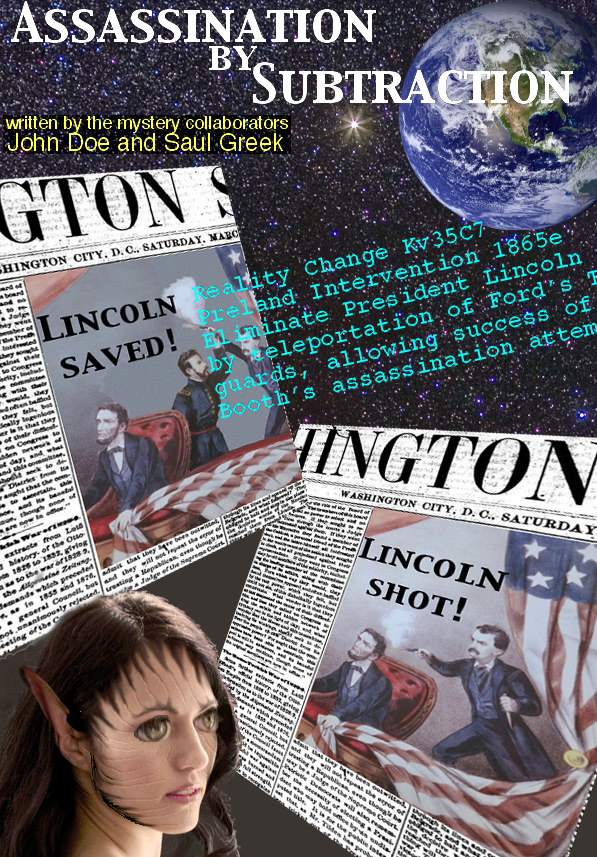
Twitter is magical juxtapositions. There seems to be a law of physics that links the creation of tweets to their equal but opposite anti-tweets. To the right is shown such a
tweet/
anti-tweet pair that fell into adjacent positions in my twitter feed today.
That's right... as a science nerd, I can't observe any phenomenon without imagining a scientific law (formulated in mathematical language) that might account for the observation.
I often imagine that the basis for science is our human capacity to create fantasy stories. In case you suffer from "nerd blindness", suggesting that there is a natural law that creates tweet/anti-tweet pairs is a joke. Still, scientists play with imagined possibilities all the time. They quickly reject absurd fantasies and move on. Unless, of course, they also like to write
science fiction stories.
And many science-minded people do. In my case, I started out with a love of "hard science fiction" and it took decades for me to even allow myself to write a story in which faster-than-light speed space travel was possible. To this day, I remain "
fantasy blind": I'm unable to read or write fantasy.
"
Most science fiction today is actually science fantasy, or rather science action. The science element is usually fairly minimal, and seldom explained except in the form of Star Trekesque technobabble, meaning it sounds scientific, but is actually just nonsense." -
G. Jack Urso
Fantasy vs Science Fiction
I've
previously blogged about the fact that I was horrified (back in the previous millennium) when the mega-book store chains started putting both science fiction and fantasy books in the same section of their stores. I've tried to read fantasy and I've tried to watch fantasy films... without success.
Maybe the problem goes back to my childhood when I'd get to watch only the first part of
The Wizard of Oz. About the time when the dead witch's legs would magically shrivel up, it was time for me to go to bed. I blame that movie for the fact that I've always had dreams about tornadoes.
Through the years, I've learned that some book covers have good clues that signal the likelihood that I won't enjoy them. For example, a book with a sword on the cover is not for me.
One of the few books that I ever bought with a sword on the cover was
The Faded Sun: Kesrith. I learned my lesson: hot chicks with swords are trouble... the kind of trouble that I'd prefer not to read about.
But.
Today I saw also saw
this tweet about a book store that does not want readers to judge books by their covers.
I Object
For me, the dictum "don't judge a book by its cover" is a useful reminder that just because not every book can have a wonderful cover illustration by an artist like
Gino D'Achille that does not mean that you should not buy books with bad covers.
Example: when I bought my copy of
Trullion, the discount store had ripped off the cover. I already knew
Jack Vance, and I did not need a cover illustration to help me decide to buy the book.
However, in the opposite direction, I do still judge books by their covers. In particular, I can usually judge from its cover if a book is fantasy or science fiction.
It is an interesting question: does there exist a book with a sword on the cover that I would buy? Deep in my heart, I feel that I've already learned everything I want to know about books with swords on their cover.
Might I miss reading a great science fiction book simply because I refuse to touch books with swords on their covers? I doubt it.
Can John Judge a Book by its Cover?
I like doing experiments, and a good opportunity arose today at
this webpage where I was offered the chance to explore "new authors" and find a few "free" books to read.
To the right on this page you can see all of the book covers from these potential "new authors" (new to the reader). I wondered if could I guess which of these books are actually science fiction just by looking at the covers.
I also wondered: could these covers help guide me to a science fiction book that I might actually want to read?
I was pleased to find that the first book cover (for
Fire and Ice) is heavy on the sword. My immediate guess was: "this is a fantasy novel" and it turns out to be part of a "dark fantasy" trilogy.
I congratulate Patty Jansen on selecting book covers that immediately let readers know that these are fantasy books. In the old day, book publishers used to print the word "Fantasy" on such books, but I guess that practice was abandoned long ago.
Mutations
I've previously blogged about the role of
mutations in pop culture. The dude in the biohazard suit on the cover of
Mutation Z: The Ebola Zombies hints that this might be science fiction, but any story about
zombies is a horror story. I object to horror stories that pretend to be science fiction, particularly when they are absurdly anti-science.
I recently mentioned
Shambleau as an example of a story that puts an element of ancient mythology into a science fiction setting.
Upon seeing the cover art for
The Devil's Concubine I was intrigued by what looked like a metallic device on the woman's head.
I'm always in the market for a new science fiction plot device that gives us access to the mind! However, any book with the word "devil" in its title is not likely to be a science fiction story.
However, I have to admit that there are many science fiction stories that feature concubines. "Devil" and "concubine" is an interesting juxtaposition... I've seen
Lilith described as the Devil's concubine. The reviews of the book indicate that it is "for fantasy lovers".
I must add,
anyone who comes to science fiction by way of
Dune is not likely to be on the same science fiction wavelength as I am.
Mission: Flight To Mars and
Kill It With Magic provide a great example of science fiction/fantasy antiparticles.
Maybe it should be a rule: science fiction books have spaceships on their covers and fantasy books must have a sword.
 |
| Fantasy Five? |
 |
| ancient astronauts |
Having read
The Gentle Giants of Ganymede, I know that it is possible to write a science fiction novel with the word "giant" in the title, but I suppose if your name is "
Dragon" you simply have to write fantasy.
Sword lemma: if the word "sword" is in the title then its fantasy.
The Mage's Grave and
Hell is Coming both look like fantasy books. The only possible science fictiony art among these five book covers (above) is that for
Qualify. But first, a word about...
Online Book Reviews
 |
book "reviews"
The most prolific book reviewer in the universe:
Mr. Amazon Customer. |
I've written a few. But then I noticed that most online "reviews" started looking like those shown to the right. They are not reviews.
Even the "review" by "Joy Mah" was ranked as "helpful", but clearly it is not.
Related reading: "
How an industry of ‘Amazon entrepreneurs’ pulled off the Internet’s craftiest catfishing scheme" & "
Don't Necessarily Judge Your Next E-Book By Its Online Review"
 |
| off to planet Atlantis! |
Back To The Cover
I'm sure that you can write science fiction about
Atlantis, but my reaction to the cover of
Qualify was: "Atlantis grail?"
GRAIL? It must be fantasy. The weird blue astro-swirly thing and planets on the cover told me that Vera had put the Atlantis myth into outer space. Wheee!
Ancient astronauts, my favorite kind of sci.... um....
Past the Cover
Oh, my aching hunger games. Anyhow, you can judge for yourself if this qualifies as science fiction. Reviewer
Andrea, tells us that this is really a "young adult" Twilightish story. Is it science fiction because it has some spaceships in the plot? With the word "Atlantis" on the cover and a story featuring "teenage nerd Gwen Lark and Logan Sangre, her sexy high school crush", thi$ look$ like pop $ci Fi. So who is the author, anyhow?
 |
| We all need to be able to laugh |
The blurb about
Vera Nazarian is intriguing: "She is the author of critically acclaimed novels DREAMS OF THE COMPASS ROSE and LORDS OF RAINBOW, the outrageous parodies MANSFIELD PARK AND MUMMIES and NORTHANGER ABBEY AND ANGELS AND DRAGONS, and most recently, PRIDE AND PLATYPUS: MR. DARCY'S DREADFUL SECRET in her humorous and surprisingly romantic Supernatural Jane Austen Series, as well as the Renaissance epic fantasy COBWEB BRIDE Trilogy, and the high-octane adventure YA / teen dystopian apocalyptic science fiction Series THE ATLANTIS GRAIL"
I'm glad I don't have to make a living by pandering to the fickle fate of a current "young adult" fashion craze.
"
This is the first review I have written - just to stop others from wasting their money."
 |
| cyborg super soldiers! |
The only one of these next five (above) that looks like a science fiction book cover is
Hard Duty which I would pass over because it looks like
military Sci Fi (from the blurb: "Sixteen billion dead in the last alien invasion". The last? But who's counting?).
I was surprised to "look past the cover" and find that
Birthright is described as "sword and planet" Sci Fi... I'd hoped
that went away with
John Carter. Similarly,
Conquest is described as "Space Opera Paranormal Thriller".
Into The Dark is described by one commentator as "science fiction without the science"... I guess that is a
sailing ship spaceship on the cover! Fooled me.
Calling is apparently about wizards.
"
Motorcycles, cute girl, motorcycles, cute girl minus some clothes, violence (dumb violence)."
 |
| the vampire of Alcatraz! |
 |
| a ragtag flotilla! |
These five (above) covers all look like fantasy. After looking at the blurbs, maybe
Mythical is trying to be military Sci Fi. I don't care enough to figure it out.
The next five book covers (below) look like they have fantasy cover art except for
Brothers in Exile. Looking inside, I found that
Joe Vasicek is a
Star Wars fan. That explains it.
"
Stoneblood Saga Book 0" -my kind of marketing!
"
The terminology was unfamiliar and not explained. The continuous violence became tiresome."
 |
| 70 pages? |
After a glance at these next five covers (above) I thought that maybe
High Pressure System and
The Bridge might be science fiction. Apparently
High Pressure System is about a "weather war".
The Bridge is described as cyberpunk.
In the next set of book covers (below), those for
Nano Contestant and
Polarized looked like they were illustrations hinting at possible science fiction stories. Looking inside, my worst fear for "
Nano" was realized: it is yet another hunger games clone.
Polarized does seem to be science fiction, some kind of galactic space opera.
"
Once it became clear that they were worshiping Luke Skywalker it really turned me off to the book."
"
so boring I couldn't bother finishing it"
 |
| "just HORRIBLE!" |
Might
In Distress be a science fiction story? Or are helical tattoos the latest style? Looking to the blurb: "dystopian science fiction love story". And: "Warning: There are S/M scenes as Malcolm needs pain to release stress and there are M/M sexual content. AMAZING!".
Subjected to a quick look, none of the next five covers (below) looked like science fiction. Looking inside.... Apparently
Life is a Beautiful Thing is cyberpunk.
Clause is the most interesting of these for me because I'm a sucker for any story about "lost tribes" of humans. But...
Journey of a Snowman?
"
Not science, weak fiction, not worth the time."
From among these five covers (above), that for
The Deep Link looks like a science fiction story. I love
first contact stories, but I'm probably over my limit of dealing with pesky "world-crushing ships".
My quick glance missed the word "invasion" on the cover (see below), but apparently
Fallen is a first contact story (11 pages?).
"
Shit, the aliens!"
The last 4 book covers are shown below. Alas, none of these looks like a science fiction story. However, according to the
blurb, the Safanarion stories involve time travel and "cryostasis".
Riddles (A.K.A.
genre chemistry):
Q: What do you get if you mix horror and science fiction? A: Horror.
Q: What do you get if you mix fantasy and science fiction? A: Fantasy.
Q: What do you get if you mix romance and science fiction? A: Romance.
 |
| we all have swords! |
Q: What if you mix science and science fiction? A: Science fiction.
Q: What if you mix adventure and science fiction? A: Science fiction.
Q: What if you mix wonder and science fiction? A: Science fiction.
There is a pattern here.
"
mixes sword and sorcery with science fiction"
Next: looking into
The Deep Link.