Showing posts with label The Mule. Show all posts

Dec 30, 2019

Rate of Change

In the Ekcolir Reality.
Original cover art by Hans Wessolowski
Here at the end of 2019, I am currently involved in my annual rituals of 1) looking back at the past year of Sci Fi blogging and story writing and 2) getting ready to celebrate the writing of important science fiction writers who were born 100 years ago. On January 1st 2020, I will post some commentary on Frank Herbert's (October 8, 1920 – February 11, 1986) 1963 story "Dune World". On January 2nd 2020, I will post some commentary on Isaac Asimov's (January 2, 1920 – April 6, 1992) 1952 story "The Currents of Space".

Galactic Empires
Before there were interstellar empires such as those depicted in Asimov's Foundation Saga (starting in 1942) and "Dune World" there was the evil Boskonian Empire as imagined by Edward Smith. As depicted in Ed Smith's 1937 story, "Galactic Patrol", the Boskonians were part of a vast intergalactic empire that was under the control of ancient aliens: the Eddorians. 

                                             Good vs. Evil
The Boskonian Empire was built around the kinds of governing principles that we might associate with a crime syndicate or 20th century fascism.

When "Galactic Patrol" was first published, Asimov was just starting to write science fiction stories that he hoped to publish in Astounding magazine. Asimov read "Galactic Patrol" and along with the rest of Sci Fi fandom, he was enthralled by the idea of interstellar space travel and life on distant exoplanets. A few years later, after Asimov had read Edward Gibbon's History of the Decline and Fall of the Roman Empire, he decided to model his own imaginary Galactic Empire on the Roman Empire.

mind control
Telepathy and Empire. About the same time that I first read the Foundation Trilogy, I also real the entire Lensman Series by E. E. "Doc" Smith and his earlier Skylark Series. Unlike Smith, who glorified mindless conflict between the evil telepathic Eddorians and the saintly Arisians (who could predict the future just by using their gigantic brains), Asimov depicted a balancing act between the First Foundation, which was devoted to physical science, and the Second Foundationers, who wielded their telepathic powers of emotional control. The Second Foundationers also wielded the imaginary science of Psychohistory, which Asimov depicted as the basis of their ability to predict the future.

Trantor: a planet covered by a single gigantic city.
When I discovered Asimov's Foundation trilogy in the 1970s, I was charmed by the quaint habits of the folks who lived in Asimov's imagined empire of the future. For example, they all smoke tobacco in the future! It was easy to see (but hard to accept enthusiastically) how Asimov had transplanted human behavior that was appropriate for ancient Romans to the future Imperials who ruled the galaxy from the planet Trantor. Asimov grew up in New York City and he imagined a capitol world for his empire that was a single gigantic city of 45 billion residents.

The Mule
1945
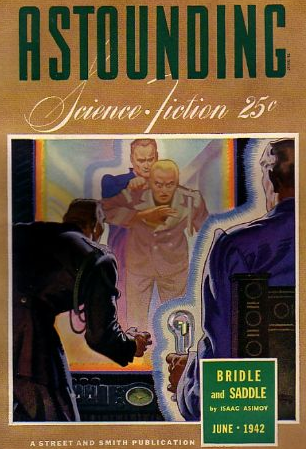
One of Asimov's great literary inventions is the megalomaniacal Mule, who has "mentalic" powers. Asimov used the term "mentalics" to refer to the ability of both the Mule and the Second Foundationers to alter the emotional make-up of human minds. The Mule was nearly able to take control of the entire galaxy by using his telepathic powers of mind control. In addition to making his subjects incredibly loyal, he could induce in his enemies debilitating depression and self-doubt. 

For me, what was most intriguing about the Mule was his ability to alter the minds of scientists and unleash their inventiveness. Asimov depicted his Galactic Empire, tens of thousands of years in the future, as being a place where the residents could barely keep their existing technologies running. There was essentially no social structure for scientific study and technological advancement. 

source
In Asimov's imagined Galactic Empire, even the idea of making an encyclopedia to document existing technology is unthinkable to all the trillions of inhabitants of the galaxy, except for "the great" Hari Seldon.

"How could the future be dominated by an 'empire'?" -David Berri 
Economics 10101010101
In an article ("Highly Illogical: What Sci-Fi Writers Get Wrong About the Future") from 2015 that was published in Time magazine, David Berri argued that an empire "would not generally promote the technological change necessary to settle and connect millions of planets".

In the fictional future imagined by Jack Vance, he depicted two eras of "future history" among the stars. When humans were first spreading outward from Earth, there was no central government. Later, in the twilight of the galactic era, Alastor Cluster was ruled by a single man, the Connatic, a kind of enlightened despot. Interestingly, as seen in Asimov's Galactic Empire, Vance's future does not feature significant technological progress.

extracting valuable kyrt from Floriana
Is the near-absence of scientific research and technological progress that Sci Fi fans often find in future Galactic Empires due to the fact that empires are simply not conducive to progress? Berri asserted that historically on Earth, empires have tended to feature "extractive institutions" much like what Asimov depicted for exploitation of kyrt on the planet Floriana (in The Currents of Space) and what Herbert depicted as the method by which House Harkonnen extracted spice from the planet Arrakis. However, Asimov depicted a kinder and gentler Trantorian Empire that worked against the Squires of Sark during the creation of his Galactic Empire.

I don't think that envisioning a Galactic Empire is an automatic fail for Sci Fi story tellers; I made my argument for this back in 2010. There is good reason for science fiction story tellers to want technological stagnation in their galactic civilization.

Extinction Curve; technology is dangerous.
Recognizing that it would take thousands of years to colonize millions of planets scattered through the galaxy and recognizing that over the course of thousands of years advancing technology could vastly alter human society (if not the genetic foundation of human species itself), why not make use of a rigid Imperial government to impose technological stagnation?

Foundations of Eternity
In the case of Asimov's Galactic Empire, he eventually depicted the positronic robot R. Daneel Olivaw as being in control of the Empire. It is easy to imagine that Daneel actively suppressed human technological progress during most of the Space Age. The Mule could reverse that imposed "suppression" and after the First Foundation took control of the galaxy, a new era of scientific study and technological advance suddenly began. Jack Vance imagined the Institute as an organization that systematically suppressed technological advancement.

For the Exode Saga, I imagine that there can be great dangers arising from rapid technological advances. Tool using primates might be their own worst enemy.

How can you adjust the rate of technological change?
in the Ekcolir Reality
In the December 1952 issue of Astounding Science Fiction, (along with Asimov's The Currents of Space) is a Raymond Fisher Jones story "Noise Level" which deals with the question of how to speed up the rate of scientific discovery.

I suppose "Noise Level" was a natural story idea for Jones who had training in "radio engineering" and also had experience working on equipment in the USA telephone system. In this story, to speed up the pace of scientific advancements all you need to do is provide scientists with a high level of "noise" (such as imaginative stories about levitation) and then apply an appropriate "filter". In "Noise Level", the filter used is to tell a team of physicists that antigravity has already been invented and they only need to turn it into a practical technology. Within a few weeks, the research team has a working antigravity device!

Phari endosymbionts
For the Exode Saga, I imagine that humans are hybrid beings, partly biological but also with minds that are partly composed of zeptite endosymbionts. While the pek were busy creating a replacement for humans (the Prelands), humans on Earth could be prevented from developing new technologies. The creativity and inventiveness of humans could be blocked by the zeptite components of their brains.

femtobiology
Lucky for we humans, there was a way to prevent our species from being replaced by the Prelands. This involved a "femtobot hack" and help from the ancient Phari.

Investigation 901
Related Reading: control of the pace of technological discoveries in the Asimov Reality
Also: The Yerophet Experiment
AND: more R. F. Jones
Next: 2019 Nuggets

visit the Gallery of Book and Magazine Covers

May 29, 2016

Mental Science

original Astounding cover art by Hubert Rogers
In the 1940s when Asimov wrote his original Foundation stories, he described the imaginary discipline of Psychohistory as the culmination of a mathematical breakthrough that allowed for scientific understanding of the human brain, human psychology and even sociology.

1. According to Asimov's account of future science, the electrochemistry of the brain could only be understood by tracing its details all the way down to the "nuclear forces".

2. As the story was told by Asimov, not only did the Second Foundation have the mathematical tools needed to predict the future direction of Galactic Civilization, but the Second Foundationers were able to use their telepathic ("mentalic") abilities to control the emotions and motivations of other people.

3. Thirdly, the Second Foundationers were able to abandon spoken language and communicate with one-another using a new type of gestural and telepathic language.

Later, in the late 1980s, when Asimov finally returned to the task of telling the story of Hari Seldon and how he established the Second Foundation, he depicted some humans as having the genetic elements that were required to establish a small colony of telepathic Second Foundationers.

Asimov had originally described The Mule as a genetic mutant who had been born with the natural ability to control the minds of other people. In contrast to the Mule, the Second Foundationers had to practice and train in order to fully develop their mentalic abilities.

Psycho History
source
Extending back into the dark days of the previous millennium, there is a twisted history of some philosophers, physicists and chemists who have proposed that an understanding of quantum physics must be utilized within neuroscience in order for us to fully understand minds and consciousness. This idea leaves most neurobiologists cold: they see no role for quantum uncertainty in the mechanisms of consciousness that exist in the warm and wet environment of a brain.

The physics world was recently abuzz with the possibility of a new short-range nuclear force. In the Exode Trilogy, I imagine that there are additional forms of matter (hierions and sedrons) that are, as yet, unknown to Earthly science.

source
When creating science fiction stories, it is fun to imagine that some mysterious unseen particles are what might account for human telepathic communication. Maybe new and wonderful branches of physics remain to be discovered.

In the Exode Trilogy, I imagine that the events described by Asimov in his Foundation Saga and in his Robot Stories reflect actual events that took place in Deep Time, in what I call the Foundation Reality. At that point in Deep Time, time travel technology existed and Daneel was being used as a tool by the Queen of Time Travel, R. Gohrlay. R. Gohrlay was the first telepathic robot.

source
Mentalics Time
What if the predictions of future events that were believed to be "calculated" by Seldon's "little algebra of humanity" were instead actually made possible by accessing information about the future that existed in the Sedronic Domain? Possibly R. Gohrlay collected some information about the future and made it accessible to the Second Foundationers. The best way to do this might have been to link the Prime Radiant to a sort of "data base" within the Hierion Domain. Using their mentalic powers, Second Foundationers might have used the Prime Radiant as a tool for accessing the Bimanoid Interface.

If all this was done correctly, the Second Foundationers could have believed that they were simply using mathematics to calculate the probabilities of future events, while in actuality they were obtaining information about the future, information that had been carefully provided to them by R. Gohrlay.

The Doctor who created our universe (in the Ekcolir Reality).
Original Ace Double cover art by Edward Valigursky.
Additional cover art by Virgil Finlay.
For the Exode Trilogy, I imagine that Asimov was able to tell his Foundation Saga in our Reality because he had access to information from the Foundation Reality. In the Foundation Reality, Asimov was an investigative science reporter. There was much to report because a secret agent from the far future (see The End of Eternity) was pushing primitive humans towards the development of positronic robots and hyper-spatial interstellar travel technology.

image credits
In the next Reality, the Asimov Reality, it was Asimov himself (the Asimov from the Foundation Reality) who traveled through time and passed on stories of the Foundation to his analogue in that new Reality. In the next two Realities, the momentum of Time ensured that the Asimov analogue in each Reality was also informed about events in Deep Time and able to write versions of the Foundation saga.

Next: Searching for Observers on Earth
visit the Gallery of Book and Magazine Covers

May 3, 2015

What's a Robot to Do?


The Mule
I recently came across an article that describes Hari Seldon and The Mule as superhero-like characters. Seldon and The Mule are two of the most important characters in Isaac Asimov's Foundation Saga. Here, I want to discuss The Mule as seen from the perspective of the mature Asimov and a third character in the Foundation saga, R. Daneel Olivaw.

Supervillain
The Mule
The idea that Asimov would include a supervillain in one of his stories strikes me as an absurd idea. Supervillains arose and functioned as a literary device within comics, a literary genre that is distinct from science fiction. Asimov tried to present readers with intellectual conflicts between characters who had different views, but who could seldom be fit into conventional niches such as "hero" or "villain".

Transformation of Myth Through Time
Daneel
During the 1940s, Asimov wrote a series of stories featuring positronic robots. Asimov also wrote the original Foundation stories during the 1940s, but he included no robots in what became the Foundation Trilogy (audio version).  In 1953, Asimov introduced a robot named Daneel who functioned as a "partner" for a police officer named Baley.

Much later, in the mid-1980s, Asimov inserted Daneel into the Foundation Saga. In Foundation and Earth, Daneel was depicted as having guided Humanity towards the creation of Galaxia, a galaxy-spanning group mind that could defend itself against aliens from another galaxy.

Telepathy and Mentalics
In the mid-1980s, Asimov also described the origin of Daneel's telepathic powers. As presented in Robots and Empire, Daneel was poised to assist Humanity during its spread to 25,000,000 planets of the galaxy.

In my view, Asimov's retro-unification of his positronic robot stories with the Foundation Saga is among the greatest achievements of science fiction.

Daneel and The Mule
We must wonder: what was Daneel's role in The Mule's rise to power? When Humanity spread through the galaxy, Daneel discovered that aliens from a distant galaxy had, for at least a billion years, been visitors in our galaxy. For some mysterious reason, those aliens had withdrawn from the Worlds of the Galactic Core, but Daneel knew they would return some day. In order to protect Humanity against the aliens, he worked for 20,000 years to bring into existence Galaxia.

During those 20,000 years, Daneel could not risk allowing humanity to discover his existence. Daneel secretly prevented humans from developing new sciences and new technologies. However, there were a few new technological advances that were needed for the creation of Galaxia. In order to obtain those new technologies, Daneel brought into existence the First Foundation, a culture based on physical science. As described by Asimov in Forward the Foundation, Daneel also allowed a small group of humans to develop their telepathic abilities and form the Second Foundation.

Exode
The Tool of a Tool
The Mule was Daneel's tool for stimulating just enough technological progress in the galaxy so that Galaxia could be rushed to completion. Sadly, Asimov was taken from us before he could write a sequel to Foundation and Earth.

The Exode Trilogy
In The Foundations of Eternity, Isaac Asimov becomes a character in a recursive science fiction story that explains the origin of telepathic robots like Daneel. Daneel was the tool of the first positronic robot, R. Gohrlay.

By following the Laws of Robotics, R. Gohrlay became involved in a dreary Time Travel War with the alien Huaoshy. However, as told in Trysta and Ekcolir, Grean was eventually able to end the Time War and bring into existence the universe as we know it.

Related Reading: Nicotine and Technological Advancement

Jan 25, 2015

Not Holding My Breath

June 1942 Astounding
Five or six years ago rumors circulated that Isaac Asimov's Foundation saga might be put through the Hollywood meat grinder. Given the rather cerebral nature of Asimov's science fiction, I am not surprised that a Foundation movie never emerged from the land of shoot and go boom. Recently, rumors have been floated that 1) Asimov's Foundation, 2) Clarke's 3001 and 3) his Childhood's End (see this) as well as 4) a reboot of the X-Files might all find their way into production as new television shows. As a fan of Asimov, Clarke and The X-Files, I'm intrigued and fearful of what might develop from these projects.

Daneel
The rumor is that HBO intends to tell stories that are based on Asimov's original Foundation Trilogy. Asimov's original Foundation tales were published in Astounding magazine over 60 years ago.....will those old stories mesh with modern sensibilities? Another important consideration is that Asimov later "re-imagined" the Foundation saga, linking the Foundation stories with his positronic robot stories. My advice to HBO and Jonathan Nolan is that they make R. Daneel Olivaw a major star of their Foundation television show and give plenty of screen time to a female robotic character, possibly a "reincarnated" Dors.

August 1944 Astounding
I've previously mentioned my enthusiasm for the way that Asimov inserted Daneel into the Foundation saga. In Forward the Foundation, published the year after Asimov's death, Asimov depicted Daneel as the mastermind behind Hari Seldon. In Foundation and Earth, Asimov showed the end game for the Foundation, a future in which Daneel's Galaxia project might be completed. In the final analysis, "Seldon's Foundation Project" was just Daneel's way to develop the last bits of technology that were needed to make Galaxia possible.

With Foundation and Earth and Forward the Foundation, Asimov showed how to knit together the saga of Hari Seldon and the Foundations with the 20,000 year long effort of Daneel to satisfy the Zeroth Law. This "knitting" was an act of literary genius, Asimov's last great gift to the science fiction genre.

Time Vault
holographic recording of Hari Seldon
The first episode of any Foundation television show should be an hour-long rush to depict the fledgling Foundation on Terminus, mired in its first Seldon Crisis and then culminating with a dramatic appearance by Seldon in the Time Vault. A Second Foundation agent, the daughter of Wanda should be shown at work on Terminus.

".....the Second Foundation is directing the historical course of the Galaxy....." - Pelleas Anthor

Time Travel
April 1945 Astounding
Psychohistory is the key pseudoscientific myth that supports the Cult of Seldon. Daneel makes use of religion as the glue that holds together the forming Foundation. The key miracles of the early Foundation Era are the recordings of Seldon that are timed to play exactly when the growing Foundation faces its greatest challenges.

The End of Eternity
A Foundation television show should show time travel technology being used to make possible the ability of the psychohistorians to seemingly predict the future. The Prime Radiant is a kind of mind-control device that allows the psychohistorians to "view the future" and encode their visions in a mathematical format while preventing them from being consciously aware of the role that time travel technology plays in their work. The role of time travel (and who wields the time travel technology) should be the big reveal in the second episode of a Foundation television series.

In The End of Eternity, the Eternals constantly worked to keep Humanity safe by "editing out of Time" inventions like nuclear bombs and the mass duplicator. Daneel faced the inverse challenge: creating the conditions under which human ingenuity could discover the one last innovation required to complete Galaxia. The dynamic tension between the First and Second Foundations concealed a carefully orchestrated effort to allow research into mentalics and advanced hyperspatial drive technology.....exactly what was needed to complete the Galaxia supermind.

Telepathy
November 1945 Astounding
I'm not convinced that anyone in Hollywood has ever figured out how to depict telepathic communication and the type of non-linguistic  "mentalic" control of emotions depicted by Asimov in the Foundation saga. A Foundation television show needs to flawlessly show "mentalic mind control" and telepathic communication between Second Foundationers and positronic robots like Daneel.

Asimov knew that there was no way to mathematically predict the future and in the decades following the 1940s, concepts such as the "butterfly effect" have entered into the common consciousness. Asimov clearly illustrated that human progress cannot be predicted when he wrote the Mule into the Foundation saga. The Mule was portrayed as a dramatic random factor that could break the magical spell of Seldon's infallibility, a spell that had given the people of the early First Foundation their confidence. After The Mule's rise to power, the First Foundation had to face the fact that a Second Foundation, a cadre of genetic mutants with "mentalic" powers, was secretly at work in the galaxy. I'd rush to show the Mule crushing the First Foundation by the end of the third episode of a Foundation Television series. Bayta should be shown as the key First Foundationer resiting the Mule.

January 1948 Astounding
The central tension of a Foundation television show needs to be based on the audience's ability to identify with the First Foundationers and their struggle to not be puppets of the Second Foundationers. At the same time, viewers must be shown how Daneel is secretly working to use the Foundations for his own purpose (creating Galaxia). And lurking behind Daneel must be the mystery of who it is that has access to time travel technology and who "gave" telepathic powers to the positronic robots.

After the defeat of the Mule, the First Foundationers must be returned to their state of ignorant bliss, convinced that the Second Foundation has been destroyed.

November 1949 Astounding
I'd make Arkady the main character of episode 4, but it needs to be shown how Lady Callia uses her mentalic power to control Arkady. Once the struggle between the First and Second Foundation is established, then a Foundation television series can loop back and do all of Asimov's original Foundation stories in a more leisurely fashion. The fate of Arkady can be left hanging and remain to be resolved at the very end of the series.

Don't Hold Your Breath
I'd love to see something good come out of HBO's ownership of the rights to develop a video version of Asimov's Foundation trilogy, but I'm not holding my breath.

2017 update: Goyer and Friedman/Foundation rumor
2020 update: Foundation on Apple TV
visit the Gallery of Book and Magazine Covers


End of March Update: Fox confirmed that several new episodes of The X-Files will enter production during summer 2015.
Update 2016: The X-Files Season 10
Reality TV: New Miss Universe Contest


Jan 27, 2010

Isaac Asimov's Nemesis

Among science fiction fans, Isaac Asimov is probably most famous for his stories about artificial intelligence (particularly his robot stories) and for his Foundation Saga. Asimov managed to knit together his robot stories with the Foundation in a most satisfying way.

Asimov included a "note to readers" in his novel Nemesis. He wrote that he might someday write another novel that would tie Nemesis to the Foundation/Robots/Empire fictional universe. Sadly, Asimov was taken from us before he had a chance to do more than tantalize us with a hint.

The Mule by Michael Whelan
Can we find a satisfying way to fit together the pieces of Asimov's novels and find a way to integrate Nemesis with the rest of Asimov's fictional universe? In Forward the Foundation, Asimov mentioned (in section 5 of part IV) an ancient mythical story about a woman who could communicate telepathically with a planet near a star named Nemesis. This mention of "Nemesis" came in the context of Hari Seldon's realization that his granddaughter Wanda had telepathic ability. If Asimov had found a way to continue the Foundation Saga beyond the events depicted in Foundation and Earth, might he have had more to say about Nemesis and how it fits into the entire Asimov Fictional Universe?

One of the topics that winds through Asimov's science fiction is "mentalics", Asimov's term for telepathic powers. Asimov first wrote telepathy into his Foundation Saga in the person of the Mule, who was depicted as a mutant. Asimov later wrote extensively about how Seldon discovered the existence of humans with telepathic abilities and how that discovery allowed the Foundation to be established. Working secretly behind Seldon was Daneel, the telepathic robot.

cover art by Don Dixon
Within the Foundation Saga there was the world Gaia, an entire planet that existed as a "group mind" with telepathic powers distributed among its residents. I'm imagining that "Nemesis" is the name of Gaia's star. How could that be?

In The Start of Eternity, Asimov's Foundation Saga is linked to Asimov's time travel novel, The End of Eternity. I imagine that before the Foundation Reality, there was an earlier Reality that we could call the Nahan Reality. R. Nahan is the telepathic robot who first builds a time travel device. I imagine that it was Nahan who first started performing telepathy experiments on Gaia.

Nahan used time travel to go back in time and make a Reality Change. In a subsequent Reality, Daneel was the one to go to Gaia and begin his work that would eventually lead to Galaxia. I refer to that Reality, the one depicted in Asimov's Foundation Saga, as the Foundation Reality.

One of the "twists" in The Start of Eternity is that Asimov appears as a character. In Foundation and Earth, Asimov introduced the idea that positronic robots like Daneel can transfer their minds into the biological brains of humans. Asimov has a "close encounter" with a time traveling positronic robot who transfers her memories into Asimov's brain. Asimov goes on to create his Foundation Saga by drawing on those implanted memories from the future. One of the implanted memories is the "myth of Nemesis", but the myth does not include the location of Nemesis or the fact that Gaia is the name of the "conscious world" near Nemesis. Asimov goes on to write his own story about Nemesis and Erythro.

Erythro by Guillaume Clarisse
Note 2013. I've started a new fan fiction version of events that follow Asimov's novel Foundation and Earth: The Foundations of Eternity.

Note 2014. A new twist on the origins of telepathy.

2019: aliens and the cult of Nemesis

Top Image. "Nemesis Roman goddess of retribution Marble 150 CE" by mharrsch.
visit the Gallery of Book and Magazine Covers