Showing posts with label The search for Kalid. Show all posts

Sep 2, 2012

Planetary Space Exploration: 50 Years

Back side of Moon
I was born in 1959, the year when seven Project Mercury astronauts were selected and construction of the Saturn rocket launch facilities began at Cape Canaveral. The obvious first target for manned space travel was the Moon, but scientists had their sights set on the planets. The Explorer 6 satellite transmitted television images of the Earth and began the study of Earth's atmosphere and cloud cover. LUNIK III returned images of the back side of the Moon. In exodemic stories I frequently pretend that the Huaoshy long ago established a base on the far side of the Moon.

Where is the carbon dioxide? You are standing on it.
Carbon dioxide. In 1962 the Mariner 2 probe went past Venus and its instruments confirmed the thick CO2 atmosphere, lack of a magnetic field and the very high surface temperature for that planet. The major component of the atmospheres of both Venus and Mars is carbon dioxide: 96% and 95% of the their atmospheres, respectively. Earth has a much lower fraction of its atmosphere as carbon dioxide (less than 0.1%), but even that much is important for our global temperature. Where is all the carbon dioxide on Earth? During the long history of the Earth atmospheric carbon dioxide has dissolved in seawater and been deposited in carbonate-containing rock such as limestone.

Due to Earth's active plate tectonics, subducted sedimentary rock can release the carbon dixode back to the atmosphere during volcanic activity. Keeping  reasonable balance between carbon dioxide deposition and out gassing is important for a stable biosphere. In my fan fiction X-Files/Star Trek crossover story (X-Seven) I included an Interventionist plot designed to speed carbon dioxide trapping in the oceans as a solution to anthropogenic global warming.

Water. Venus is hot and dry (although science fiction writers like Campbell wished that it might be wet). The combined effects of a location close to the sun and lack of a magnetic field probably means that for the past couple of billion years atmospheric water molecules were split apart and hydrogen was blown away by the solar wind.

Venus
Mars
This left Venus as a desiccated green house smothered under about 100 times more atmosphere than Earth, most of it heat-trapping carbon dioxide, resulting in surface temperatures above 800 °F.

At the other extreme, Mars is cold but it apparently had liquid water long ago. Antarctica probably has about 1000 times more water than the south polar ice cap of Mars.

In science fiction stories it is fun to imagine future cultures for which there are adequate technological resources for serious terraforming of planets. Mars is a better candidate for terraforming, but it is fun to imagine that it might become possible to float "cloud cities" in the thick atmosphere of Venus.

Polar Mercury base
Mercury is even closer to the sun than Venus and it is small, with little gravity to hold onto an atmosphere. In 1974 Mariner 10 flew by Mercury and confirmed that the magnetic field is only about 1% that of Earth's and there is essentially no atmosphere.

Strata to be studied by Curiosity rover
However, there are deep polar craters that might contain frozen water, making it possible that people might one day colonize parts of Mercury.

Right now the Curiosity rover is on its way to explore what appear to be sedimentary rock layers on Mars. It will be interesting to see if this mission can find evidence for carbonates or other carbon dioxide-based deposits, as was suggested by data from the Spirit rover in the Columbia Hills. Related Reading. 2017 update.

Future Mars
Ancient Mars
In The Search for Kalid I imagined that Mars had become the target for an active terraforming effort. Exode will end with the crew of a Buld spaceship taking up residence on Mars and initiating a terraforming process.

The Buld have access to some sophisticated hierion-based technology. In particular, the hierion-powered engine of their spaceship has taken them all the way from the galactic core to Earth. With a source of essentially unlimited energy, it would be possible to melt the ice caps of Mars and start warming the planet.

Oxygen. Another technology available to the Buld is nanotechnology. It is easy to imagine that a sophisticated nanotechnology would allow for efficient conversion of carbon dioxide to oxygen and carbon compounds. It might be possible for self-replicating nanites to scavenge the atomic constituents from the lithosphere that would be needed to fully produce an Earth-like atmosphere on Mars. With hierion technology it might also be possible to harvest vast quantities of water, ammonia and methane from Titan and deliver it to Mars.

Nitrogen. The most prevalent atom in Earth's atmosphere is nitrogen. Nitrogen is the 7th most common element in the Solar System but it is about ten times less abundant than oxygen. During the formation of the terrestrial planets much of the nitrogen was lost by solar heating and blown away by the solar wind. Nitrogen is much less reactive than oxygen during planet formation and it is lost much more easily from forming planets than is oxygen. Nitrogen is probably present at relatively low abundance in the lithosphere of Mars (maybe about 10,000 times less than oxygen). Even so, it might be possible for swarms of nanites to mine and release enough nitrogen gas to provide Mars with an Earth-like concentration of atmospheric nitrogen (related reading). If energy is not limiting in a hierion-based civilization, it might be convenient to mine the atmosphere of Venus for both nitrogen and carbon dioxide.

Instant atmosphere!
Time. Given a hierion-based source of limitless energy and swarms of self-replicating nanites, how long might it take to provide Mars with an Earth-like atmosphere?

In the movie Total Recall an alien device is able to almost instantly manufacture an atmosphere for Mars.  Ah, the wonders of Hollywood.

In Hollywood anything is possible...

Magnetic field. Even if it were possible to provide Mars with an Earth-like atmosphere, it would also be nice to provide the planet with a protective magnetic field. In Exode, The Buld spaceship arriving at Mars first travels through the galaxy for thousands of years at a speed slightly below the speed of light. I assume that the hierion-based engine of the spaceship is able to generate a protective magnetic field and keep the passengers safe from cosmic rays. Hopefully hierions will also provide a way to wrap Mars in a protective magnetic field.

Exploration of the Solar System during the past 50 years has provided us with an increasingly detailed understanding of the planets. Science fiction stories need to continually adjust to the latest facts about other worlds. Many readers of science fiction are well informed about planetary science and upset when SciFi stories don't depict realistic conditions on familiar worlds like Mars.

I expect the next 50 years to be dominated by the study of extrasolar planets.

Jul 28, 2012

Samson Smash

In The End of Eternity, Asimov depicted a strange social group, the Eternals.

Noÿs Lambent calls the Eternals psychopaths. Here is how an Eternal, Andrew Harlan, the protagonist of the novel, sums up: "he saw Eternity with great clarity as a sink of deepening psychoses, a writhing pit of abnormal motivations, a mass of desperate lives torn brutally out of context."

What is the typical life of an Eternal? Almost exclusively the Eternals are boys who begin their careers when they are taken away from their homewhen at age 15, taken into Eternity and told the truth about Reality, a truth that cannot be shared with people living in Time. The truth about Reality is that from within the protected temporospatial enclave of Eternity, the Eternals watch over humanity and alter the course of Time so as to eliminate unhealthy social extremes.

Harlan becomes a Technician, one of the select few Eternals who actually steps into the flow of Time in order to initiate Reality Changes, alterations to the course of history. Technicians are shunned by the other Eternals because of the guilt and self-doubt that the Eternals feel arising from their handling of Reality Changes.

When Andrew first meets Noÿs he won't even look at her. He has no experience with women and thinks of them as a disruptive influence within Eternity. But then he falls in love and because of that love he breaks the rules of Eternity and he is willing to threaten the destruction of Eternity. And when when he thinks that Noÿs has been taken from him, he lashes out and attempts to destroy Eternity. His "Samson smash".

It is hard to know how Asimov conceptualized a "psychopath". In modern technical jargon a person with "psychopathy" is distinct from someone suffering from "psychosis". Currently, schizophrenia is a relatively commonly diagnosed type of psychosis in Western countries. Asimov wrote The End of Eternity in the 1950s and he might not have made much of a distinction between concepts such as "criminal psychosis" and antisocial behaviors, including criminal behavior, which at that time was was often falling under the umbrella term "psychopathic", at least among non-psychiatric specialists. During the past 70 years there has been a major effort to clarify and emphasize the distinction between non-violent people with mental illness and the much rarer violent criminals who suffer from some identifiable form of unusual brain function. Research on possible links between schizophrenia and homicide has been extensive and illustrates the difficulty of identifying and understanding epidemiological relationships between groups of patients who receive particular psychiatric diagnoses and the incidence of criminal behavior in those groups.

The Eternals constitute something like a monastic order, existing in an artificial social environment where they must set aside the joys and comforts of an ordinary human existence in order to focus on performing their task of watching over humanity by making use of time travel technology. The Eternals each have a job to do and they are expected to do it well and not be distracted by ordinary human concerns and emotions. When he is still trying to resist falling in love with Noÿs, Harlan wants to shout at her: "There's no fun in Eternity, Lady. We work!"

After years of trying to conform to the restrictive behavioral rules of Eternity, Harlen finally discovers the joy of something that gives emotional meaning to his life (a loving relationship with Noÿs). To maintain his happiness, he is willing to break the rules of Eternity, and he feels little guilt. Harlan is initially surprised that Twissell, the leading Eternal, admits to past criminal activity, but he comes to realize that the artificial social structure of Eternity makes it difficult for "model Eternals" to be anything but abnormal, petty, scheming, and environmentally predisposed to psychopathy. Any Eternal who acts on a natural human impulse and falls in love with a person in Time is likely to violate the rules of Eternity (as is the case for both Twissell and Harlan). Asimov tells us that only a select few individuals able to be extracted from Time and made into Eternals. Why? Maybe the entire process by which Eternity is staffed depends on identifying strange, antisocial individuals who, if left in Time, would never make a significant contribution to humanity. If there is selection of sociopaths to populate Eternity, we must wonder: what kind of behaviors will these antisocial people display when they are thrown together and made to live in Eternity?

For Harlen, his personally satisfying but unlawful love affair with Noÿs quickly becomes more important than his life as an Eternal. In the end, from the reader's perspective, Harlan can be viewed as a hero who destroys Eternity, and we come to see Eternity as a misguided system that must inevitably lead to the extinction of humanity. However, when Harlan delivers his "Samson smash" against Eternity, his motivation is very personal, selfish and does not really seem heroic....possibly romantic and gallant, but mostly just a desperate act of revenge, striking out against anything that frustrates his attempt to live happily ever after with Noÿs.

NBK
Readers of fiction intuitively understand characters who struggle against the world when they feel that they are frustrated by a crazy social system that treats them unfairly. Characters who are guided along a story line by a motive of revenge are a fairly common type of fictional hero (example).

Before reaching the happy ending of The End of Eternity, Asimov drags us through some plot twists. Harlan even comes close to murdering Noÿs. When he realizes that she is from the far future and has been using him like a puppet to make possible the destruction of Eternity, Harlan feels betrayed and, for a time, he is desperate to thwart Noÿs in her plan to destroy Eternity.

Along the way, Harlan brutally threatens Computer Finge with torture after Finge reveals how he tricked  Harlan. Harlan, wallowing in his hatred for Finge, goes from feeling that Finge is a pathetic figure to feeling humiliated by Finge and his cruel gloating about how Harlan was used by both Noÿs and Finge.

Is Harlan a psychopath?

Noÿs does not think so: she loves him. What gets Harlan into trouble as an Eternal is his capacity for love. Psychopaths often are abnormal in their ability to empathize with other people and maintain normal loving human relationships. Harlan ultimately shows his humanity and capacity for love and helps Noÿs destroy the pathological society of Eternity.

If you find yourself as a member of a dysfunctional society and you strike out against a dehumanizing aspect of life that is defended by your social group then are you a criminal or are you a heroic figure?

Amygdala
What about someone living in our society who, possibly due to an abnormal brain circuit, is unable achieve normal empathy and satisfying social relationships? The majority of psychopaths are able to navigate through life without becoming violent criminals. Harlan might have gone through life as a typical Eternal, staying faithful to his Eternals Oath, but Noÿs was able to trigger his emotional "Samson smash" by subjecting Harlan to a dramatic and provocative source of frustration. And more importantly, Noÿs made Harlan aware of a secret vulnerability of Eternity that he could brood about and scheme to use as a way to satisfy his own desires, illegal though they were. When Noÿs is taken away and upon deciding that all is lost, Harlan strikes out in the only way he can: the "Samson smash".

Would it be possible, for most people, to find a way to provoke them into a violent act? Stress someone over an extended period of time, repeatedly show them examples of how to strike out violently, then suddenly deprive them of something precious, perhaps the only thing that they value in life, then what do we expect to happen? Far too many people in our society, upon feeling hopeless pain and desperation, quietly destroy themselves. Even in the depths of hopeless agony, such people retain their empathy for others. But what about a person who is neurobiologically unable to feel normal empathy? One of the things that can go wrong in human brain development is disruption, sometimes with rather sudden onset, of the normal sense of self. Might such a person, rather than quietly end their own life, perform a more dramatic exit along the lines of Harlan's "Samson smash" through which he expected to obliterate the entire existence of Eternity?

Do some people suffer from Reality Assignment Disorder? Might fantasy worlds from video games and movies become "real" for some people? Various forms of disrupted brain function (example) might result in our loss of ability to maintain a coherent mental model of reality. Did James Holmes come to see himself as the Joker, an individual who exists in an alternative reality where normal human standards of social behavior do not apply?

Game not over. Was James Holmes ready to die? Was his plan to attract police to his apartment, giving him time to leave the movie theater before police could respond to the shooting?  When Andrew Harlan delivered his "Samson smash" he had no choice but to strike out at all of Eternity... Noÿs had maneuvered him to that fate. At that time, he was not aware of the reasons Noÿs had for wanting to destroy Eternity. Given any other less world shattering option, he would have taken it.

I generally prefer to write science fiction stories that do not contain "evil" characters. In the Space Opera The Search for Kalid we created two "evil" characters, Ketar and Aristark. Ketar and Aristark are two high-functioning psychopaths who will do anything to make sure that the Galactic Antiquist Party remains in power. Ketar is the head of a family that has struggled to maintain control over a planet and his fantasy is to rule an interplanetary empire. If humans have a form of neurodiversity that supports a social pecking order, is it possible for members of powerful families to have a strong predisposition towards callous and ruthless behavior?

Ketar and Aristark remind me of Mathor Borph and Sir Lonas, two Patrunes of the planet Natrice, in Jack Vance's novel Araminta Station. Sir Mathor is not a megalomaniac like Ketar; he and Lonas "merely want to live out their lives in placid self-indulgence", but they have been forced to take harsh measures against their foes, the Senart Scientists. When the story's protagonist, Glawen, shows up and presses an inconvenient police investigation, Mathor and Lonas show no remorse about murdering both Glawen and sergeant Kirdy Wook. Perhaps the callous attitude of Sir Mathor and Sir Lonas traces back to their ancestors, "retired pirates, slavers, fugitives and desperados of every type, along with a leavening of ordinary criminals".

While Sir Mathor and Sir Lonas might have had both a genetic predisposition for psychopathic behavior and a stressful environment that forced them to take callous and murderous action, the case of Aristark in The Search for Kalid included and additional twist. Aristark was a trained assassin and tool of the "evil" mastermind, Ketar. Aristark has been behaviorally programmed to defend Ketar's interests. When Kalid begins to realize the horrific consequences of Ketar's evil actions, and is simultaneously broadcasting the revelations to a courtroom audience, Aristark launches a murderous attack against Kalid.

To what extend can our experiences program us to take violent action under certain circumstances? Why is a murderer who strikes out in jealous rage treated differently than a murderer who has a motive other than jealousy? Can we all be "temporarily insane", can you be temporarily "out of your mind"? Can someone like James Holmes slip into an altered frame of mind, play a fantasy role like the Joker, and then have no memory of having committed mass murder?

When is it sane to defy your society's rules and become a criminal? For several decades Mutually Assured Destruction was the policy of the United States. The MAD doctrine was explored in Level 7 and the protagonist's calm participation in the extermination of humanity remains one of the most horrifying examples of non-heroic behavior that I have read.

Our species is in the middle of figuring out the world we live in. In the past, millions were mysteriously struck down by infectious diseases and it was all too easy to adopt an attitude of desperation and helplessness when we had no tools for observing microbes. Now the science of microbiology routinely makes it possible for us to understand, treat and prevent microbial diseases.

Each human brain is a tangle of circuits shaped by genes and experiences arising within a complex and changing social environment. Even if we are initially baffled by small pox, polio, AIDS, schizophrenia and a hundred other brain disorders, our species will not rest until we map that tangle and learn much more about how genetic predispositions towards mental illness can be amplified by certain experiences.

With study, we will learn how to more efficiently recognize and prevent lethal combinations of "wiring problems" and social experiences. Already we can sometimes prevent tragedy by actively providing mental health services for young people who abandon healthy patterns of behavior. In the future we should be able to increasingly prevent mental health problems rather than simply hope to be able to efficiently react to them.

Imagine a story about a boy who idealistically wants to understand the brain and mental illness. He grows up in a culture where "recreation" involving video games, movies, drugs and paintball becomes more real than his studies of neuroscience and the brain. His academic performance falters and he becomes increasing obsessed with "fantasy violence". The psychiatric safety net fails. You write the story; how does it end? With a Samson smash?
___________________________________________________
Related Reading:

SUICIDAL COMPROMISES: PSYCHOPATHY AND REIABILITATION

Unusual Sleep Experiences, Dissociation, and Schizotypy: Evidence for a Common Domain

The Dark $ide of Hollywood

Jun 28, 2010

The Moon in Science Fiction

In 2009, the Lunar Crater Observation and Sensing Satellite (LCROSS) mission took place as part of on-going efforts to search the Moon for water. In what some have called the first work of science fiction (Somnium by Johannes Kepler) it was imagined that creatures living on the Moon made use of large bodies of liquid water.

These days, it is hard to imagine natural reservoirs of liquid water near the surface of the Moon, but if there were large deposits of water ice then it would become easier for human colonists to survive on the Moon.

Like many science fiction writers (see this list) I often find it convenient to make use of the Moon as a location for a human outpost. In The Search for Kalid, one of the main characters visits the Moon and explores an outpost where a small group of humans hide their little colony behind tunnels that are flooded with water. The residents of the colony are hiding because they have unusual brains that give them a kind of telepathic ability.

In Foundation and Earth, Isaac Asimov described a secret base, hidden under the lunar surface, where the positronic robot Daneel had worked for 20,000 years to guide humanity towards a safe future. Of course, Daneel is not your typical robot since he has telepathic abilities. Still, Daneel does not want to attract attention, so he works hard to make sure that the location of his lunar base is secret. In The Start of Eternity, Asimov appears as a character who goes to the Moon and learns that alien beings from a distant Galaxy long ago established a hidden base of operations on the Moon.

Predestination Moon
In 2009 I wrote Moon Hammer, a science fiction ghost story. In Moon Hammer, I imagine that Heinrich Kramer, a famous witch hunter, was taken to the Moon and his mind transferred into a robotic body. Kramer lives on and is present on the Moon when the LCROSS rocket booster strikes the surface of the Moon. It is rather chilling to note that Kepler's fanciful story about a trip to the Moon apparently resulted in accusations of witchcraft against Kepler's own mother. That's a rather appalling welcome from our Demon-Haunted World to the newly emerging science fiction genre.

In 2008 I started a novel, Cellular Civilization. Cellular Civilization is a story set in what I call the Exodemic Fictional Universe. There is a secret base on the Moon where hidden Observers collect data about the development of Earth's human civilization. Earthlings go about their affairs, unaware of the fact that some people (the Observers) are living on the Moon. Observer Base is also home for the Overseers, descendants of Neanderthals. The Overseers are a kind of police force who keep the Observers in line and cover up any evidence that might suggest to Earthlings that they are being observed.

X-Phile Moon
Having made a good start on Cellular Civilization back in 2008 and getting some collaborative help, particularly with the 'Thomas' character, I recently returned to the story. The first part of the story (written in 2008) mostly takes place on Earth. Two of the characters (Charlie and Lanora) depart from Earth and begin a new adventure in the outer Solar System. Not only are there humans living on the Moon, there are also other human colonies scattered around the rest of the Solar System. My plan is to show some of those other colonies and then Charlie (an Earthling) and Lanora (by the way, 'Lanora' is not her real name) will get to travel out of the Solar System.

Nicotiana Intervention
In Cellular Civilization there is no space travel at faster-than-light speeds. I'm still thinking about the issue of how to depict the years-long journey of Charlie and Lanora to another star. Maybe they will just treat the cruise as their honeymoon. If you have ideas, feel free to join the fun.

Related Reading: science fiction stories set on the Moon

Feb 26, 2010

Speculative Science in Science Fiction


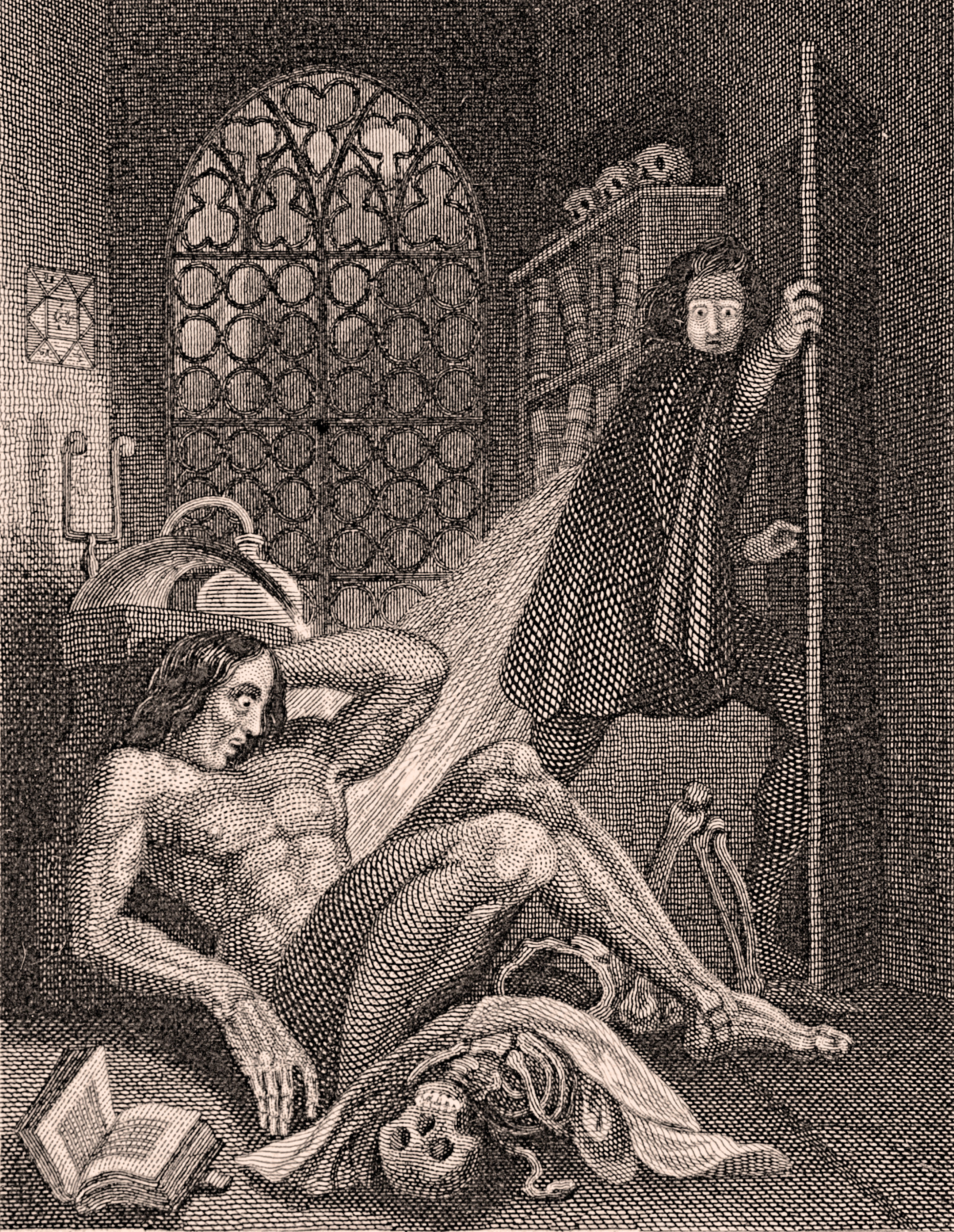
Frankenstein by Mary Shelley
I'm comfortable with thinking about science fiction as a type of fantastic story in which we are not forced to deal with the supernatural. If a story says that something happened because of a magic spell then I'll call that fantasy. However, I accept the idea that advanced science and technology can seem like magic.

Science fiction stories often include plot elements that seem magical and never get explained. For example, Asimov's "positronic brain" sounds cool and Asimov never tried to explain how it works or how it might make telepathy possible. Science fiction writers need not explain their faster-than-light spaceship engines, how their time travel machines work or details about any imagined technology. However, sometimes it is fun to constrain the scientific account of an imagined scientific advance or technology. For example, if Asimov says that a positronic brain contains platinum, then we start to feel that he has not tried to slip something magical past us, the damned thing is a physical device, we just do not know the technical details.

I was recently looking at Frankenstein. Shelley wrote, "I see by your eagerness, and the wonder and hope which your eyes express, my friend, that you expect to be informed of the secret with which I am acquainted; that cannot be". We were provided no details on how to create life, but Mary Shelley went out of her way to indicate that there was a scientific way to animate non-living matter. When writing science fiction, is it best to simply avoid all detailed explanations of speculative science and technology?

Charlie Jane Anders seemed to advocate such a "less is more" approach for science fiction in the context of "the force" in Star Wars (see: The Real Problem With Midichlorians). However, I like some constraints on science fiction plot devices. Go ahead, mention that there is platinum in positronic brains, stress the importance of dilithium crystals, mention the fact that Luke has many midichlorians and so can be expected to learn how to tap into "the force". Such imagined technological details make the story richer and remind us that we are playing around inside a science fiction "what if" game, not a fantasy scenario. This is a matter of taste: some people would rather not hear about platinum, dilithium and midichlorians. I can live with variation in individual taste with respect to detail in stories that include speculative science.

While collaborating to write The Search for Kalid, I wanted to write about people who were coming to understand how telepathy is possible. I wanted there to be a speculative science account for how telepathy works. By imposing some constraints it becomes possible to make a richer story. I suppose that I was influenced in my thinking about telepathy by the idea of "midichlorians". You could say that I took the seed idea, that of a small body component that is important for "mental powers", and I ran with it. How might a biological structure (I called mine "telastids") produce a form of communications signal that might be used for telepathy?


Diagram for the roll of telastids in telepathy.

This diagram (above) is meant to summarize key parts of a "science of telepathy". Readers who are not interested in technical details can read The Search for Kalid without worrying about the technical details. If you have a taste for constraints and a few details concerning speculative science then those details are available for your enjoyment.

You might feel that "midichlorians" were "not an explanation you can build on", but I don't feel that way and I think the "telastids" are a fun direction in which to build. Science has a way of revealing that the universe is built on all sorts of things that might at first strike us as crazy or impossible. Funny how science can be dismissed as "hand waving" by people who do not want to hear the truth (example), usually people who imagine that a supernatural "explanation" is best. Sorry, but a supernatural "explanation" is the true hand waving. The speculative science "midichlorian" is the kind of plot element should be in a science fiction story.

Similarly, for The Start of Eternity I started with Asimov's suggestion and invented a reason for using platinum in positronic circuits. My main motivation for including details concerning speculative science is that it helps me make richer imagined worlds where human actions are constrained in "logical" ways. Another motivation is that by including such details the characters in stories can be shown struggling to understand their world in the way that scientists and engineers do. I think it is great when science fiction stories include people who are making scientific discoveries and developing new technologies. In my mind, throwing in a few details makes for a more satisfying account of speculative science than Shelley's "I could tell you the details, but I won't" or Obi-Wan Kenobi's techno babble account: "The force is an energy field."

Charlie Jane Anders prefers the content-free (energy field) "explanation" of "the force" because it allows for the possibility that there is no science involved, it could be that "the force" is "mystical and soul-related". Well, okay, if that floats your boat, but, um, there's a reason why it is called science fiction. Anders claims that "midichlorians actually contradict" the original content-free explanation, but I do not see how. Midichlorians were an elaboration of the original idea, a way of linking "the force" to physical reality. Sure, that will offend you if you imagine that "the force" is non-physical magic, but that's your problem, a problem that you created for yourself. I'm willing to follow Lucas in the direction he took the story rather than complain about it. I'm in the market for more platinum, midichlorians and telastids. I'm happy to find such details in my science fiction, particularly when they make clear that I did not fall into some fantasy story where supernatural forces "explain" things.

Related reading: my blog post on science fiction as a literary genre.

Oct 6, 2009

Time Travel and Mental Powers, Part 2


This blog post is a continuation from Time Travel and Mental Powers.

Today I read the first chapter of Paul Levinson's novel "The Plot to Save Socrates". It reminded me of the first story I ever wrote that is set in the Exodemic Fictional Universe. That story is called "Exodemic" and a major element of the plot concerns a virus that is discovered on Earth...a virus that was used to protect Observers, humans not born on Earth who visit Earth in order to observe the development of human civilization on Earth. "Exodemic" is mostly concerned with events after 1759, but I included a prelude from 322 B.C.E. in which Aristotle is taken off of Earth by an Overseer.

It is fun to imagine that extraterrestrials might have first visited Earth hundreds of millions of years ago and that the entire history of our species has been monitored and recorded by "Observers". In the Exodemic Fictional Universe there is no need to imagine time travel that carries people with advanced technology back into what is for us the past history of Earth. If extraterrestrials long ago started the practice of taking lifeforms off of Earth, then we can imagine that some humans were long ago taken to live in a secret underground base on the Moon where they developed advanced technologies and accepted the task of observing, but not disrupting, the on-going development of Earthly civilization.

However, in what I hope is a tribute to Asimov, I am trying to create a sequel to his novel "The End of Eternity". As I have discussed before (Painting Corners), Asimov was unable to find a good conclusion for his Foundation stories. I hope that "The Start of Eternity", a kind of fan fiction, can provide a suitable conclusion by linking Asimov's Foundation stories into the Exodemic Fictional Universe. Will the "The Start of Eternity" mean the end of Time Travel?

After reading Paul Levinson's knol about "How Pierre-Simon Laplace’s Demon Finds a Stage in the Foundation and Dune Trilogies", I started thinking about secret groups of people with "Mental Powers" in the Foundation and Dune Trilogies and the Haldus Order of The Search for Kalid. To what extent might humans with "mental powers" secretly influence, shape or control the course of human events? If a "mutant" subpopulation of humans with "Mental Powers" existed, how would they use their powers and how would they interact with the bulk of humanity?

It might seem that I have raised two different issues here, Time Travel and Mental Powers. However, within Asimov's Foundation Universe, maybe these two issues are linked. What if it was human invention of the "positronic brain" that allowed for both "Mental Powers" and Time Travel? If so, then invention of positronic circuits becomes the critical event in the "Foundation Reality". "The Start of Eternity" explores this idea. The story is still under construction and collaborating authors are welcome.

Image. Public domain.

Time Travel and Mental Powers

By "mental powers" I mean abilities such as telepathic communication of thoughts, precognition and the "mantalic" abilities described by Isaac Asimov in some of his science fiction stories. Time travel is another popular plot element in science fiction. I am a fan of Asimov's Foundation Universe and the way he united it with his Robot Stories. I also like the idea that his time travel story The End of Eternity can be linked to the Foundation Universe by means of telepathic robots who used time travel to assure that the Foundation would come into existence. 

Time Travel and Mental Powers are popular science fiction plot elements that have long made me uncomfortable. Along with Faster-Than-Light space travel, I have no reason to suspect that Time Travel and Mental Powers are possible. I enjoy hard science fiction and I always feel most comfortable when stories stay away from plot elements that seem to contradict what we know about the universe. However, I've been trying to become more open to plot elements like Time Travel and Mental Powers. For example, I worked hard to get comfortable with telepathy in "The Search for Kalid". To do so, I had to invent an entire "science of telepathy" that I could imagine as speculative future science. 

I've long been puzzled by the way that Asimov seemed to pull the idea of telepathic robots "out of the blue". My first step towards finding a way to accept telepathy within the context of "hard science fiction" was the story Mnemtronium. The idea behind that story is that it might be possible to discover some "new physics" that would make telepathy possible. I'm pleased with the way the idea of "T particles" developed as a plot device for telepathy in "The Search for Kalid" and I look forward to further developing the idea in "The Start of Eternity", particularly in the context of robots with positronic brains.

When I started writing stories set in what I call the Exodemic Fictional Universe I did not allow myself the luxury of Faster-Than-Light space travel. However, I'm certainly dealing with FTL travel in The Start of Eternity and I was able to live with FTL communication in VirileMail. Of course, "The Start of Eternity" also deals with Time Travel (as imagined by Asimov), although my intention is to arrange things so that Time Travel becomes impossible by the end of "The Start of Eternity". I still have mixed feelings about FTL travel in science fiction. I think there are many interesting science fiction stories that could be written about a future without it, but most people just reflexively assume that outer space is boring unless you can travel quickly from world to world. I'm very troubled by time travel in science fiction. Asimov's "The End of Eternity" has some appeal because it puts a limit on the use of time travel. Without such a limit, time travel scenarios tend to degenerate into silly fantasies such as "time travel wars" where people endlessly revert each other's changes to time. 

I started thinking about Time Travel and Mental Powers today when I was playing around on Facebook. I began experimenting with Twitter earlier this year and I finally got around to starting a Facebook account. I found a Facebook group devoted to Asimov and a discussion post there from Paul Levinson. This knol contains the topic of that Facebook post (the Facebook post links to where you can listen to an audio version). I'll explain in my next blog post how Levinson's topic (How Pierre-Simon Laplace’s Demon Finds a Stage in the Foundation and Dune Trilogies) and his novel "The Plot to Save Socrates" got me thinking about Time Travel and Mental Powers...and exactly what I'm thinking along those lines. 

Image. I made this as a cover image for "The Search for Kalid". This image was made by using a few copyleft images: Details and Credits.

Aug 12, 2009

Overly Melodramatic


I use 'abysses of pain' as shorthand for overly melodramatic description of a character's emotional state. "His eyes were deep, dark wells of agony," and so on. A lot of bad fantasy does this and I used to be prone to it.

The above is a comment about my previous blog post. I've been trying to embrace melodrama while working on The Search for Kalid, a science fiction novel that has elements of Space Opera.

I agree that there are times when making a story overly melodramatic will only earn the label: FAIL. However, part of the magic of art is that it is possible to take an idea so far beyond the point of failure that it emerges from the "dark side" and becomes something wonderful. The are some formulas that "work" so well that they can tell us something fundamental about human nature. Artistic forms can go out of style, but there seems to be a large momentum associated with successful formulas. Art critics might lament the plebeian tastes of an audience, but that will not stop people from spending hard-earned money on the forms of art and entertainment that they truly like. There always seems to be an audience for melodramatic forms, even if going down that path might earn you an automatic failing grade from a publisher.

In the case of The Search for Kalid there is a scene in which the young Sybil is worrying and worrying (and worrying some more) about her future. All the worrying is just too much and the reader might wish that Sybil would just shut up. Hopefully the reader does not give up in disgust because while Sybil's worrying is close to pathological, it is in the story for a reason. Spoiler warning: plot details follow. Sybil has telepathic powers and is able to receive information from the future. She's getting "bad vibes" from the future, but she does not know that.

I think there is a theorem: when writing, anything can be done right or wrong...write with adequate awareness of a goal and a purpose and you can get away with anything. The corollary is that writing anything reflexively and for no good reason will earn you scorn.

Image: source.

Jul 30, 2009

Structure of a novel


My previous blog post was about complex plots. Since I made that post, I completed The Search for Kalid and blogged at the fiction wikia about the structure of that novel.

Wikia seems to be working out the bugs in their system for blog articles at wiki websites, so I have been doing most of my blogging there. Another recent blog post was about creating a book cover for The Search for Kalid.

Image. I made this image. The diagram shows that The Search for Kalid has four parts. The first seven chapters establish the Space Opera aspect of the story and the mystery of "Mental Powers". Chapters 9-12 take the reader off in an unexpected direction, our Solar System! Chapters 14 & 15 take place on Earth, but the reader might not recognize our poor and abused planet. After a quick trip to the mysterious Haldus star system, the story concludes back on the Moon. Chapters 8, 13 and 16 are pivotal chapters that twist the plot off in new directions. The following video was made to be watched by readers when they reach the end of the novel:

Jul 13, 2009

Is plot structure simple?


In this blog post by Victoria Mixon she says... "plot structure is simple".

By analogy, we could say, "song writing is simple". Such a devotion to simplicity might be appropriate for someone trying to make the next hit pop music tune, but does such a slogan apply to a complex piece of classical music?

Similarly, is there a temptation to "dumb down" novels so as to increase their potential for mass marketing? I think a novel should be a slice of life and life is often complex and messy so why can't a novel reflect the reality of life by being complex rather than simple? Maybe most readers will not be able to keep up and slog through a novel with a complex plot, but does that matter? Does the goal of making a profit and maximizing the number of paying customers dominate this world to the exclusion of letting a novel be complex when it is about a complex story?

"The middle of a book is common bogland". So, if an author does take on the challenge of making a novel with a complex plot, how do you keep the reader from getting confused and bogged down? I'm a great fan of maps, both physical and conceptual. A great advantage of constructing novels in wiki format is that hypertext links and media files can be provided for the reader. For example, The search for Kalid has maps and a glossary. How much of the aversion to complexity in novels is the result of printed books being an inferior medium for dealing with real world complexity?


Jack Vance talks about the value of complexity in life.


"A book filled with characters talking the way we really talk, with tags, goes on forever and bores even the writer to tears." Well, surely it depends on what they are talking about. I think Isaac Asimov showed that novels "filled with talking" can work. Of course, in this age of the tweet, fewer people probably have the required attention span to read a challenging novel. That does not mean that challenging novels should not be written.

Image. This is a diagram of functional modules in the human brain. Creative Commons Attribution License. See: "Uncovering Intrinsic Modular Organization of Spontaneous Brain Activity in Humans"

Jul 12, 2009

Escaping certain death


I've been having fun with the Space Opera elements of The search for Kalid. Ever since the escape of Odysseus from certain death at the hands of Polyphemus, unlikely escapes have been a grand tradition in adventure stories. I'm now in need of a "great escape" for The search for Kalid.

Before I was old enough to read about getting Polyphemus drunk and poking his eye out, I learned about unlikely escapes from death by watching television. Lost in Space was ahead of Star Trek by a year and ahead in Space Opera theatrics by a light-year. The waving arms of the Model B-9, Class M-3 General Utility Non-Theorizing Environmental Control Robot of the Jupiter 2 were a surer sign of immanent danger than the appearance of a new red-shirted crewman on the Enterprise.

A supernova explosion is over a billion times stronger than a nova. Similarly, there is a big difference between 1) showing a character's impossibly narrow escape from death and 2) making the reader think that a character died, only to later say, "fooled you, that character did not really die!" It is this category of super-deception that I'm dealing with. I've never enjoyed it when other story tellers pull this Dirty Trick on me, so I'm searching for an acceptable way to "bring back to life" an apparently dead character. Actually, it is a package deal...two characters have to be returned from the "not quite dead".

A major part of The search for Kalid is its mystery elements. As the story unfolds, the reader learns about the science of "T-particles", the basis of telepathy. I want the reader to start out by adopting the assumption that telepaths can be tracked down and killed because of their emission of "T-particles". But eventually it is revealed that some telepaths can control their production of "T-particles" and escape detection. I want to find a way to let the reader suspect that a particular telepath escapes detection and is not dead, even if Kalid himself can't figure it out. Would the reader, by feeling superior to Master Kalid, not feel so cheated by the Dirty Trick?

Image: Polyphemus takes one in the eye. GFDL.

Jul 8, 2009

Telepathy and Humor

Image source: Flickr Creative Commons
Attribution-Noncommercial-Share Alike
and Fair Use.
Isaac Asimov wrote a story called Jokester in which it is discovered that jokes only exist as part of human culture because of an experiment being run by aliens. In The search for Kalid, telepathic communication is portrayed as a recently evolved human ability. I've been thinking about the evolution of telepathic communication and the idea that aliens might play a decisive role in allowing humans to develop telepathic communication.

Baby talk, or "parentese" is is a special style of speech used by adults when talking to children who are learning human language. The idea is that it is helpful for language learners to hear a simplified and exaggerated version of language while they are trying to learn it. Similarly, is there a "trick" that could be used to help people develop their innate telepathic abilities?

The search for Kalid
The plot device for telepathy in The search for Kalid is that telepathic communication involves exchange of "T-particles". But even if a human brain could "encode" a thought in the form of "T-particles" and even if another brain could produce neuronal signals in response to received "T-particles" carrying encoded thoughts, how could the receiving brain ever decode such a signal? If you were bombarded with a pattern of flashing lights that represented a thought, how would you know that it represented a thought, and a particular thought?

Can a SciFi Story Poke Fun at SciFi?
Jokes can be "hard to get" unless you share the cultural background of the person telling the joke. Example: "There are 10 types of people...those who know binary and those who don't." If you know binary and realize that "10" in binary is equal to "2" in decimal, then you can "get" this nerdy joke. (For a related chuckle, see the binary joke from Reboot.) Would the telling of jokes provide an efficient way to develop someone's telepathic skills? Knock knock.

"Knock-knock. (Who’s there?) It is not the owner of Yu-Gi-Oh."

In The Bicentennial Man, comedian Robin Williams had a funny scene in which he played the part of a robot trying to tell jokes. He told them "robotically". Could a robot with no experience or understanding of human experience tell jokes in an intentionally funny way and truly "get" them?


Language of Thought
I was thinking today about a way for Set and Amethyst to interact in The search for Kalid so as to awaken her telepathic ability. Why not have Set tell a joke?

This fits with an idea in The search for Kalid, the idea that telepathy evolved as a way for humans to judge each other. People such as the anthropologist Terrence Deacon (See his book The Symbolic Species) have discussed the idea that human language might have evolved as a way for humans to judge if potential mates have worthy brains. Why not the same for telepathy? How many people look for a mate with a good sense of humor?
 __________
August 2014
Note:  I modified the original text of this blog post so as to put Robin Williams in the past tense.

More book and magazine covers.