Showing posts with label social science fiction. Show all posts

Jun 9, 2022

Masters of the Machines

mountain top thought transmitter
interior art by Frank R. Paul
 In my previous blog post, I discussed several science fiction stories published by Mary Wright between 1929 and 1935 and tried to imagine how they might have influenced Isaac Asimov's writing. Wright's story "The Brain of the Planet" was published in 1929 and it begins with the dramatic scientific discovery (in the year 1935) that humans have telepathic abilities.

Masters of the Machines. After the discovery of telepathy, Harry Maxwell, a professor of psychology and an inventor, soon constructs a thought transmitter (see the image to the right) and deploys it against the Evil™ Masters of the Machines who "control the means of production and distribution". In analogy to a radio transmitter that broadcasts radio frequency light waves, Maxwell's thought transmitter broadcasts "thought vibrations" and it functions as a "central brain" for all the people of planet Earth, liberating them from the Evil™ "tentacles of materialism". 

Figure 0. Text from page 15 of "The Brain of the Planet".

 Technology-Assisted Telepathy. When the thought transmitter is first activated, thousands of the most extreme radicals and conservatives around the world quickly die because their minds are not compatible with the new regime of thought being imposed by Maxwell. Then Maxwell begins to gradually increase the intensity of his well-intentioned thoughts that are being mechanically broadcast to the people of the world (see Figure 0, above). 

the power of positive thinking
 Just Think! Sadly, readers of "The Brain of the Planet" were given little information about the mechanism of Maxwell's thought transmitter. Mary Wright simply wanted readers to accept that capitalism, superstition and nationalism would soon collapse... shazam! In 1906, William Walker Atkinson published Thought Vibration or the Law of Attraction in the Thought World. Atkinson proposed that thought is analogous to radio transmissions and that people can accomplish great things just by having positive thoughts and desires.

I suspect that Mary Wright was inspired by the "new thought" movement to imagine a mechanical "thought transmitter" that could put on display Atkinson's "new thought" beliefs inside a science fiction story.

Figure 1. text from page 19 of "The Brain of the Planet"

By 1970, under a world government, a Golden Age is achieved and Maxwell destroys the thought transmitter; it is no longer needed.
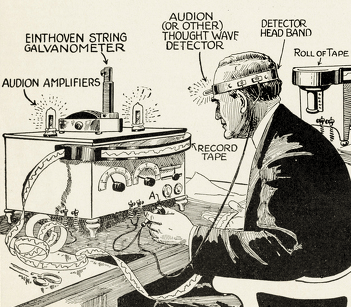
Gernsback thought detector
 Under the influence of Maxwell's "central brain", human civilization has been transformed, including a universal enjoyment of much leisure time and perfect health. Readers are also told that "relations between the sexes became perfect" (see Figure 1, above). "The Brain of the Planet" suggests that before telepathy was scientifically demonstrated to exist, it was already used by some people (positives) to control the behavior of others (negatives). Strangely, once the new Golden Age of Humanity is achieved, there is no more mention of telepathy in the story.

into the future

It is interesting to ponder the origins of Mary Wright's interest in telepathy and also Hugo Gernsback's willingness to publish "The Brain of the Planet". In Gernsback's novel Ralph 124C41+ (A Romance of the Year 2660), he included the idea of a "menograph", a device that could convert thoughts into a printed form of communication that could then be read by others. The device required electrodes placed on the temples to pick up a person's thoughts. Published in book form in 1924 and republished in Amazing Stories Quarterly, in 1929, it seems possible that Mary Wright was aware of Gernsback's novel about future times. 

E. E. "Doc" Smith published his novel Skylark Three in 1930 and his story also featured technology-assisted communication between brains. 

cover art by John Solie

Here is how Smith described the power of a futuristic education device that could transfer thoughts between the alien Orlon and the human crew of Skylark Three: "from his mind into theirs there flowed smoothly a mighty stream of comprehension". This was some form of technology-assisted telepathy which required the use of special headsets worn by the learners.

I conclude that by the late 1920s, science fiction fans and story tellers were probably quite comfortable with the idea of technology-assisted telepathy. Mary Wright also seemed to take seriously the idea that humans might have a form of telepathic communication that can function without the aid of any mechanical amplifying device.

image source
For some of his science fiction stories, Issac Asimov adopted the idea that some humans had a form of telepathic ability by which they could influence the behavior of others. Asimov published several stories (example) in which some people had the inherited ability to make others like them. In the last science fiction novel written by Asimov (Forward the Foundation) Wanda inherited her telepathic ability from her father and it was possible for her, and others like her, to form the Second Foundation and a new human society composed of skilled telepaths.

Why were so many science fiction story tellers so eager to invent stories about telepathy? The history of psychology as a science of the mind includes people such as William James who treated the possible existence of human telepaths as a worthy topic for scientific investigation. Among some psychologists, telepathy seemed more likely than the idea that people could obtain information from past lives by reincarnation or communication with the dead.

When I was about 12 years old, I broke my foot and my sister, who was about 150 miles away, felt that something bad had happened to me. Similarly, in 1893, Hans Berger fell off a horse and his sister had a bad feeling about her brother. 

Figure 2. image source
That experience provoked Berger to wonder if there had been telepathic communication between himself and his sister. Berger went on to become a psychiatrist and did research on electroencephalography and is now credited with having made the first successful recordings of electrical signals from a human brain. For some of his science fiction stories, Isaac Asimov suggested that it might be possible to achieve telepathy by means of having a brain that could pick up electrical signals coming from another person's brain.

Asimov did not stop at telepathic "mind reading" by humans; he also wrote stories about telepathic robots (see Daneel). Asimov also suggested that powerful telepaths could use their mental powers to "reach" into another persons brain and exert "mind control" (see the Mule).

I've previously mentioned "The Tissue Culture King" by Julian Huxley (1927). Some people have traced the idea of a "tin foil hat" (to protect against telepathic thought control, see Figure 2, above) back to Huxley's story. Sadly, most scientists can't imagine how the jumble of weak electrical signals emitted by a brain could allow for "mind reading".

What was the general academic environment in the late 1800s when the physician-scientist Berger seriously considered the possibility of telepathic communication between people? In 1884, William James became one of the founding members of the American Society for Psychical Research. It was not unusual for scientists to be interested in the possibility of some as-yet-undiscovered way to send telepathic signals between people. Even in the 1900s, Joseph Rhine became famous for his claims about telepathy. Sadly, we got the book Extrasensory Perception in 1934, not the proof of telepathy that Mary Write envisioned for 1935.

 Related Reading: "The Machine Stops"

Also: eloptic energy

Next: a telekinetic experiment

visit the Gallery of Book and Magazine Covers

Nov 14, 2019

The Organization

source
Back in 2015, I mentioned an old Jack Vance story called "Dodkin's Job", first published in the October 1959 issue of Astounding Science Fiction. You can get the story in ebook format (along with "Rumfuddle" and "Moon Moth") at this website. This month, I've been looking back at some old stories by Vance and Isaac Asimov (see), so in this blog post I'll discuss "Dodkin's Job" from the perspective of 60 years after Vance got the story published.

I have no idea what motivated Vance to write "Dodkin's Job". I wonder if it was related to his experience writing scripts for "Captain Video". Apparently Vance could not conform to the requirements that Captain Video stories be properly sanitized for a children's show on television in the 1950s. Alternatively, I can also imagine that Vance may have been reacting to an idea previously published by Asimov.

Searching for the source
of power in The Organization.
Interior art for "Dodkin's Job".
Anyone who published as many stories as did Asimov and Vance almost certainly needed to have a good sense of humor. It is easy to picture both Vance and Asimov chortling over something that they wrote.

In "Dodkin's Job", Vance leads readers on a silly search for the source of a stupid bureaucratic policy. Vance's setting is some sort of dystopic world in which every worker must conform to the Rules of Organization. In that world, Nonconformity (such as questioning the stupid orders that arrive from policy makers) is a great sin and likely to get you demoted.

Is it science fiction?
The Languages of Vance
I have to wonder to what extent Jack Vance was influenced by Orwell's book 1984. Orwell's invented language, Newspeak, was a fairly one-dimensional tool for spreading propaganda. In his 1957 story The Languages of Pao, Vance imagined the creation of several new languages that would lead to dramatic alterations to the social structure of the world Pao. Maybe "Dodkin's Job" was written at about the same time as The Languages of Pao, when Vance was in an Orwellian phase.

When I was in high school and I had to read 1984, I was told that it was a science fiction story. There is a category of "social science fiction", however, at the time, I was reading what I thought to be "real" science fiction with spaceships and aliens beings from distant planets.

cover by Alan Harmon
In 2011, NPR asked people to suggest good fantasy and science fiction novels. There must have been millions of other school kids who were also told that 1984 is science fiction because it ended up on that list (at position #6!).

Later, SF Signal made a flow chart which attempted to divide those 100 novels into 1) fantasy, 2) science fiction and 3) other types of books. I agree with the way that SF Signal categorized 1984 and their opinion that 1984 is not really a science fiction story simply because it was set in Orwell's future.
1984 at the lower right; not categorized as science fiction. (source)


Computers
interior art by Bernklau
So, is "Dodkin's Job" science fiction? I suspect that Vance only cared about the genre status of "Dodkin's Job" because he wanted to get the story published. He got it published in Astounding, which needs some kind of explanation. In the October 1959 issue of Astounding, editor John Campbell had an essay about semiconductors, transistors and computers. He also announced plans to have more actual science and technology content in the magazine and requested that people working in various technical fields submit articles, sharing the most exciting advances in their areas of expertise. I've previously suggested that in the 1940s, you could try to get your story published in Astounding by included an equation and a character with telepathic powers. In 1959, at the dawn of the space age, what was Campbell looking for?

Network analyst (line-tender) in "Dodkin's Job".
In "Dodkin's Job", at the bowls of The Organization, there are cubicles with workers seated at "projection desks", analyzing streams of textual data. Before the dawn of the information age and the arrival of millions of office workers seated before their computer screens, Vance depicted The Organization as depending on an army of such workers who each have ready access to the Information Bank, an archive of all the information of interest to The Organization.

21st century servers
Input/Output for the Information Bank.
Vance imagined that one of the positions in The Organization was a "line tender". In "Dodkin's Job", it is almost as if Vance was imagining and describing the future Information Age with workers who would access and process business information using networked computers.

In 1950, Asimov published a story called "The Evitable Conflict" in Astounding. Asimov imagined a future world with a few gigantic centralized computers (he called them "the Machines") that came to control the entire economy of Earth. Asimov raised the question, "what would happen if false data were fed into the Machine"? For his story, Asimov argued that bad data would be quickly detected and rejected. However, in "Dodkin's Job", Vance imagined that a low-level employee of The Organization could enter false data into the Information Bank and cause all sorts of mischief. Vance's character "Dodkin" may have been the first computer "hacker" ever depicted in a science fiction story.

source
In our world of actual computer systems, we know that Vance was closer to the truth than was Asimov. After having published "The Evitable Conflict" in 1950, Campbell later published "Dodkin's Job", perhaps realizing that Asimov's scenario of futuristic computing was a bit too rosy.

Related November Retroreading: 1949 "The Sub-Standard Sardines" by Vance, 1949 "Mother Earth" by Asimov, 1969 "Feminine Intuition" by Asimov, 1969 Emphyrio by Vance.

Next: dinosaurs in science fiction


visit the Gallery of Book and Magazine Covers

Oct 15, 2016

1953

1941: Reason
Original cover art: Stephen Youll
Back in August, I got into my time machine and went back 75 years, traveling in my imagination to the year 1941, the year when Isaac Asimov's positronic robot QT-1 appeared in Astounding magazine.

I like to imagine that QT-1, Michael Donovan and Gregory Powell might have existed in a previous Reality, what I call the Foundation Reality. In that Reality, both space travel technology and artificial intelligence research zoomed ahead at a faster pace than in our universe.
Origins of the Science Fiction genre.
here
When I was a boy growing up during the Space Race, I was surprised to discover a book called Modern Space Science. As shown in the graph, above, the term "space science" was very new in 1961. I was intrigued by the idea that there might have been an earlier era of space science before the "modern" era of NASA and rocket ships going to the Moon.

The graph, above, also shows the time period in the 20th century when the term "science fiction" came into common use. In 1953, a book called Modern Science Fiction was published and it included an article by Asimov.

Asimov wrote about "Social Science Fiction", which he contrasted with earlier types of science fiction that might be called "gadget stories" or technology-oriented "adventure stories". There is nothing wrong about including cool gadgets and rousing adventure in science fiction stories, but Asimov was among a group of scientifically-literate authors who could think deeply and creatively about the impact of science on society. By including in their stories reasoned speculation about how science could impact human societies, authors such as Asimov, Robert Heinlein and Arthur C. Clarke could take the science fiction genre to a new level of sophistication.
The origins of a science of space travel and space travel in science fiction.
Rockets? Who needs rockets?
1930 cover art by Hans Wessolowski
Long before the arrival of science fiction as a new and distinctive literary genre, some story tellers imagined travel through outer space (example). Those early stories included no suggestion of how such space travel might be possible. When The War of the Worlds was written by H. G. Wells in the late 19th century, the invading Martians magically traveled from Mars to Earth. In the early 20th century it finally became possible for scientists to imagine how rockets could be used to move spacecraft through space.

In 1920, Robert Goddard's early suggestion that rockets could function in space was ridiculed in a New York Times editorial. 49 years later, The New York Times finally published an apology for their ignorant dismissal of rocket-powered space travel, doing so just a few days before the first man walked on the Moon.

An early science fiction rocket ship
cover by Nick
Even after Goddard explained to the world that chemically fueled rockets could power space flight, many early science fiction stories continued to use imaginary propulsion technologies for space travel. One of the most famous of these fictional spaceship propulsion technologies was imagined by E. E. "Doc" Smith and published in the 1920s.

In 1924, Robert Goddard published an account in Popular Science of how chemical rockets could work in outer space. Soon there were science fiction stories that made use of the idea of a "rocket ship" that could travel to distant planets. Rocketry was taken more seriously in Germany than in the United States. In 1929, Woman in the Moon was an early film depiction of travel in space using rocket propulsion.

Rocket ships and ray guns.
Early Asimov; cover by Robert Sherry
Although there was censorship of rocket stories in Germany leading up to World War II, Clarke's "We Can Rocket to the Moon – Now!" (in 1939) was an essay that made clear the practical application of rockets for space travel (read Clarke's May 1939 article on page 24 of Urania: "The First Space Ship").

The young Isaac Asimov grew up right when the first science fiction magazines were available for him to read in his family's candy store. He started publishing his own stories when John Campbell had taken editorial control at Astounding. Asimov had become impatient with some of the tired old science fiction story plots of the pulp magazine era. For example, he disliked all of the clanking murderous robots that had been included in science fiction stories and he knew that it was silly to imagine the existence of human-like residents on nearby planets such as Mars and Venus. Asimov, as a writer of science fiction, was ready to be pushed in new literary directions by Campbell.

Science Fiction in 1953
a more mature Asimov
The year 1953 was an interesting milestone year for both science and science fiction. In 1953, Watson and Crick published the double helix model of DNA. Classical biology was transitioning into the era of molecular biology in which the nanoscale components of living cells could be studied and provide a mechanistic understanding of life.

in the Ekcolir Reality
original cover art by Henry Van Dongen
and Edmund Emshwiller
In the 1950s, the original science fiction era of pulp magazine publishing was transitioning into a new era of science fiction book publication. Looking back from the perspective of 1953 on the new type of science fiction stories that he had published in Astounding magazine during the 1940s, Asimov could take some pride in his contribution to the development of social science fiction as a literary form that appealed to readers who had interests in science and technology.

1953
In 1953, Asimov published a short story called "The Micropsychiatric Applications of Thiotimoline". In our Reality, this thiotimoline story was an opportunity for Asimov to have some fun. I like to imagine that in the Ekcolir Reality, when time travel still existed, it may have been possible for the Writers Block to medically intervene and extend the life of the Asimov analogue in that Reality... perhaps just long enough for Asimov to be present at the arrival of the Fru'wu on Earth.

Nanopore
1 Asimov - "Social Science Fiction"
2 Heinlein - "Speculative Fiction"
3 Clarke - Childhood's End

1953 in the Asimov Reality

Next: a new investigation of the Asimov Reality
visit the Gallery of Book and Magazine Covers