Showing posts with label alien biology. Show all posts

Jul 15, 2026

Magic Microbes

Figure 1. SIHȺM: SIH Microbes.
Search for Interesting Hollywood Microbes.
Unless I have forgotten something, the first magic 'microbe' I ever saw was the single-celled space organism in "The Immunity Syndrome". Of course, the alien space cell in Star Trek was hugely pregnant and big enough for Spock to spend an entire afternoon filled with scientific investigations inside of it. In the end, and in the spirit of scientific discovery, Spock deploys his calm and cool intellect to reach the logical conclusion that this amazing alien life-form must be disintegrated with an antimatter bomb. 💣 💥

 Impossible Fiction. Back in March,  I began my 2026 Search for Interesting Hollywood Aliens by mentioning the film "Project Hail Mary" which was being advertised as depicting an "impossible scientific mystery". My first question is: does this movie provides us with a couple of hours of entertainment featuring an interesting alien? Bonus: is there an interesting microbe?

 Sun Fiction. Back in 2022 I commented on the 1942 story "Proof" by Hal Clement. That story featured life-forms with a "matrix of electrons" that could convert stellar radiation into neutrons. Not only does the "skin" of these Sun creatures (the hero of the story is named "Kron") surround a core of neutronium (held in the creature's "nucleus"), but the "skin" can convert energy from the environment into new "particles of neutronium" that are then guided by magnetic fields towards the body core. I'm a huge skeptic when it comes to imaginary life-forms that live in or on a star, particularly if they are biological life-forms composed of cells.

 Alien Invasion. In "Project Hail Mary", we are apparently being asked to believe that some alien cells are able to fly through outer space and gather around stars and store lots of energy as neutrinos. Maybe all of this fantasy biology is explained in the book, but in the film, people just talk fast when "explaining" this alien biology and hope that we will be distracted by the one other alien life-form that is in the movie: Rocky, an Eridian.  

 Alternate Technologies. We are told that the technologically-advanced Eridians are "unaware of relativity". A memorable example of this kind of "technology blind spot" is in Clifford D. Simak's story "The Big Front Yard" where there are aliens who never thought to invent paint. I find it hard to believe that any alien with technology advanced enough to be traveling around the galaxy would either never have invented paint or never noticed relativity.

 Thanks for the memories. I don't mind when futuristic technologies come bundled with with constraints and costs. In "Project Hail Mary", we are told that an incredibly great source of energy is available (the conveniently wrapped neutrinos in the space microbes), but we can't store ten years worth of food in our interstellar spaceship. Would sleeping for three years cause selective and temporary loss of some memories? I don't know, but I do know that this overly long movie could have been improved by not including this issue in the film.

 Rocky and hoodwinkle show. The Eridians might have skipped class on the day when relativity was discussed, but they do have some cool technology. I can't stop myself from imagining that they might have advanced nanotechnology and access to hierions. Imagine a type of hierion that could be made into a composite with xenon, forming a metallic substance that is both easy to form into useful shapes, yet is also very strong.

The Rocky character in "Project Hail Mary" is amusing for about 30 minutes. Not sure I'd want to spend the rest of my life teaching young Eridians. Shouldn't someone be out trying to prevent more habitable planets from having their solar energy supply blocked? Maybe that is for the sequel.

 Disclosure Day. Apparently there actually is an alien on screen at the end of "Disclosure Day", but the movie seems to actually be about some absurd corporate/government conspiracy like in The X-Files. While searching for "Disclosure Day." I saw a marketing trick for the film, a red cardinal flying across the search results page. Good to see Google has endless ways of making $$$ from corporations even while providing search engine results for a movie that claims to be about aliens helping to take down a SuperSecret™ conspiracy by some mysterious corporate entity.

Figure 2. Image source.

 Microbe Search. I decided to search for old science fiction stories about weird microbes. Before taking a deep dive into the ISFDB, I'll mention two of the earliest science fiction stories featuring microbes that I read or saw on television: "Surface Tension" and "Fantastic Voyage". In James Blish's "Surface Tension", Blish had the audacious idea of a character who was an intelligent paramecium which deeply offended my 12-year-old self's view of the universe. "Fantastic Voyage" was only memorable for a scene in which Raquel Welch gets encased in white blood cells which then have to be pealed off of her curvaceous body by three groping men. Related Reading: see the stories by Arthur Porges, see also "Un homme chez les microbes" by Maurice Renard which features a man who is shrunk. 

 The first candidate microbe story I came across at the ISFDB was "A Major Microbe" by W. L. Alden, but that story is not science fiction and is not actually about a microbe. The same can be said for "The Princess and the Microbe" by Margaret Sherwood.

 Weird title. I discovered that the French translation of "Needle" was titled "Le microbe détective". My best guess is that misleading title was used because there was an existing sub-genre of crime fiction about using microbes as murder weapons. 

At "First fictional lab-created plague" it says that "Professor Bakermann's Microbe" (published in 1890) is set in 1935, where the microbes causing all known diseases have been studied. The wacky Professor Bakermann cooks up a new disease microbe that can't be stopped; it is resistant to all known drugs and treatments. I've never read the story, but Google's AI Mode agent likens it to Mary Shelley's Frankenstein. The story was first published as a serial in La Science Illustrée (see Figure 2).

image source

I've skimmed through "The Master of the Microbe" (1926) which seems incredibly long and muddled, something like a James Bond movie with an evil character threatening the world. In the story there is a "crimson carnet", the "silver cylindar", assorted uncles, detectives and doctors along with several women to chase around after while a man-made plague spreads. The microbiology in "The Master of the Microbe" seems diseased and confused, although Google's AI Mode agent assured me that Robert Service had written into the story the idea that a pathogenic bacterium could be countered by a bacteriophage. However, the word "virus" appears only once in the story, in a sentence that makes no sense and we are told that Professor Hermann Krug (the discoverer of the plague bacterium) is a "well-known savant of Swiss origin, and considered in University circles to be a supreme authority on Micrology." It seems clear that Service knew nothing about microbes or microbiology. I could not sort out what is going on in the story with the dude named "Sinistra" who was apparently an "alias of Maximus Quin", not to be confused with "Cyrus Quin". However, I am still confused, but not interested enough to actually read the story.

image source
 Murder by Microbe. In "The Microbe of Death" by Rudolph De Cordova, a doctor kills a fellow doctor using anthrax (1897). "Some men see things as they are and say why. I dream things that never were and say why not" -George Bernard Shaw. In the case of De Cordova: "Some men go to medical school and save lives, I learned in medical school how to take lives." In the same spirit was "The Microbe Murders" by Frederik G. Eberhard (1935), featuring a killer who commits murders using deadly germs and microbes.

 A Strange Case. Not much is known about John Geo. E. Leech, author of "The Microbe of Love" published in Pearson's Magazine, October 1902. This is a joke story in which a "bacillus" is found that causes people to experience the pangs of "love sickness". The discoverer hopes to make big $$$ by selling an antidote, but he falls in love before he can devise the antidote. Related Reading: "Mate in Two Moves", published in the May 1954 issue of Galaxy Science Fiction. 

full sized image here
 In "The Secret of the Extinct Microbe" by Clement Fezandié (1924, part of the Dr. Hackensaw's Secrets series) the bumbling Dr. Hackensaw unleashes a virulent microbe from an ancient Egyptian archeological site. Readers are told that the only way to defeat the virulent "extinct microbe" is to find another ancient microbe that is able to destroy the first one.

 I skimmed "The Bacillus of Beauty" by Harriet Stark (1900). It is impossible for me to say that "The Bacillus of Beauty" is about a microbe. Readers are told that a woman's appearance is transformed by a bacillus, but there is no reason to believe it. The story seems like a fantasy where a magic spell does the transformation. 

 "The Bacillus of Conscience" (1905) by Wilbur Dick Nesbit (Wikipedia) is pretty funny. It inspired a song titled "B. Conscience". In  "The Bacillus of Conscience", Nesbit followed a standard Sci Fi formula with a scientist, his daughter (Constance) and a man who is love with the daughter. Song lyrics:

[Verse 1]
I must offer some comments
on the bacillus of conscience 
but refer to it as B. conscience
“B is for Busy,” giggled Constance
Busy B stands before our conscience
shall I confess to giant nonsense? 
Small it is, in the strong sense

"B. Conscience"
[Chorus]
It’s a tiny little bug with a heavy load
Screaming down a dusty, lonesome road
If you got a secret, it’s gonna find a way
To make you spit it out by the end of the day
(B. Conscience, honey)
(It’s a heavy price you pay)

[Verse 2]
In the bacterial inventory
was it new or a priori?
Obtained from a criminal gory
it made just a little history
For Professor Bindham's glory
and to be a science fiction story
B. conscience left the laboratory

[Bridge]
Is a man still a man if the truth is forced
Like a dry creek bed or a dying horse?
It ain't a choice when it’s under your skin
Just a fever burning out the original sin
(Burning it out)
(Let the truth walk in)

[Verse 3]
A microbe from 1905, I confess it
discovered by Wilbur D. Nesbit
It began with a crime committed  
Bacillus conscience with no respite
made the criminal confessed to it
We need it in 2026 just a bit
to use it on our president

[Final Chorus]
Oh, it’s a tiny little bug with a heavy load
It don't care about the laws or the code
If you got a secret, it’s gonna find a way
To make you scream it out by the end of the day
(B. Conscience, honey)
(It’s the only way)

[Outro]
Just a little drop for the man at the top
Once the valve is open it’s never gonna stop
(B. Conscience)
(Sinking in)
Yeah, it’s catching
Watch your mouth now
(B. Conscience)
It’s catching
(Catching) 

Figure 3. Interior art by Leo Morey
 Most Tedious. As fun as "The Bacillus of Conscience" (see above) is,  "The Bacillus of Death" by Arthur B. Reeve (1912) is contrived, tedious and pointlessly formulaic. In the competition for "most tedious" was "The Beautiful Bacillus" by Patrick Dutton (1931). This meandering story is science fantasy, very light on the science. First we are witness to a bacterium that grows quite large (see Figure 3) and becomes conscious then one of the two microbiologists responsible for this "advancement" shrinks and becomes a microbe that infects his buddy.

 Wells, Wells. In "The Stolen Bacillus" (1894) by H. G. Wells, an anarchist threatens the London water supply with cholera stolen from the laboratory of a bacteriologist. Disaster is averted when we learn that the stolen bacterial strain is not cholera, but rather a microbe that turns the skin blue... and only the anarchist is infected.

Figure 4. Interior art by George T. Tobin.
In 1895, the antics of anarchists was taken up in "The Purple Death" by W. L. Alden. After having published "A Major Microbe"  (see above on this page) someone must have explained to Alden what a microbe is (or maybe he read "The Stolen Bacillus"). In "The Purple Death", readers are told that the "purple death" is a a disease caused by a microbe found in snake venom. A nutty microbiologist hopes to use the "purple death" to cure poverty... by killing the poor.

 In "Dr. Cox's Discovery" by Herbert D. Ward (1903), the second paragraph includes this sentence: "What will not the bacillus be responsible for next?" Dr. Cox wants to isolate a "microbiote" that can cause death from old age. Here is another line from the story: "Nothing pleases an Englishman more than a spice of adventure in which the superstitions of an inferior race are trampled upon." 

Figure 5. Imaginary cover
art by Flow. (original cover)

Eventually, Dr. Cox finds something that that acts like a fountain of youth. In this fantasy story, Ward could not be bothered to provide a coherent explanation, just the hint that it involved test tubes. Then there is a contrived "explanation" for why Dr. Cox throws away the "fountain of youth". The End. As hinted at in Figure 4, much of the story revolves around a weird love triangle. The only two test creatures for the "fountain of youth" are a dog and the mother (the brunette in Figure 4) of Dr. Cox's girl friend (the blond in Figure 4). After dear mom dies, Dr. Cox apparently gets to live happily ever after with the daughter.

 Another "fountain of youth" story was "The Blue Germ" (1918) which is available via Google Books. I tried to read "The Blue Germ" but I soon began skimming and then at page 38 is: "The bacillus was ultra-microscopical. It could not be seen even with the highest power, under the microscope". Other people have interpreted this as indicating that the "fountain of youth" was a virus, but the term 'virus' does not appear in the story. I suspect there is nothing resembling science fiction in this novel.

 "Max Hensig: Bacteriologist and Murderer" (1907) by Algernon Blackwood is long, tedious and contrived. The story seemingly includes an attempt to depict a man getting so drunk that all the alcohol in his body will serve as protection against bacterial infection. The imaginary cover art for "Max Hensig: Bacteriologist and Murderer" (see Figure 5) was made using this text prompt: "A full color movie still showing two men in a prison cell, the accused criminal is a light-haired stripling with blue eyes and drooping mustache, that rare type of deliberate murderer, cold-blooded and calculating, who kills for a song, delights in killing, and gives its whole intellect to the consideration of each detail, glorying in evading detection and reveling in the notoriety of the trial, if caught. At first he had answered reluctantly, but then the young murderer warmed up and became enthusiastic with a sort of cold intellectual enthusiasm, till at last he held forth like a lecturer, pacing his cell, gesticulating, explaining with admirable exposition how easy murder could be to a man who knew his business. And he did know his business! The reporter watched in dismay and horror."

 Heart of Gold. "The Golden Rat" by Alexander Harvey (1913) is one of the most unique stories that I have found while investigating old stories that involve microbes. It is a fantasy story with only very minor science fictional microbiology elements. The narrator (a psychoanalyst) imagines that he was infected by golden bacterium from a golden pet rat (named 'Philander') that turns his blood into gold. "The Golden Rat" is also a strange "love story", in that the golden rat eventually leads the narrator to realize that one of his patients, Miss Lancaster, is in love with him.

 "Strangers on Paper" is an episode of "Murdoch Mysteries" that was first shown about six months ago (January 2026), but I only just watched it. In one of the silliest "mad scientist" stories ever, the plot of "Strangers on Paper" includes an angry scientist who tries to put Staphylococcus aureus into the water supply in revenge for loss of funding for research on Staphylococcus aureus. Related Reading: Amerithrax.

Figure 6. Interior artwork by Leo Morey

 Great Northern Protist. "Nœkken of Norway" by Bob Olsen (1934) provides an account of a close encounter with a giant amoeba that lives in a lake in Norway. Readers are told that if an endocrine problem in the pituitary gland can make for a giant human then why not an amoeba that just keeps growing? As shown in Figure 6, the giant amoeba is usually found in water, but when it gets hungry it will go onto shore and grab yummy people for a snack. It turns out that mistletoe is the giant amoeba's kryptonite. By the way, Wikipedia's article on kryptonite has more references than the article about mistletoe.

 Figure 7. Interior artwork by Malcolm Smith
 "Amoeba 'Roid" by Henry Bott (1948) takes us into the age of radar and rocketry when life has already been found on Venus. So why not also on an asteroid that is two miles long? That's John and Grace (see Figure 7) having a close encounter with an asteroid amoeba. As the story "Amoeba 'Roid"  is told, this amazing life-form does nothing more exciting than extend a tentacle out from its pit that curls around the curvaceous Grace, but John insists on incinerating the creature with burning rocket fuel.

image source
 Leaping ahead to the 22nd century, "Amoeba-Hunt" by Morton Klass sends us hunting for a giant amoeba on Procyon IV. Humanity has evolved since the old days of "Amoeba 'Roid" and the alien amoeba must be captured alive. Why? I have no idea. I suppose because it is there.

 The first mention of microbes in this blog was in 2012 when I was speculating about the everyday microbial horrors that might have motivated some of the horror elements in Frankenstein. I wrote, "Our species is in the middle of figuring out the world we live in. In the past, millions were mysteriously struck down by infectious diseases and it was all too easy to adopt an attitude of desperation and helplessness when we had no tools for observing microbes. Now the science of microbiology routinely makes it possible for us to understand, treat and prevent microbial diseases." Even a story as goofy as "Amoeba 'Roid" can be viewed as a human reaction to the never ending conflict between humans and microbes.

Foundations of Eternity
 In 2013 I wrote, "Imagine that the Huaoshy have a monitoring system that is analogous to the way that humans might monitor microbes for pathogenicity and potential to harm people." It is fun to compare the relationship between the technologically-advanced Huaoshy and we humans to the relationship that we humans have with microbes.

 My story Foundations of Eternity included the idea that Neanderthals were driven to extinction because they were susceptible to microbial diseases that were spread by modern humans. When Manny the bumpha takes an interest in the unusual behavior of the Neanderthals, she Intervenes by secretly providing Neanderthals with key resistance genes.

Back in 2015, I introduced the idea that in a past Reality, Earth might have been intentionally pushed towards having high green house gas levels. Such a Reality could be used as a laboratory for "developing microbes that could efficiently metabolize methane and trap atmospheric carbon dioxide in marine sediments". The climate change mitigation methods developed by humans in such a Reality might then be re-used in another Reality to prevent global warming. In "The Hierozyme Intervention", I explore this strategy. How can a microbial solution to global warming be brought into a Reality without alerting the pek Overseer of Earth to such an alien Intervention? I'm currently writing Chapter 10 of "The Hierozyme Intervention" in which Marda is trying to gain access to Eddy's Reality Viewer. Anthony has been moved out of Casanay and his replacement, Ada B. Catalana, has just been hired. Systolina suspects that Ada is a secret agent for Manny the bumpha, but how can Ada be used to give Marda access to the Reality Viewer that is hidden inside Eddy's computer?

image source
 In 2018, I wrote a story that depicted the Phari as having arrived on Earth before the arrival of the pek. The idea that a Phari facility for evolving new microbes and positioned deep inside Earth survived intact for two billion years seemed a stretch, but more recently I've written stories depicting the pek as having reached Earth about four billion years ago. For "The Hierozyme Intervention", the Phari and the bumpha seem to be collaborating to solve Earth's global warming problem without alerting the pek to the fact that alien technology has been used.

 For "The Hierozyme Intervention", I'm still deciding on exactly what Marda will be able to learn from past Realities by using Eddy's Reality Viewer. Possibly in the Ekcolir Reality, humans eventually engineered microbes by artificial evolution that can be "re-animated" by Marda in the Final Reality and combined with hidden hierozymes. However, it is not clear why the pek would fail to notice the deployment of hierozymes. Maybe after first allowing Tyhry to be punished for using hierozymes, the final solution deployed by Marda will involve zeptites that are not detected by the pek.

This image was made
using Mystique VI
by emden09 available
under the CC BY-NC-SA 3.0.
image source
In "The Hierozyme Intervention", I depict Manny as making an effort to prevent Systolina and replicoid copies of Tyhry at Observer Base from obtaining information about the future of the current Reality. Maybe the end of the story will involve Systolina and the replicoid copies of Tyhry finally Viewing the actions of Marda on Earth, but still being unable to notice her use of programmable zeptites. I'm imagining that Systolina and the replicoid copies of Tyhry can waste decades trying to re-invent positronics. In the end, will they believe that their positronic tools broke Manny's embargo on information about Marda's future or will they recognize that all of their efforts were a waste of time and only a distraction engineered by Manny?

Back in 2022, I read a large number of old science fiction stories featuring doctors and some of those stories involved microbes. One of those stories by Murray Leinster featured a microbe called the "chlorophage" that not only ate chlorophyll and killed plants, but which also had an appetite for hemoglobin. I don't know if Leinster's story was inspiration for the Star Trek episode "Obsession", but maybe the "gaseous Di-Kironium creature" was actually some form of advanced nanotechnology, a kind of femtozoan.

Related Reading: Ooze & Liquid Life. Magic microbes at the end of the world.

Related Music: Weird Swamp Protist.

Next: plans for Chapter 11 of "The Hierozyme Intervention".

Visit the Gallery of Movies, Book and Magazine Covers.

Oct 1, 2024

Kwononk

Figure 1. Alien Halloween.
Click image to enlarge.
 While writing my science fiction story "The Fesarians" I have been experimenting with AI-generated images of alien plants. Today I was working on that project and I began to get some AI-generated images of that seemingly included "alien pumpkins". Gemini told me that an Abenaki word for "pumpkin" is "kwononk".

Past Pumpkins. In 2009, I wrote a "ghost story" called Moon Hammer. That story is on this page of this blog. In 2023, I got a few AI-generated images from Mr. Wombo that included pumpkins (example). Sometimes Mr. Wombo just randomly includes a pumpkin in an image, as shown in Figure 12 of this 2024 blog post. A few additional AI-generated pumpkins are in this 2023 blog post.

 Alien Halloween. The AI-generated image in Figure 1 (shown to the right on this blog page) is a composite. The smaller alien creatures at the bottom of Figure 1 were each generated individually and pasted into the main image for this scene.

Spaceport pumpkin merchant.

 Pumpkin Merchants on Exoplanets. Another AI-generated image with pumpkins is shown to the left. This image was made using the "steampunk v2" style of WOMBO Dream. The image to the left is actually a composite, made by combining two AI-generated images, one providing the hazy background for what I imagine to be a spaceport on a distant exoplanet. 

I've previously mocked science fiction story tellers for imagining economies of the future galaxy that are built upon one fantastically valuable commodity like cotton. However, maybe there is an alternate Reality where pumpkins are the most important product in the universe.

An alien pumpkin merchant.

An alternative scene with an alien pumpkin merchant is shown in the image to the right.

Halloween on Elemacha-z
 Halloween Party. I'm in the middle of writing "The Fesarians" and I'm concerned with creating fun illustrations of the alien creatures on the planet Elemacha-z. In my imagination, the image to the left is a depiction of Talia, Xylo and Ylyndra experimenting with body-sculpting nanites that they obtained from the alien Neoma who are the technologically advanced natives of Elemach-z.

However, when I used the setting for weak dependence of the image generating process on the reference image, Mr. Wombo also wanted to make scenes with human pumpkin merchants.

A human pumpkin merchant.
 The image shown to the left was the scene that Mr. Wombo created with a depiction of a human pumpkin merchant.

Figure 2. Alien pumpkin patch.

 Depicting Aliens. The image that is shown in Figure 2 was too strange and unusual to put into Figure 1. The alien egg-headed creature in Figure 2 has the kind of tentacle-like arms that were often given to both alien creatures (example) and early depictions of robots in science fiction stories (example). In "The Fesarians", the Neoma are technologically advance artificial life-forms composed of femtobot components. They can take on any convenient physical form, but they prefer to use biological forms. The creature in Figure 2 is too mechanical in appearance to serve as a depiction of a life-form on Elemacha-z.

Talia's vision of Dani.
 Sedron Time Stream. For the image above showing a human pumpkin merchant, Mr. Wombo had originally generated an image that centered on a woman with red hair. I then asked Mr. Wombo to make an updated version in which she was made to resemble Cintia Dicker. For "The Fesarians", I have been telling Mr. Wombo to make images that depict Dani the humanoid robot as having an appearance that is inspired by Cintia Dicker. Talia can access the Sedron Time Stream and that allows her to have visions of the future. Even while a young child living on Martiz 23, Talia had visions of Dani. The image to the left is a depiction of Dani surrounded by nanites.

When Dani arrives on Elemacha-z, the alien Neoma send their femtobots into Dani's body and they adjust Dani's positronic brain circuits. With the help of Mr. Wombo, I've been making depictions of Dani at the time when her body is invaded by alien femtobots (see also:  Figure 15 in this recent blog post). 

Xylo triumphant by Mr. Wombo.
 Another one of Talia's visions of the future is shown to the right. That is Talia's vision of Xylo. When Talia experienced this vision of the future, she had no idea what she was "seeing". Later, while in Starfleet's training program for colonizers of exoplanets, Talia and Xylo met and were soon working together to plan a human colony on the planet Elemacha-z.

Talia's vision of a plant woman.
Even before going to Elemacha-z, Talia had visions of strange creatures: plant women. When Talia finally is able to begin communicating with the alien Neoma on Elemacha-z, the aliens begin altering their physical form so that they can use the human body shape. One of these future visions of the Neoma is shown in the image to the left.

Talia's vision of the Fesarious.

From a young age, Talia has had visions of Dave Bailey and her future life living with him onboard the Fesarious. 

The image to the right shows a depiction of Talia's future vision of the time when she is living inside the Fesarious. This image was generated by Mr. Wombo and is a typical example of the artificial intelligence's preference to force women to wear high heels. 

Reference image.
click to enlarge

 Fun Fact: this image of Talia onboard the Fesarius (to the right) began as a reference image that was a satellite view of hurricane Helene. 

The National Oceanic and Atmospheric Administration satellite image that is shown to the left includes clouds from the western half of Helene on the morning of September 26th. The lights from cities in Texas became the orange lights above Talia, inside the Fesarius.

Plant woman Helene.
I also used that satellite image as a reference image for making a depiction of a Neoma in humanoid form (see the image to the right). This image was made by Mr. Wombo using the "Monster v3" style, so there is a creepy purple creature behind the plant woman. In this AI-generated image, lights from a Texas city became the monster's eye.

A Neoma takes on human form.
I zoomed in on the plant woman who is in the image to the right and then using that new reference image, Mr. Wombo was able to generate the more sedate plant woman who is shown in the image to the left. The clouds of the hurricane remain as the forest mist. Text prompt: "a pretty plant woman with green skin, the plant woman is a beautiful twenty year old Cintia Dicker, the plant woman is cute, the plant woman has large glowing eyes, forest mist in the background, the plant woman has healthy glowing skin, Cintia Dicker has big bushy red hair, Cintia Dicker is looking to the side".

Gemini generated this image of a "pumpking".
 Pumpking. I asked Gemini to: "generate an image depicting a "pumpking". The pumpking is a pumpkin-shaped humanoid alien from a distant exoplanet. Make the head of the pumpking look like a cross between a Jack O'Lantern and a humanoid alien face. The pumpking has all of the usual visual trappings of an Earthly king of old, including a golden crown. In the image, show the pumpking surrounded by some adoring subjects (regular pumpkin people)." Gemini actually generated four images, one of which is shown to the right. Sadly, neither Gemini or Mr. Wombo (see below) got into the spirit of depicting a group of pumpkin people (I imagined that they would have humanoid arms and legs) gathered around their king.

Pumpking by Mr. Wombo.
 Me: "Gemini, create a 350 token-long verbal description of the pumpking and the scene that shows the pumpking surrounded by his pumpkin people subjects."

Gemini: "The Pumpking and His Subjects. Imagine a world where pumpkins are sentient beings. In this realm, a towering figure reigns supreme: the Pumpking. His head resembles a pumpkin. Yet, this isn't a mere vegetable. His face, a mesmerizing blend of a Jack-o'-lantern and a humanoid alien, is adorned with piercing eyes. Atop his head, a golden crown, encrusted with precious stones, gleams in the sunlight. Surrounding the Pumpking are his loyal subjects, a diverse array of pumpkin people. Their faces vary, each with its own unique expression of devotion and admiration. They gather around their monarch, their eyes fixed on him with reverence. The Pumpking, in turn, surveys his kingdom with a benevolent gaze. His presence is a source of comfort and security for his people, a symbol of their unity and prosperity."

Pumpkin Queen.
I had Mr. Wombo make his version of a "pumpking" using the "pumpking" image that had been generated by Gemini and this text prompt: "vivid colors, on an exoplanet, the Pumpkin-king's head resembles a pumpkin, the Pumpkin-king's face is a blend of a Jack-o'-lantern and a humanoid alien, piercing eyes, the Pumpkin-king has a toothy grin and atop his head is a golden crown, surrounding the Pumpkin-king are many beautiful pumpkin people, green plants in the background" One of the images that was generated by Mr. Wombo is shown above and to the left on this page.

I then used WOMBO Dream to make a "pumpkin queen" (see the image to the right). This image is a composite with three layers: 1) the background with many Jack-o'-lanterns, 2) the Pumpkin Queen and 3) the "king" Jack-o'-lantern (being held by the "queen"). Her head and body were generated separately by Mr. Wombo and then manually pasted into the background image.

Ten Panels. Panels 1 - 10 illustrate an AI-generated transformation of an alien pumpkin king (panel 1) with a crown morphed into a pumpkin queen with hair and oranges. (Transformation performed by Mr. Wombo.)
For another example of a sequential image transformation see this other set of 10 images.
Cintia the plant woman.

image source
To transform the pumpkin king to a pumpkin queen, I repeatedly used a text prompt that included the name Cintia Dicker. As shown in the wide image above this paragraph, while using the "normal" setting for dependence on the reference image, Mr. Wombo successively generated images more and more like the one shown to the right. 

To generate the image to the right, I used the "weak" dependency on the reference image and this text prompt: "a pretty plant woman with green skin, the plant woman is a beautiful twenty year old Cintia Dicker, the plant woman has large eyes, green plants in the background, Cintia Dicker has big bushy red hair, green lips". Her lips, the tip of her nose and her ears were all rendered by WOMBO Dream in shades of pink and I manually adjusted the lips and ears to green.

Plant woman Cintia.
 More Cintia-inspired alien plant people. While having Mr. Wombo generate alien pumpkin women, some images like the one shown to the left appeared in which the foliage began to look more and more like citrus leaves.

At the alien Orange Festival.
 Oranges, please. Since I was was using text prompts that included the word "orange" during my efforts to depict alien pumpkin people, Mr. Wombo was constantly tempted to convert random orange leaves into oranges as can be seen in the ten-panel image that was shown above and also the image shown to the right.

Alien "pumpkin creature".
 Transforming an Alien Pumpkin into a Kwono. One of the strange "alien pumpkins" that was generated by Mr. Wombo is in the bottom part of the image that is shown to the left on this page. 

Figure 3. reference image

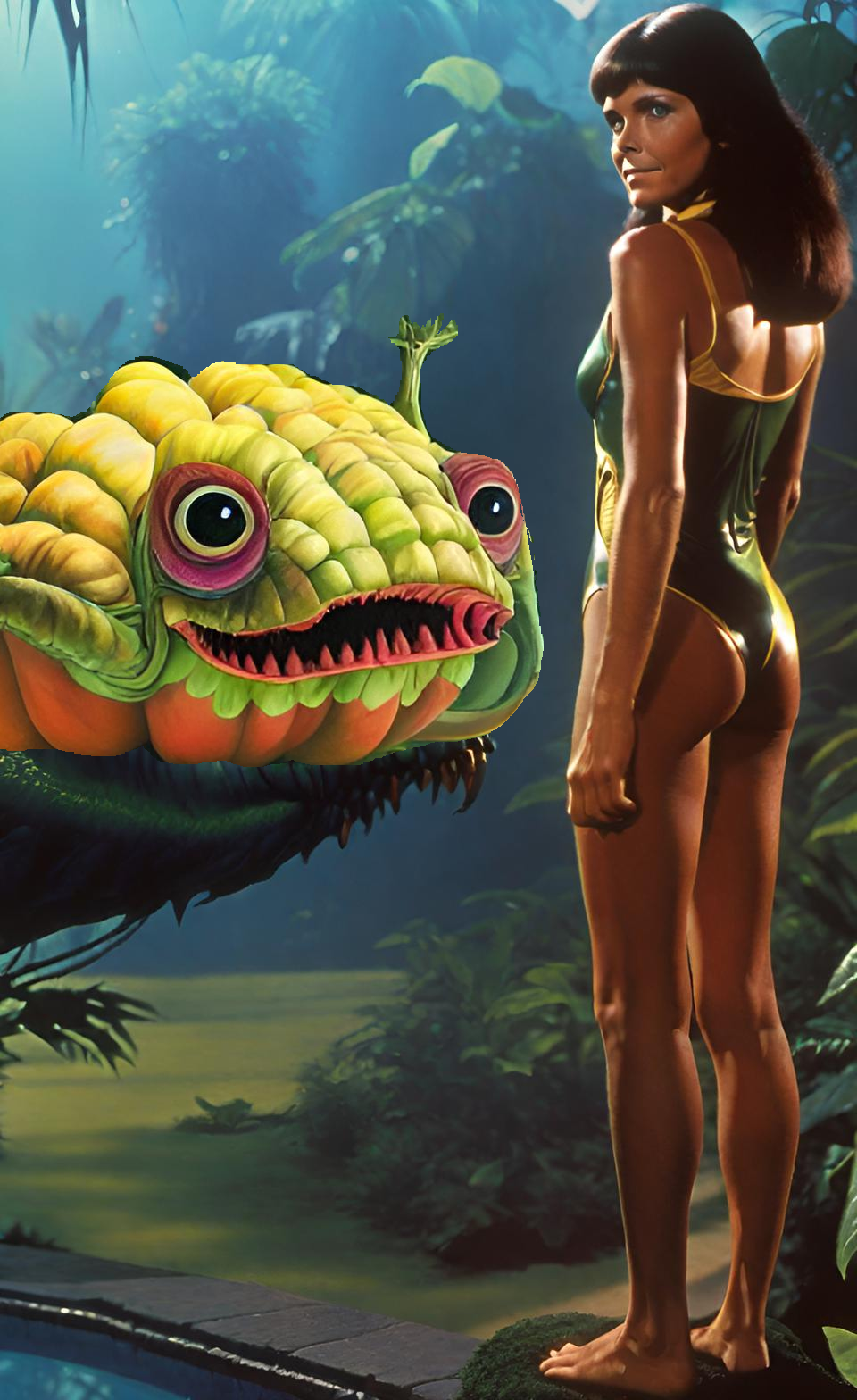
I manually cut out this "alien pumpkin" and pasted it into another image that was a scene with Talia (see Figure 3) on the extremely hot exoplanet, Elemacha-z. I've been having Mr. Wombo generate depictions of Talia Vance using "Kate Jackson" in my text prompts.

Next, I used that composite (Figure 3) as a reference image for WOMBO Dream with this text prompt: "a very young Kate Jackson with an alien creature, Kate Jackson has long black hair, Kate Jackson is a pretty twenty year old girl, Kate Jackson is smiling, Kate Jackson is dressed Victoria's Secret style in a swimsuit, green plants in the background, Kate Jackson is looking over her shoulder, Kate Jackson is happy". 

Figure 4. Talia and a Kwono.
One of the images that was generated by Mr. Wombo using Figure 3 as a reference image is shown to the left in Figure 4. The alien creature in Figure 4 is quite different in appearance from my previous attempts to have Mr. Wombo depict an adult Merovae. Now I wondered: what might the rest of this alien creature look like?  

Figure 5. Kwono of Elemacha.
 Kwonok Time. The image in Figure 5 was generated by Mr. Wombo, expanding on the alien head from Figure 4 to show the entire bodily form of this alien creature. I had not been imagining any large land animals for Elemacha-z, but I suppose I should take my "world building" obligations more seriously. Maybe the Kwono is only one species of alien creatures that roam the hills around Port Cooway.

Figure 6. Alien holding  a pumpkin.
Full sized: see "Alien Halloween".
I was making some variations on the "alien pumpkin" that is shown above and Mr. Wombo generated the image shown in Figure 6. 

While looking at Figure 6, I realized that this "alien" could be transformed into a caricature of Donald Trump.

Figure 7. The Donald.
After several repeated rounds of asking Mr. Wombo to generate images depicting "Donald Trump holding a pumpkin", I got the image that is shown in Figure 7.

I particularly like the eyebrows that Mr. Wombo put on the pumpkin, without any mention of eyes or eyebrows in my text prompt. I did not expect Mr. Wombo to turn the alien's "orange hair" into a second pumpkin on his head. Mr. Wombo was very persistent in giving Donald those glowing eyes. The steps by which the green alien in Figure 6 was transformed into bright-eyed human of Figure 7 are shown below in Figure 8. It seemed strange that Mr. Wombo tried to make a beak-like nose (see the image below).

Figure 8. Steps by which Mr. Wombo transformed the image show in Figure 6 into the new image in Figure 7.
Figure 9. An alien pumpkin
creature holding a pumpkin.

 More Pumpkin Aliens.
Among the variations on "alien pumpkins" that Mr. Wombo generated, I particularly liked the one shown in Figure 9. In my imagination, this cute alien has green arms and feet but a large orange pumpkin-like belly. I like how this pumpkin alien is holding a small pumpkin in its hand.

Figure 10. Pumpkin embryo.

 Biological Processes of Alien Pumpkin People. I wanted the image shown in Figure 10 to become a depiction of an alien pumpkin woman giving birth. 

However, this image was locked into an attractor devoted to having her obviously holding a pumpkin in front of her body and I could not find a way to get Mr. Wombo to merge the pumpkin into the pumpkin woman's belly in the way that was successfully accomplished for the image in Figure 9. I really like the fact that the little pumpkin fetus is holding a very tiny orange ball in its hand.

Figure 11. Pregnant plant woman.

 Figure 11 shows an alternative pumpkin woman for which the pumpkin looks like it is her bulging belly. Mr. Wombo also gave this pregnant plant woman pumpkin-like breasts. The image shown in Figure 11 is a composite. The pumpkin embryo was cut out of another AI-generated image and pasted into this scene, giving us a view into her uterus. For some reason, the word "uterus" activates Mr. Wombo's NSFW filter.

 Pumpkin in Pumpkin. Mr. Wombo likes to show small pumpkins inside of large pumpkins. In my imagination, the little green fetus shown in Figure 11 is either emerging from a second, small pumpkin or else pumpkin embryos have a developmental stage in which they have a very large pumpkin-like abdomen.

Figure 12. Plant eats animal.
 The Insects of Elemacha-z. One of the pumpkin people created by Mr. Wombo had a leaf in its mouth. I asked Mr. Wombo to convert that leaf into a caterpillar. The resulting image is shown in Figure 12. I find it amusing to imagine alien plants that can telepathically control alien animals. In "The Fesarians", the plant-like Neoma can telepathically control the behavior of the amphibian Merovae.

I had not previously given any thought to the possibility of insect-like creatures on Elemacha-z. In Jack Vance's novel The Killing Machine, Kirth Gersen visits a planet where there are insects that look like tiny white monkeys.

Figure 13. The pumpkin laboratory.
 Frog People. When one of the AI-generated alien pumpkin people reminded me of Kermit the frog, I asked Mr. Wombo to make a more frog-like variant of the creature in that image. Also, I put the AI-generated pumpkin person into a "pumpkin laboratory" that had been generated by Mr. Wombo. The resulting scene is shown in Figure 13.

Figure 14. Bad pumpkin experiment.

 Pumpkin Research. The image shown in Figure 14 is an example of the image diffusion process resulting in the merging the scientist's nose with the stem of the pumpkin. There are more "pumpkin laboratory" images at the bottom of this blog post (Figure 25). 

Plant meets animal.
The image to the right shows another example of Mr. Wombo merging two objects. On a planet such as Elemacha-z where there are artificial life-forms composed of femtobot components, it should be possible for a plant and an animal to merge their bodies.

Proud parent.
The image to the left is similar in theme to Figure 11. Maybe some aliens lay eggs inside pumpkins and then, eventually, the growing juvenile eats its way out of the pumpkin. I particularly enjoy the AI-generated images where there is a small pumpkin inside a larger pumpkin.

Figure 15. An anti-gravity
pumpkin experiment.

For the scene in Figure 15, I had Mr. Wombo place Talia Vance into an alien biology laboratory. In my imagination, Talia is using anti-gravity technology in this experiment and successfully reducing the weight of the pumpkin that she is holding.

Figure 16. Talia and a Noema.
For "The Fesarians", Talia is not experimenting with pumpkins; she discovers that the plant-like Noema of Elemacha-z can alter their physical shape by re-arranging their femtobot components. I had Mr. Wombo modify Figure 15, removing the pumpkins and adding in some alien plants from Elemacha-z. The resulting image is shown in Figure 16.

As a bonus, there is the head of a Merovea at the bottom of Figure 16. I don't really imagine a Merovae being brought inside for experiments, but maybe the Neoma have their own plans for infiltrating Merovae into human buildings of the settlement at Port Cooway.

Figure 17. Neoma morphing experiment.
Another scene with Talia and a Neoma in the laboratory is shown in Figure 17. The orange color in this image is all that remains from the pumpkins that were in the original reference image. In my imagination, there is a serious communications barrier between the Neoma and humans. The Neoma have a form of technology-assisted telepathy that is based on hierions. Talia has some access to the Sedron Time Stream, but is not a very good telepath. In this image, the Noema is trying to learn how to program its femtobots to take on human form. Talia is rather astounded to see what she thought was just a plant is able to take on human form.

Eventually, the communications barrier is overcome by making use of the synapex nanites that Talia has brought to Elemacha-z from her home world of Martiz 23.

Figure 18. An alternate body
form for a Noema.

 The Elemacha-z Biome. Figure 18 shows another alien creature that was generated by Mr. Wombo. In my imagination, this could be one of the many physical forms used by the Neoma.

Figure 19. Play time.
 Play Time. The image in Figure 19 could be a depiction of a juvenile Kwono playing with a Merovae hatchling. For the first few weeks after hatching, the Merovae juveniles live on land and feed on special land plants that grow in the marshy land near the ocean. During this time, there would be opportunities for interactions and play between the Kwono and the Merovae.

Figure 20. Fun and games.
 Other life-forms of Elemacha-z are shown in Figure 20.  

Figure 21. A bird-like alien (top).
 In "The Fesarians", Balok uses an avian body form. I've never seriously thought about there being flying creatures on Elemacha-z, but why not? Figure 21 shows what might be an avian creature of Elemacha-z, standing on the ground near what could be another juvenile amphibian. Why should there be only one amphibian species on Elemacha-z?

Figure 22. Gray alien.
 I'll close out this blog post with three more examples of "pumpkin aliens" that were generated by Mr. Wombo. Figure 22 shows what I'll call a gray alien. Sometimes when asking Mr. Wombo for a pumpkin, you get a bonus of a bat flying through the sky.

Figure 23. Exoplanet Halloween.
 The image shown in Figure 23 is one of the more "classic" Halloween images that Mr. Wombo generated in this series in the sense that this alien looks like it it trying to scare us. This could be a scene on a distant exoplanet where there is a large orange planet in the sky of this world.

Figure 24. Talia is in a pumpkin.
 Flower Child?  Figure 24 shows a depiction of Balok holding a pumpkin. There's Talia inside the pumpkin, ready to help with Balok's attempt to determine the secret location of R. Nyrtia's base of operations inside the Hierion Domain. 

 There are no wizards in science fiction. In the original AI-generated image, there were some stray autumn leaves, but when I had Mr. Wombo modify the image, the leaves turned into flowers. As shown here in Figure 24, Mr. Wombo is likely to dress aliens in wizard robes when they are holding a pumpkin (see also: Figure 14).

Next: Part 5 of "The Fesarians".

Figure 25. Compare to Figure 15, above. Visit the Gallery of Movies, Book and Magazine Covers