Showing posts with label lost worlds. Show all posts

Dec 1, 2021

An Amazing Contest

see original cover by F. W. Small

Hugo Gernsback favorably compared "The Metal Man" by Jack Williamson to Abraham Merritt's story "The Moon Pool". I read "The Moon Pool" as re-published in the May 1927 issue of Amazing Stories, however it is beyond my Sci Fi event horizon. 😕 Luckily, while taking a dip in the Moon pool, I ran into some interesting stories in old issues of Amazing...

Disappearing Continents. Merritt's story features the 100,000-years-old remnants of an ancient civilization and makes mention of the sinking continent of Muria. We lost Muria? Wait... I thought we had lost Lemuria. Before the 1920s, when it was widely recognized that chemical rockets could send Sci Fi adventurers into outer space, there was a seemingly endless number of adventure stories about trips to remote corners of the Earth where aliens dinosaurs mad scientists lost civilizations secretly existed, waiting for their chance to take over the planet.

Gernsback's comments on "the editors"
No Fairies Zone. It is fascinating to read the old editorials by Gernsback that he wrote in the late 1920s while creating the science fiction genre. In 1927 he was still using the older term "scientifiction". Was "The Moon Pool" magical fantasy or science fiction? Let's find out.

Holger Behr's map

 Maps. I admit that I'm a sucker for any story that includes a map. Probably my favorite example of a fictional map is found in Trullion by Jack Vance. While mentioning Vance, I must say that he was better than Merritt at describing strange locations and events. Merritt could write an entire page about eerie moon light, which might have delighted readers in 1920, but that is over the limit for readers' patience in this millennium. Shown to the right on this page is an image depicting Nan Madol, an archeological site in the middle of the Pacific ocean. 

A review of early visits by Europeans to Pohnpei can be downloaded here

Internal art for "The Moon Pool" from the May 1927 issue.
In his article, Christophe Sand describes visits by westerners to Pohnpei going back to the early 1800s. One of F. W. Christian's photographs of the site from his 1899 book is shown. Christian is mentioned in "The Moon Pool".

Shown to the left is the map that can be found in the 1927 version "The Moon Pool".

In his imagination, Merritt vastly expanded this archeological site and invented the idea of a hidden chamber under the TAU islet; the location of the titular Moon Pool. The huge swinging door at the entrance to the Moon Pool only opens during full moon when the moonlight-sensitive detectors on the door detect enough moonlight.

The second Moon Pool illustration from the May 1927 issue.
Gernsback seems to have been pleased by Merritt's story because there is occasional discussion of the possible technological basis for the seemingly magical events in the story. I love the idea of technically advanced folks on Earth in ancient times and I've even imagined underground bases for the pek (see Slave Craton and River of Time), but Merritt did not hesitate to imagine an entire sub-oceanic civilization beneath the Pacific ocean.

In amongst sciensy sounding things like "Becquerel ray condensers" we also get mention of giant chamats,  a nisse, banshees, the "green people" and ghostly devils flying across the ocean to carry out alien devilish abductions of passengers from cruise ships. Is there a scientifically plausible explanation for mythical creatures such as banshees?

In Part 2, next week: "The Dingo took my baby!"

cover art by Frank R. Paul
Merritt crafted "The Moon Pool" around Dr. Scully Dr. Goodwin, who is depicted as continuously seeking a scientific explanation for the strange phenomena that are encountered. After stating authoritatively that there was once an entire continent in the Pacific where only scattered islands remain, Goodwin proclaims that the volcanic islands of the Pacific are "honeycombed with caverns and vast subterranean spaces, literally underground lands running in some cases far out beneath the ocean floor". So, not only was there a lost continent, but a lost race and as the continent sank under the waves, the residents were eventually trapped in their underground caverns. Dr. Goodwin also states his belief that the "lost race" had/has SuperDuper™ advanced technology and he worries that "this lost race is planning to emerge again upon Earth's surface!" (cue menacing music)

the Moon Pool
One of the wonderful things about old stories such as "The Moon Pool" is that they are full of references to real people. The fictional Dr. Goodwin cites Herbert Spencer and William Beebe as authorities behind ideas such as there being "a basis in fact for every myth and legend" and the idea that subterranean residents of islands such as Papau will soon burst out of their hiding places.

The Dweller. When the Moon is full, seven magical beams of moonlight reach the Moon Pool and draw forth the "Dweller" (see the image to the left). Merritt provided a very long-winded "explanation" of how sunlight reflected off the Moon attains the power to animate the Dweller. I'm going to blame Herbert Wells for popularizing long-winded fake science "explanations" for his fantasy stories. The goal seems to be reaching the point where you have thrown enough sciensy sounding verbiage at the reader or the magazine editor so that you can either 1) get your story published or 2) bamboozle your scientifically-illiterate readers. "There would be nothing scientifically implausible about such a process."

Dr. Goodwin's "scientific" theory of how moonlight animates the Dweller


In the Ekcolir Reality: The plant people of Muria!


I've never understood the popularity of stories (even in 2021) about magical Moon power, but who am I to question an authority such as the Great Kubalski?

For Merritt, Germans are Evil™ and it is a bit of a shock when Dr. Goodwin arrives at Nan Madol Nan-Matal and is told that a German, Dr. Hetzdorp recently went to investigate the archeological Dweller-haunted site. This is like Indiana Jones traveling to the distant South American city of crystal skulls only to find that Nazis got there before he did. Damn!

More Super Science™. Hetzdorp has determined that the liquid in the Moon Pool is like radium, but way cooler. Literally. When it burns human skin, it feels cool. Luckily, there is another passage way that leads downward and avoids the Moon Pool. 

see the original 1951 cover art
Having sunk down into a great hole under Nan-Matal, Dr. Hetzdorp mentions the theory that the Moon was formed from the Earth, leaving behind the Pacific ocean. Then the adventurers from the surface of Earth meet some of the residents of Muria: plant people! Just kidding. But conveniently, there are plenty of glowing rocks in the underworld so that the green dwarfs, red dwarfs, frog people and other residents can be seen. And luckily both Dr. Goodwin and Dr. Hetzdorp know how to speak the language that is spoken in the underworld, since it is related to some languages of Pacific islanders.

I'm amazed that Gernsback was so enthusiastic about "The Moon pool. Maybe it gets better in parts 2 & 3 of the story, but I'll have to take a break from this fantasy adventure below the Pacific ocean. I'll report back if and when I finish the story.

interior art for "The Ultra-Elixir of Youth"
Moving On. While excavating through the issues of Amazing Stories that hold the three parts of "The Moon Pool" I came across stories by Alpheus Hyatt Verrill and read "The Ultra-Elixir of Youth" in the same issue of Amazing that holds "The Tissue-Culture King".

In "The Ultra-Elixir of Youth" a new chemical element (Juvenum) is discovered that reverses the aging process, causing biological organisms to grow younger. Tests are performed on experimental animals and a bird goes through reverse aging and turns into an egg. The next day, the egg disappears. 

the power of tubes
You might think that scientists studying the reverse aging process would exercise caution, but no, they can't resist exposing themselves to the magic potion and they also regress to babies and then disappear. A fire burns down the research lab and thus we were saved from further experiments on Juvenum (apparently a hard-to-find gas that was only discovered "by accident").

I was left wondering how such a silly story of fictional biology and chemistry came to be published in Amazing. I think the secret to being published in Amazing was to include mention of magical Sciensy™ rays in your story. In "The Ultra-Elixir of Youth", exposure to Juvenum is lethal unless you are also exposed to emissions from the glowing tubes of a radio receiver. Having read that Verrill was a "naturalist" and that he had a father who was a biologist I hoped to find some interesting speculative biology in his works, but no....
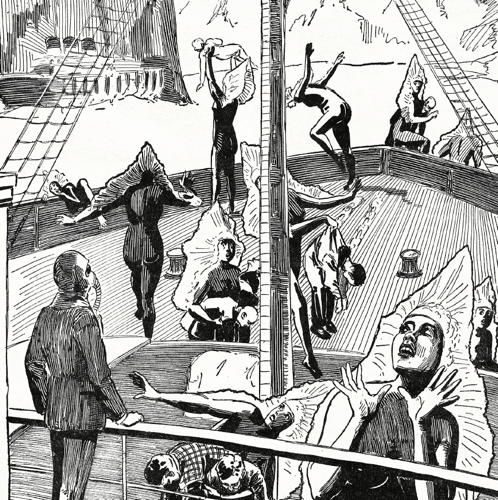
cannibals of the inner world; interior art by Frank Paul
I was intrigued that in the July 1927 Amazing Stories there was "The Voice from the Inner World" by Verrill, "The Lost Continent" by Cecil B. White and the third part of "The Moon Pool". I felt compelled to investigate this mini-collection of lost world stories.

In "The Voice from the Inner World", a ship full of people is lifted out of the ocean by a UFO and taken through the mouth of a tall volcano and on down into the "Inner World" where cannibalistic females reside.

The world got to hear the story told in "The Ultra-Elixir of Youth" because a diary was left behind describing the discovery and effects of Juvenum. 

promotional blurb for "The Voice from the Inner World"
Don't Forget Your Radio! For "The Voice from the Inner World", one passenger on the ship had a gas mask and was able to protect himself from the knockout gas used during the alien cannibal abduction. Using a radio transmitter, calls are sent to the surface of Earth from the Inner World explaining how the cannibals can be defeated. Once again, mere mention of a radio apparently allowed another silly fantasy story to be published in Amazing.

cover art by Frank R. Paul
What about "The Lost Continent" by Cecil B. White? Like "The Voice from the Inner World", "The Lost Continent" was submitted to Amazing as part of a contest. Gernsback had asked for 10,000-word "scientifiction" stories inspired by the cover illustration that appeared on the December 1926 issue. Verrill's story about cannibal women of the Inner World closely matched the image (shown to the left on this page).

Cecil B. White was a pen-name used by astronomer William Henry Christie. Most Sci Fi short story writers might content themselves with creating a story about time travel or a story about anti-gravity, but Christie's Dr. Lamont (a physicist) casually invents both a time travel machine (sadly, Lamont's time machine only sends things into the past) and an anti-gravity device. 

promotional blurb for "The Lost Continent"
I've previously commented on John Campbell's enthusiasm for a fake anti-gravity device that had interesting similarities to the fictional anti-gravity device in "The Lost Continent". While Verrill simply imagined the ship-hoisting UFO as appearing magically from the Inner World, in "The Lost Continent", a couple of junior physicists build the gigantic gravity-defying craft in just 9 months, using blueprints supplied by the crafty Dr. Lamont.

small demo model anti-gravity sphere
interior artwork by Frank R. Paul

As envisioned by Christie, the anti-gravity flying sphere was propelled by ionic thrusters composed of huge x-ray tubes. The power source was nuclear energy generated by a light-weight power source (sadly, taken for granted and not explained by the Super Genius™ Dr. Lamont).

Think of all you could do with a gigantic flying time machine! All Dr. Lamont can think about is visiting the lost continent where Atlantis once (14,000 years ago) existed. Dr. Lamont takes along an ocean liner holding many members of the International Geological Survey (possible a fictional analogue of the IGU) who can serve as witnesses.

Golly Mr. Science! From the October 1928 issue of Amazing.

interior art by Frank Paul
Apparently, the only other science fiction published by Christie was a two part story that began with "The Retreat to Mars" in the August 1927 issue of Amazing Stories. An expedition in Africa finds a set of records left behind by visiting Martians, 500,000 years ago. Those ancient records suggest that humans may have evolved as descendants of the visiting Martians. I'm a complete sucker for stories about aliens visiting Earth long ago, so I had to also read the sequel story...

The second part of the story, "The Return of the Martians" was published in the April 1928 issue of Amazing Stories. 500,000 years after first visiting Earth, the Martians are now able to better deal with conditions on Earth. They begin to transform primitive Earthly society into a more advanced civilization, one like the ancient SuperCool™ civilization on Mars.

image source
It is quite a relief to see a story depicting Martians as peaceful folk who are not intent on going to war with Earth. However, the biology in Christie's Mars stories is hard to swallow. The Martians have sophisticated medical imaging technology, but the idea of genes as molecular information storage devices was seemingly quite unfamiliar to Christie. Thus, we get no discussion of the molecular differences (if any) between Earthly and Martian life.

There are some interesting similarities between Christie's stories about Mars and Carl Sagan's "Contact". It would be interesting to know if Sagan ever read "The Return of the Martians".

the Atlantis Clones
I'm glad that I investigated "The Moon Pool" because doing so allowed me to discover the science fiction stories of the astronomer William Henry Christie. 

I find it fascinating that all the elements of alien abduction stories were established long before the classical era of "flying saucers" that began in the 1940s. It is an interesting concatenation of events that just when the scientific study of plate tectonics made it impossible to sustain the market for lost continent stores (with hidden civilizations inside Earth), the arrival of rocket science made possible an explosion of stories about space aliens coming to Earth from distant planets. 

experimental mice
 Related Reading: Alley Oop

Next: Road to Siteq

See Also: Part 7 of "Telepaths of Site Q".

May 9, 2021

Vance's Worlds Beyond

In the Ekcolir Reality. (see also)
I'm on a mission to read all of the science fiction stories that were published by Jack Vance in 1951. In the March 1951 issue of Startling Stories was a short story by Vance called "Men of the Ten Books". The setting for this story is a "lost world" of the Beyond.

Last year when I was reading Vance's Magnus Ridolph stories, I could not resist imagining how some of his stories might have moved in different directions had they been written in an alternate Reality where women dominated the golden age of science fiction. "Men of the Ten Books" starts out with Elizabeth "Betty" Welstead who is working with her husband Ralph as prospectors, searching the depths of galactic space far from Earth for rich loads of platinum or uranium. In the far Beyond, they stumble upon an Earth-like planet in orbit around the star Eridanus 2932. Ralph offers to name the planet "Elizabeth", but Betty tells him to not be ridiculous. 

cover art by Earle Bergey
From the ridiculous to the... Then they move closer to the newly-discovered planet and find that it is already inhabited by 300,000,000 human beings who all speak perfect English: these are the titular "Men of the Ten Books". They call their world "Haven".

I like the Earle Bergey cover art for the March 1951 Startling. However, you can see that Leigh Brackett could not avoid using "Starmen" in the title of her story and Ed Hamilton had "Earthmen". Vance tells us that the 300,000,000 people of planet Haven all arose as the descendants of 34 men, 25 women and 4 children who arrived from Earth 271 years before the time of the events in the story. Betty and Ralph become friends with a man named Clay who introduces them to his wife and the four youngest of his nine children. The people of Haven have big families. Apparently the women of Haven are too busy taking care of all their children to have any lines of dialog in the story.

Star Trek Beyond (image source)
In the Hi Tek™ future of interstellar travel that is the setting for Vance's story, the only source of information about Earth brought to Haven by the colonists was the ten volume Encyclopedia of Human Achievement. Those ten encyclopedia volumes are the titular "Ten Books". The plot of "Men of the Ten Books" reminds me of the Star Trek episode "A Piece of the Action". On Haven, the entire population mistakenly believes that Earth is populated by nothing but artistic and scientific geniuses such as those described in the encyclopedia. Shaping their world according to that absurd belief, the people of Haven have created a culture where everything is beautifully constructed and decorated, striving to match the glorious conditions of their imagined Earth.

Jacqueline Browne
Deela, the fast woman. The folks responsible for writing and producing Star Trek mined old science fiction stories for ideas. "Wink of an Eye" used as a plot device the idea that it might be possible to find a chemical substance that would "accelerate" human physiology. I've previously mentioned a story from the 1930s that was called "The Hormone" and featured the magical hormone "cortin" that could accelerate people. In 1926, the very first issue of Amazing Stories reprinted the story "The New Accelerator", originally published in 1901 by H. G. Wells.

I despise stories that feature the "brilliant scientist" who makes an amazing technological break-through in his basement that nobody else can ever replicate. In the case of "Men of the Ten Books", the singular technological break-through is the interstellar space-drive. Clay explains to Betty and Ralph that Haven has a pleasant utopian society because they started out with all the knowledge and experience that had previously been accumulated by Earth. 

Schwartz achieves telepathic superpowers
after one session with the synapsifier.
Yes, everything is idyllic on Haven, except that during the past 271 years they have never been able to re-invent the interstellar space drive technology that brought the colonists to Haven in the first place.

In the case of "The New Accelerator", we might ask, what happened to the old accelerator? A realistic depiction of technological advance would feature an earlier invention being improved upon and modified. However, rather than provide readers with some imaginary science, Wells instead spends much effort assuring us that Professor Gibberne is unequaled in his understanding of drugs that can alter the function of the nervous system. No mere neurophysiologist, Gibberne is also an expert chemist who in his spare time does cutting edge research in the local hospital's laboratory. Of particular note on Gibberne's illustrious résumé is Gibberne's B Syrup, a famous stimulant which Wells assures readers has "saved more lives than any lifeboat". 

interior art for "The New Accelerator"
Isaac Asimov (who was a fan of the science fiction romance stories of H. G. Wells) could not avoid jumping on the accelerator bandwagon. In his 1950 novel, Pebble in the Sky, Asimov introduced the fantastic future technology of the synapsifier. Upon being exposed to the magical synapsifier, the synapses in the brains of people are sped up, converting them into super geniuses. A lucky few, like the hero of the story, develop telepathic powers.

Professor Gibberne was not satisfied with first generation drugs like Gibberne's B Syrup because all of his first generation stimulants only altered the behavior of part of the human body. Thus, he worked on, tirelessly searching for a UNIVERSAL stimulant that would make a man think twice as fast as usual. 

another fast woman: Linda Darcy
The skeptical reader might ask: but is such a thing really possible? Wells reminds his British readers the "Jews and Orientals are quicker in thought than we are", so if Nature™ has accomplished that, why not a drug that goes one step further? Wells was not even attempting to write science fiction, a genre that would not arrive for another 30 years, so just sit back and try to enjoy the fantasy ride...

Of course, after a year of further fictional scientific effort, Professor Gibberne has successfully crafted his magical super-accelerator potion. Rather than simply accelerate people two-fold, this newly-crafted magic potion speeds up every aspect of the human body to rates a thousand times faster than usual. Imagine the human heart beating once every millisecond and the brain processing complex sensory inputs like vision 1000 times faster than usual! Gee whiz.

fantasy
 Anti-science Fantasy. Wells made a big deal over the idea that by moving 1000 times faster than usual, an accelerated human was in danger of burning up from the friction of rubbing against the air. In writing his silly story about the world's greatest physiologist, and not being in the least concerned about biology, Wells ignored the fact that an accelerated human body would produce waste heat at 1000 times the normal rate simply through its on-going metabolic processes. However, the two accelerated characters in the story have no problem defying physics and magically dissipating all their self-generated body heat. Their hearts have no problem pumping 100 liters of blood every second and their lungs exchange 100 liters of fresh air every second. The whole super-accelerator idea is absurd fantasy. It is hard to imagine why the idea caught on and has been used as a plot element in countless other stories.

Interior art by Peter Poulton
I was first exposed to a silly story about "accelerated" people in the Outer Limits episode called "The Premonition". In that case, it was not a magic drug that caused the acceleration, but rather some magical effect of having been involved with the new-fangled X-15 rocket-powered aircraft. Lucky for Jim and Linda Darcy, after being caught in the magical wake of the X-15, they eventually returned to the normal rate of flow through time. Actually, who knows what is going on here? Are Jim and Linda actually moving a thousand time faster than everyone else in the world, or maybe the world has slowed down and they are going at the normal rate. When presented with such fantasies, we are not expected to think too deeply or ask any questions.

The Warriors of Day
A Lost World. In "Men of the Ten Books", Ralph decides that Haven is such a wonderful place that he can't allow any contact between Earth and Haven. Ralph puts it this way: if Earth learned about the existence of Haven, millions of tourists would ravish Haven in the same way that a "platoon of invading soldiers would treat a pretty girl".

For Vance's contorted plot, he concocted an accident that sent the original colonists to distant Haven rather than their intended destination, the Rigel star system. Because of that accident, their out-of control spaceship had to be abandoned, and the colonists landed on Haven in lifeboats. The malfunctioning spaceship kept going on, traveling across the galaxy. In "Men of the Ten Books", after 271 years of trying (and failing) to re-invent the interstellar space-drive, apparently the people of Haven don't even think to look inside the spaceship that brought Betty and Ralph to their world. That spaceship just sits in a city park until Betty and Ralph try to sneak away from Haven in the middle of the night. 

cover art by Paul Callé
However, when Ralph tries to secretly depart from Haven, he discovers that Clay has stowed away inside the departing spaceship. We learn that all the folks of Haven needed was some loose talk by Ralph that led them to try a new angle of space-drive research that quickly (in three days) led them to discover the needed dodecahedron structure. Ralph had previously said nothing specific about using a dodecahedron of quartz to complete the space-drive, but simply by mentioning the need for a "special environment" the scientists of Haven almost instantly solved the puzzle of space-drive. Betty also had loose lips and warned Clay that she and Ralph were departing from Haven. I'm glad I read this story, even though it is contrived and silly. It is interesting to see an early version of the "lost world" theme that Vance used again and again in his later stories.

In the Ekcolir Reality.
I'm not going to comment extensively on Vance's story "Brain of the Galaxy" (A.K.A. "The New Prime") that was published in the February 1951 issue of Worlds Beyond. This is the sort of Vance fantasy that I feel falls outside of science fiction. I'll label it Galactic Fantasy and move on to more interesting topics. Vance grew up reading Weird Tales and he did not like being called a science fiction writer. It is easy to understand why Vance was quick to submit stories to Worlds Beyond.

There was another Vance story ("The Loom of Darkness") in the December 1950 issue of Worlds Beyond. It was in that first issue of Worlds Beyond that the editor provided a description of science-fantasy as a new literary genre:

Damon Knight was the editor of Worlds Beyond.

DIANETICS
Given my preference for science fiction, I would not normally read a science-fantasy magazine such as Worlds Beyond, but the first issue of the magazine had a "review" of Dianetics. It seems appropriate that a science-fantasy magazine would review Hubbard's book about an invented, fantasy science. We might wonder if the fans of a fiction magazine that was taking a step away from hard science fiction might enjoy a rollicking fantasy like Dianetics. Here is the review by Damon Knight:

Review of Dianetics by Damon Knight


more brains

In an alternate Reality, "Brains of the Galaxy" might have become a science fiction story about the advanced computer technology that allowed all of the worlds of the galaxy to be linked to a central brain. Vance could have fleshed out his thinking about virtual reality and made a useful contribution to the science fiction genre. In his later works, Vance would only occasionally mention computers and robots, but he extensively developed the idea of the "Beyond": the portion of the galaxy that was being actively explored by humans, but had not yet become part of the organized core worlds of human civilization.

January 1951
One of the joys of looking through old science fiction magazines is discovering folks who you never knew existed. The cover art for the first issue of Worlds Beyond was Paul Callé. Seeing that cover art led me to "The Warriors of Day" which James Blish published in 1953 (originally "Sword of Xota" in 1951). You can download the story here. There is a rather odd "review" of Blish's book here that claims the "Elron" character in the novel is supposed to be L. Ron Hubbard. What about Blish's explicit published comments on Dianetics?

In the November 1950 issue of Planet Stories, Blish had an essay called "Dianetics: A Door to the Future" in which Blish repeats the absurd claim (first printed in a science fiction magazine by Campbell) that L. Ron Hubbard was an engineer. Blish informs readers that Planet Stories editor Jerome Bixby had also been investigating Hubbard's grandiose claims about Dianetics. Blish wrote this about Dianetics: "it may well be the most important discovery of this or any other century".

Blish in Planet Stories

The January 1951 issue of Planet Stories had a letter from magazine reader Al Wickham complaining that Dianetics is not a science, that Hubbard shows no evidence of knowing what science is and suggesting that Blish and everyone else be highly skeptical of Hubbard's unsupported claims for Dianetics.

In the Ekcolir Reality.
Immediately after the letter from Wickham was a response from Blish in which he admitted that Dianetics is not a science and that its claims were unproven. Blish advised science fiction fans to be skeptical.

I have to wonder if there is a boundary between science fiction fans who know how to be skeptical and science-fantasy fans who revel in the act of accepting absurdities so that they can enjoy a story like "The New Accelerator". I've previously categorized the fiction of H. G. Wells as "scientific romance" and I'd be willing to label Vance's "Brain of the Galaxy" as "galactic fantasy" or "galactic romance".

Related Reading: Frank Scully on UFOs and Wilhelm Reich's orgone accumulators

See also: Chapter 11 of "Meet the Phari".

Next: "Winner Lose All" by Jack Vance

Visit the Gallery of Book and Magazine Covers


Nov 26, 2015

Jack Vance: A Lost World

cover art by Gino D'Achille
My two favorite authors are Isaac Asimov and Jack Vance... two writers who go together like oil and vinegar. I often search the internet for commentary from readers who enjoy reading stories that were written by Vance and/or Asimov and so I recently came across a "retro review" of a Jack Vance novel (The Killing Machine) by Ken Korczak. Mr. Korczak says:

"In my almost 50 years of reading thousands of science fiction novels and short stories – The Killing Machine is among my Top 5 of all time. It’s just that good."

Lost Worlds
I've previously blogged about some of the "lost worlds" that Vance wrote into his stories. In The Killing Machine, Vance transports us to a lost world called Thamber, but most of the novel is not really about Thamber. We don't even reach the planet Thamber until we are 75% of our way through the story.

source
In his famous Foundation Saga, Asimov turned Earth into a "lost world". That trick took some mentalic magic by Daneel because the quadrillions of people who live on the 25 million settled planets of Asimov's imagined galaxy all originated from Earth only a few 10s of thousands of years before the age of the Foundation. How could everyone just forget the location of the home world of Humanity?

If you are a certain type of literal-minded nerd (and I am) then you worry about such things. I once collaboratively wrote a space opera in which Earth was "lost" in plain sight by means of  technological trickery.

In the case of Thamber, Vance just expects us to chill out and not question how the planet was lost.

In the Oikumene Fictional Universe where Vance set his five Demon Princes novels, about 1,500 years in our future, humans are still slowly spreading outward from Earth into the vast galaxy, into the Beyond. Somehow, it is possible for planets to be colonized by humans and then those planets can be "lost" and allowed to develop in isolation for centuries or millennia. Maybe we should blame the mysterious Institute for the ease with which entire planets can be lost.

hormagaunt
In any case, Thamber is the playground of Kokor Hekkus the hormagaunt. Back on page 15 of the story, we get to read a set of instructions titled: "How to become a hormagaunt". The basic idea seems to be that if you obtain certain substances ("the ichore of youth") from the glands and organs of children then you can use that elixir to transform yourself into an immortal hormagaunt.

cover art by Louis S. Glanzman
Hey, if we can have a lost planet, then why not also have lost knowledge like the secret of eternal life? Elsewhere in the Demon Princes Saga, Vance suggests that it might be just a matter of time before space travel itself is banned and it is hinted that the Institute has already "covered-up" many scientific discoveries.

A side-effect of becoming a hormagaunt is that your skin becomes a transparent film across the surface of your head, allowing your facial muscles to show through. This does not bother Kokor Hekkus, who has a set of rubber masks and disguises that allow him to play the roles of several different people. On the planet Thamber, the human population lives in a primitive medieval society, but Kokor Hekkus has a spaceship and access to all the advanced technology of Earth. Thus, Kokor Hekkus finds it easy to rule over the people of Thamber and he secretly lives among them, acting out his preferred roles in a kind of virtual reality.

the origins of gizmo fiction
The Killing Machine
One of the native life forms on the planet Thamber is called a "dnazd", a large animal with many legs and powerful mandibles. Kokor Hekkus owns a mechanical "killing machine" fashioned after the dnazd. Having imported this mechanical monster from off planet, Hekkus can use it to terrorize a tribe of primitive warriors on Thamber (the Tadousko-Oi). Apparently Mr. Korczak is particularly enamored of Hekkus' mechanical dnazd.

One of the originating threads of the science fiction genre is what I like to think of as "gizmo fiction". Probably for as long as humans have existed we've been intrigued by tools and toys. In some sense, you might argue that Asimov's positronic robots are just cool gizmos. However, it might be closer to the truth to say that Asimov's most famous robot, Daneel, became humanity's tribal god: a being that could watch over the human species and guide us into the future.

I've seen multiple commentators describe The Face as their favorite Demon Princes novel. Some prefer The Palace of Love and the Mad Poet, Navarth. I was surprised to see Mr. Korczak rank The Killing Machine so highly without comparing it in any explicit way to other novels by Vance. I was provoked to ask myself: do I have a favorite novel that ranks highly because it contains a cool gizmo?

source
I'll admit that I've long had a soft spot in my heart for the space elevator. However, none of the novels that I've read with a space elevator in the story is a favorite of mine. So, upon introspection, I conclude that I love gizmos in science fiction stories, but not for their own sake. No, what I enjoy about gizmos in science fiction is when an author can construct a story that shows how a gizmo would alter human existence.

low-G space Bonding
By inventing gizmos such as the robot Daneel and exploring their impact on Humanity, Asimov proved himself a master of science fiction. Kokor Hekkus' walking fort strikes me as a stage prop that is typical of those deployed in order to support and advance Vance's playful literary style, which he was reluctant to even place within the science fiction genre.

I'm comfortable categorizing the Demon Princes novels within the science fiction genre, but Vance puts much more on our plates than is typical for run-of-the-mill science fiction stories. Mr. Korczak rightly compares Vance's protagonist in the Demon Princes novels (Kirth Gersen) to James Bond. In each of the five Demon Princes novels, Gersen takes time out of his busy life to have a dalliance with a damsel in distress.

Interchange
In The Killing Machine, the damsel is Alusz, the 10,000,000,000 SVU girl from Thamber. Gersen first meets Alusz when they are being held as prisoners at Interchange.

Gersen and Alusz - cover art by David Russell
The relationship between Gersen and Alusz is a strange one. Gersen makes use of Alusz as a way to find the lost planet Thamber and kill Kokor Hekkus. Along the way, he steals 10,000,000,000 SVU from her, money that Kokor Hekkus raised by a string of kidnappings and paid to Interchange in order to gain possession of Alusz.

Although Gersen and Alusz grow fond of each other, their romance has no real prospects for enduring. Alusz can't understand Gersen's single-minded devotion to killing the three remaining Demon Princes. Gersen is only slightly tempted to relax and enjoy his vast wealth in the company of Alusz.

projac and planet
My problem with Alusz is that she irritates me. She's a spoiled princess. On Thamber, she was destined to marry Prince Sion Thumble, one of the secret identities of Kokor Hekkus. Supposedly Sion Thumble captured a spaceship from Kokor Hekkus and then Alusz read the instruction manual and departed from Thamber in order to escape from the evil Kokor Hekkus who demanded that she be turned over to him.

Eventually, Alusz learns about Gersen's background and the reason why he wants to kill the five Demon Princes. She can't really fault his motives, but she endlessly badgers Gersen to change his ways. Eventually, both Gersen and the reader are glad to see her depart from the stage.

bipedal version!
The final 25% of The Killing Machine, which takes place on Thamber, is far less entertaining than the first 75% of the story. As soon as Gersen arrives on Thamber, his flying machine is shot down by a Tadousko-Oi arrow. Then Gersen has to engage in hand-to-hand combat against the Tadousko-Oi hetman, their highest ranking warrior. In fine Hollywood tradition, Gersen never fails to win a fist fight.

After a few encounters with Sion Thumble and Franz Panderbush (another identity of Kokor Hekkus), Gersen notices that they are the same person in disguise, indeed, the same person that Gersen previously met playing the roles of Billy Windle and Seuman Otwal on other worlds of the Oikumene. Gersen unmasks Kokor Hekkus, kills him and liberates the people of Thamber from Hekkus' tyranny.

 
What do you get for a Demon Prince who has everything? I can accept that Vance wanted to explore the idea of an evil mastermind who controlled an entire planet and I accept that Vance did not want to confine his writing to a single defined genre such as science fiction, but my tastes do not run towards the type of sword-and-planet fiction that Vance grew up reading. I purposely avoid some of Vance's work in which he drifts into the domain of fantasy.

I've long regretted that Vance did not put more thought into Thamber rather than just adopting a conventional sword-and-planet culture for Kokor Hekkus' toy planet. I get the feeling that Vance himself was rather bored with the final 25% of The Killing Machine, which reads like it was slapped together in a rush to meet a publishing deadline.

A Hollywood tradition is the evil master-mind who always fiddles around while the hero closes in and ultimately dispatches the bad guy. When Gersen arrives on Thamber, Kokor Hekkus seems to just keep playing his usual masquerade games, even though Gersen clearly represents a serious danger from off planet. Given my biases, the ending of The Killing Machine, with the feel that Vance inserted a fantasy novella set on Thamber, marks this as my least favorite of the Demon Princes books. I suppose that Vance fans who enjoy his fantasy stories might prefer The Killing Machine and its touch of sword-and-planet fiction.
Related Reading: Lost Worlds
Next: a return to Asimov's Foundation

visit the Gallery of Book and Magazine Covers