Jan 29, 2012

The Asutra


I previously mentioned (see this blog post) the fact that I've thought about a fan fiction sequel to Jack Vance's novel The Book of Dreams. Today I saw a blog post by Patrick Hudson about Vance's novel The Asutra in the Durdane series.

Patrick wrote about Vance novels ending on a "down beat note" or "a sour note". Which do you prefer? That a character you have followed through a trilogy reaches a happy ending, you close the book and never give a thought to what might happen next.....or.....you finish the trilogy and you can't stop imagining what the protagonist will do for the rest of his/her life?

Patrick wrote, "Etzwane longs to travel the universe, see Earth, but Ifness dismisses him as he might dismiss a bumpkin.....Etzwane even refuses to join his old musical band."

Etzwane has struggled mightily against the horrors inflicted upon the people of his world, Durdane. The Durdane trilogy progressively shows us the expansion of Etzwane's understanding of the causes of these horrors. At first, it seems that his woes are due to a freakish religious cult that controls the small community where he grows up. When he runs away from home, he learns about the bizarre political system of his nation, a "system" by which the ruler, The Anome, can instantly kill any of his subjects. Then things get bad. Durdane is attacked by space aliens. Finally, even after the alien attack is beaten off, Etzwane is left with the knowledge that people from the distant planet Earth watch Durdane and those observers (such as Ifness) from Earth do nothing to prevent the horrible cultural degeneracies of Durdane such as the the religious nightmare that set Etzwane on his path in life.

I love the fact that Vance ends his story in such a way that we are left wondering what Etzwane will do. In a similar situation, in his novel The Killing Machine, the people of a lost world that is similar to Durdane -cut off from Earth and technologically degenerated- decide that they must rejoin the community of human worlds that have space travel technology. At the end of the trilogy we are left wondering: can Etzwane bring Durdane back into the community of space-faring worlds? It would be against his nature to just rejoin the band and forget about Earth.

There are other memorable endings to many Vance novels. In Trullion: Alastor 2262, Glinnes and Duissane, after much adversity and conflict, find themselves with vast wealth at the end of the story. We wonder what their future will be like as they walk off together down the beach. In Marune: Alastor 933, Efraim and Maerio survive their challenges and become the rulers of a "mountain realm". However, they are not comfortable with the restrictions of the culture they grew up in and at the end of the novel we are left wondering about their future life together and what changes they will bring to their world.

Efraim: What shall we do?
Maerio: I don't know.
Efraim: I don't know either.

I particularly enjoy the Durdane trilogy because Vance manages to position Human Observers from Earth in the role that I usually assign to aliens in my "Exodemic" stories.

Images. Top: cover art by Peter Dama scanned from my copy (1978) of The Asutra. The "flying boat" is the property of Ifness; it allows him to move around Durdane and pretend that his flying machine (he does not let the natives see it fly) is no more sophisticated than the primitive technology of Durdane (sailing ships). Lower: Cover of Marune: Alastor 933.

I was looking for the cover image that is on my 1975 Ballantine Books copy of Marune: Alastor 933 (see above) and came across a bunch of other cover art for other editions of the novel.

The image to the right seems to be an artist's conception of Sthelany, who played with a toy puzzle while waiting for her brother to kill Efraim. However, in the story, she never saw Efraim looking in through a crack in the window that had been shuttered during Mirk.

The image to the left is apparently an image corresponding to the book cover for a foreign language version of Marune: Alastor 933. I can't imagine what the image has to do with the story unless the young lady is just supposed to be one of the display pieces in the Marune chamber of the Ring of Worlds.

I suppose that science fiction publishers have an equation that predicts how many thousands of book sales you can expect for each breast on the book cover.

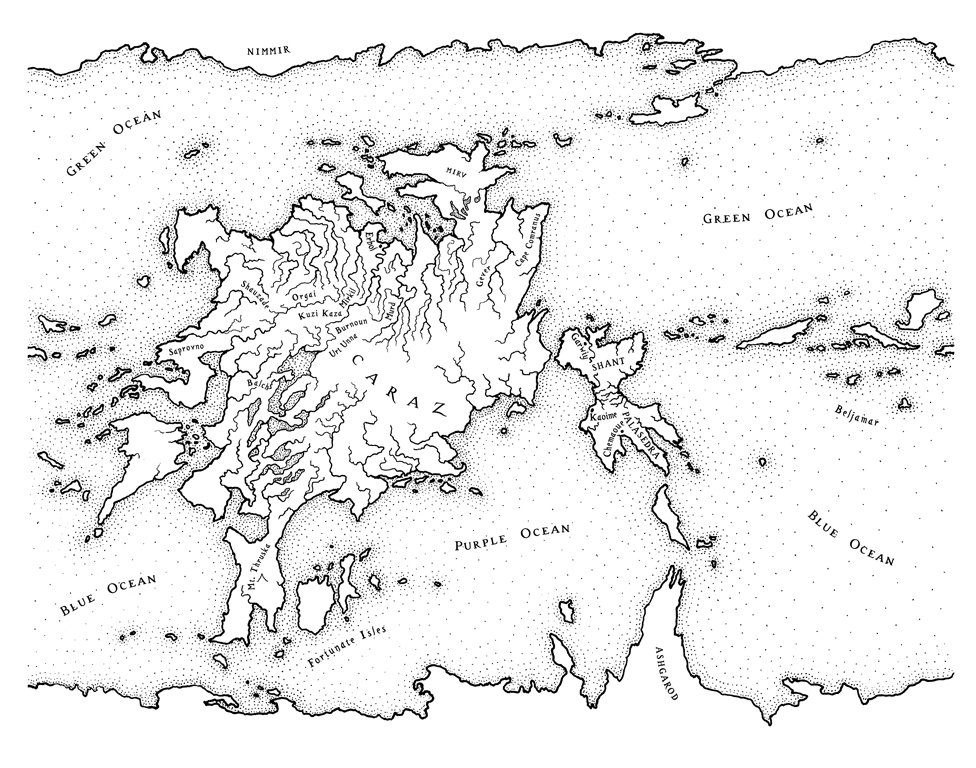
Related eye candy: map of Durdane.

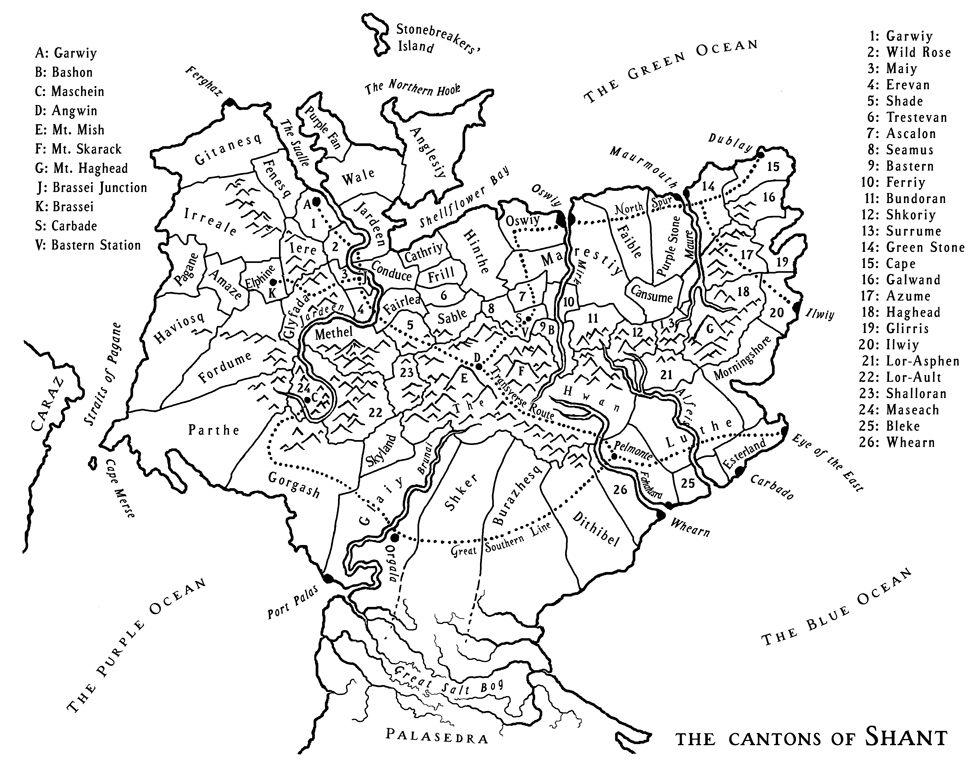
Below, a map of Shant
(from www.jackvance.com)
(full size)

Aug 1, 2011

The Olmec Intervention


By any measure I get an "F" in Pop Culture. When Firefly was shown on the Science Channel this year I thought it was a new television show. Now I see that there is a movie called Apollo 18 in the works.

I've been searching for a new title for a collaboratively written story that was originally called Apollo 23. If I had to select a title today I'd go for something like The Janus Intervention. It would probably be best to use "The Mayan Intervention", but the story meanders back through Earth's history to the Olmec civilization in search of a way to pretend that an as yet unknown Mesoamerican script might be found, one that influenced the development of the Mayan civilization.

Apparently Apollo 18 is a horror movie. I'm not a fan of horror. The only horror movie I've watched was The 2 Headed Transplant, which was enough to last me for life in the horror genre. I've never understood the idea of seeking out experiences that cause you to experience fear. In "The Face" by Jack Vance, the protagonist, Kirth Gersen, hunts down Lens Larque who is one of the most well-known criminals in the galaxy. Lens Larque is famous for making use of his whip, Panek. Gersen is warned that he will be taken by Lens Larque to a secret place where he will slowly and carefully be flayed. Gersen is a cool dude, but the thought of being "given to Panek" puts him on edge. Gersen seems more human because he fears Lens Larque and his whip, but horror is not a major part of Vance's story.

I've been thinking about including the practice of human sacrifice in the story of Pultep, the time traveler who is sent back to prevent Olmec civilization from developing science and technology. I'm thinking that "The Olmec Intervention" is basically the introduction of prescientific thinking and practices into the Olmec civilization, with an emphasis on astronomy. In order to prevent the Olmecs from developing a civilization based on science, Pultep could push the Olmecs towards some unpleasant religious practices such as human sacrifice. It has even been suggested that the Olmecs might have practiced child sacrifice, which seems quite horrific to me. I guess the idea was that continuation of life had a cost...you had to sacrifice something that was valuable in order to assure continued life.

I've been shaped by living in a culture where it is common to think about self-sacrifice. Pultep is asked to sacrifice his chance for a comfortable life as a Genesaunt in order to save humanity from global disaster. Does it take more courage to sacrifice yourself or your child? Could Pultep find himself in the position of having to use child sacrifice to save humanity?