Mar 16, 2013

Prophecy by Time Travel

In my previous blog post I mentioned a strange story that is passed from Noÿs to her daughter, Gwyned. Noÿs is a time traveler from 10,000,000 years in our future, so it easy to imagine that she could tell some interesting tales to the people of the 20th century. Noÿs provides Gwyned with a warning about global warming, but this takes place in the early 1960s, before there is widespread recognition of the idea that human activity can alter the global climate.

How much did Noÿs know about her own future? According to the backstory for Noÿs that was developed by Asimov in his novel The End of Eternity, she made use of advanced technology from the future that allowed her to view alternate "Realities", alternative time lines that might come into existence. Speaking to Andrew Harlen, Noÿs says, "I studied the Reality in which....you and I, together, returned to the Primitive. I saw our lives together and they were happy...."

Captain Christopher's son will command the first
manned mission to Saturn. Left. Right: Kirk.
Does Noÿs have the power of prophecy because of her use of advanced technology that allowed her to watch her future self? I've hinted that Noÿs and the humans from 10,000,000 years in the future might be prophetic in another way: because of access to special knowledge by way of their contacts with the Huaoshy, an advanced alien artificial lifeform that has god-like powers. The Huaoshy are fanatical about keeping secrets from Earthlings, so anyone with special access to the Huaoshy will know things about Earth that nobody else on Earth can know.

Journey into the Primitive
For Noÿs, the "Primitive" means specifically the 20th century. In Exode, Noÿs arrives in the 1930s and she does live happily there with Andrew for a while and they have a son, Thomas, but then Andrew is captured by the Overseers. If she was able to see her "future" life with Andrew in the 20th century then why didn't Noÿs know that Andrew would be captured, why didn't she take steps to protect Andrew?

Assignment: Earth
As Noÿs explained to Andrew, "No matter how finely we focus on a given Reality...there are fuzzy spots. One fuzzy spot spoiled things." So, although Noÿs saw into her own future, the future that she helped to create was different in detail from the future that she originally saw, planned for and tried to bring into existence. Most importantly, as described in The Start of Eternity, the Reality that Noÿs brings into existence (what I call the "Foundation Reality") is one that ultimately allows the Huaoshy to discover that positronic robots on the Moon have invented time travel.

However, regardless of the differences between the version of the Foundation Reality that Noÿs tried to bring into existence and the Reality that was actually formed, I like to imagine that Noÿs did know that Andrew might have to be sacrificed to the Overseers even before she traveled with Andrew to the 1930s. However, she would have tried to bring into existence a Reality in which Andrew avoided that fate. Similarly, she tells Andrew, "There is a probability, not a certainty, of course, that that Earth will end up with a largely radioactive crust." Asimov later described how Earth did become so radioactive that it could no longer support human life (in Robots and Empire). I imagine that Noÿs believed it was desirable for Earth to be abandoned by Humanity, for the same reason that Giskard allowed Earth to become dangerously radioactive.

Noÿs views her future in the Primitive
I imagine that Noÿs and Andrew lived "happily ever after" in the "Foundation Reality" (see below), although Andrew died long before Noÿs, simply because of the extended life span enjoyed by Noÿs. The most interesting thing about the Foundation Reality was that it eventually allowed the alien Huaoshy to realize that time travel had been invented by robots living on the Moon. With that critical understanding finally achieved, the Huaoshy set about creating another Reality in which, when the time to sacrifice Andrew approached, I imagine that Noÿs discussed with Andrew the advantage to be gained from allowing himself to be captured and he volunteered to be taken to the secret Observer Base on the Moon. I imagine that Noÿs was aware of the possibility that Overseers might notice the presence of Andrew and Noÿs in the 19th century and in anticipation of being detected she had a plan that would involve allowing Andrew to sacrifice himself so that Noÿs could escape and continue her effort to establish a future that involved control of the galaxy by Humanity.

The Foundation Reality
In The Start of Eternity, I imagined that Noÿs works in the 1930s to bring into existence the Foundation Reality, a timeline within which events unfold as told in Isaac Asimov's fictional universe. However, despite the best efforts of Noÿs, the Huaoshy develop their own time travel technology which they use to put an end to the Foundation Reality and bring into existence the Reality that we know (for reasons described below and in Exode, I call this Reality the "Buld Reality"). Further, after regaining control of their secret base on the Moon, the Huaoshy put an end to all time travel. For Exode, I imagine that Noÿs, while living in the 20th century, is contacted by time traveling Huaoshy and her efforts in the "Primitive" are re-directed towards the task of creating our Reality.

Testosterone and brain sexual dimorphisms
The Noÿs Reality. When Andrew is captured and taken off of Earth (1949), Noÿs and her young daughter, Gwyned, escape from the Overseers and go to live in Australia. Andrew is the first father that Gwyned knows, but he is not her biological father. While living in Australia, Noÿs uses the name Trysta and she eventually marries Merion Iwedon. Upon reaching adulthood, Gwyned knows Trysta and Merion as her parents and Andrew fades from her memories. Gwyned never really knows Ekcolir, her biological father, very well. Ekcolir is an Interventionist agent from Hemmal and he is something of an absentee parent. Gwyned never understands why Ekcolir only occasionally shows up to consult with "Trysta" and only stays for brief visits. Thomas is Gwyned's half brother. Thomas grows up to be a writer of  fiction: science fiction stories that involve "alternative histories". I expand on the life of Thomas in my next blog post.


Temporal Inertia
One of the features of "Reality Changes" in The End of Eternity is the inertia of time, by which Asimov meant that even if a time traveler causes an altered course of events, time tends to "heal itself" and the course of events can return to its original shape after a limited period of time travel-induced alterations.

As a further example of the resiliency of time as depicted by Asimov in The End of Eternity, the main character, Andrew, visits a library in Eternity that has records for many alternative Realities. Among the library holdings for alternate Realities of the 575th century are 15 that included novels written by Eric Linkollew, "usually described as the outstanding writer" of that century. Each of the 15 different sets of "complete works" of Linkollew are different: "One set was noticeably smaller than all the others." Asimov never explained how many alternate Realities in a particular century could be brought into existence by Reality Changes while leaving most people unchanged, but since I'm using Asimov's version of time travel for Exode, I'll adopt this feature of time travel. The Reality that we know is slightly different from any that Noÿs "viewed" in preparation for her time travel to the 20th century, but most of the people that she viewed remain the same and have an existence in our Reality.

Noÿs brings nuclear technology to the 20th century
I imagine that when Noÿs "viewed" her own future in the 20th century she saw her son Thomas and her daughter Gwyned. Gwyned grows up as a gifted science student and starts a career in physics research. I imagine that in the Foundation Reality she played an important role in the development of fusion power.

As a biological product of her two unusual parents, Gwyned is not  typical Earthling. When Gwyned is teleported off of Earth (in the Buld Reality) and arrives at Lendhalen she provides Parthney with a rather perplexing introduction to the existence of a human female who is not sexually attracted to men.

For Exode, I imagine that Noÿs comes from the far future, a time when there is only one human gender. As described by Asimov in The End of Eternity, humans "just die out" at some point in time more than 10,000,000 years in our future. Noÿs is part of a project that is designed to put an end to Eternity, the time travel system on Earth. The mere existence of Eternity is blamed for the inevitable extinction of the human species in the Mallansohn Reality. For her mission back in time, Noÿs has been surgically engineered to have the appearance of a human female of our primitive age and she has some advanced nanites that facilitate her disguise. In the Buld Reality, Gwyned, as a biological hybrid between Noÿs (with the mono-gender genes of humans in the far future) and Deomede (a false Buld from Hemmal), is genetically unable to respond to males as potential sexual partners. Parthney is not particularly attracted to Gwyned, either. They are almost two different subspecies of humans.

Leymaygn on Oib
Gender Wars
Gwyned's sexual preferences come to the attention of Deomede and when he decides to teleport her off of Earth he is happy to so. Ekcolir (in the Noÿs Reality) and Deomede (in the Buld Reality), as Interventionists, are rather aggressive and militant in their efforts to make sure that heterosexual humans inherit the Earth rather than the hermaphroditic Prelands. Also, the Overseers are all genetically modified females, which further biases Interventionist agents on Earth (who are all males) against women like Gwyned. Their prejudice against the Prelands and the Overseers often extends to include humans who are not obviously heterosexual. Deomede does not trust Gwyned so he gladly teleports her off of Earth.

Spock: "Interesting experiences...." Smirking Kirk.
When Gwyned is on Earth, her mother (Noÿs)  talks to Gwyned about certain myths and legends and she hints that they are relevant to the future of Earth. Gwyned can't make sense of what Noÿs is telling her, but later, at Lendhalen, she passes along what Noÿs said to Parthney. When Parthney reaches Earth he "connects the dots" and realizes that Noÿs provided useful information about global warming and how the Buld, soon to arrive in the Solar System, can help the Earthlings deal with their technological adolescence and problems like rising sea levels.

Parthney comes to understand the concept of global warming because of Leymaygn's skilled interpretation of Gwyned's reports about events on Earth. Leymaygn is familiar with the on-going effort to warm Oib, and she correctly recognizes the cryptic warning from Noÿs about melting glaciers and rising atmospheric carbon dioxide levels on Earth. Leymaygn tells Parthney about the technology that is used by the Buld to transmit vast amounts of energy to Oib.

In The End of Eternity, Asimov showed the Eternals confronting the implications of people who, through the use of time travel technology, know their own futures. August Sennor proposes the theory that time paradoxes are impossible, that people cannot know their own futures: something will always prevent people from obtaining knowledge of their own future. Asimov does not adopt that conservative theory, but the people working within Eternity are depicted as having an almost superstitious aversion to even contemplating the idea of meeting yourself in time. Similarly, in Star Trek, allowing people to learn about their future was often just too much fun to avoid. In Tomorrow is Yesterday, the crew of the Enterprise tells Captain Christopher that in his future he will have a son. In Assignment: Earth, Spock and Kirk can't resist telling Roberta and Gary that they have interesting experiences ahead of them, together in their future.

The Start of Eternity: the first positronic robot.
Does Parthney go to Earth knowing his own future? Not really. He has some hints about Earth that help guide his actions, but it is only after he has made critical decisions and already acted that he realizes the meaning of the message that Noÿs provided to him by way of Gwyned. Still, with the help of Parthney that critical information persists in the Solar System and is available when Kach and Izhiun eventually arrive.

The Start of Eternity
Is Exode a sequel to The Start of Eternity? I'm not going out of my way to make sure that Noÿs can jump cleanly from the pages of The Start of Eternity into Exode. It was a happy coincidence that when I finally decided that Exode should start in the 20th century Noÿs was in the right place at the right time to play a role in Parthney's mission to Earth.

For The Start of Eternity I, originally imagined that the Huaoshy would terminate time travel in 1947. However, for Exode, I want Noÿs and Ekcolir to travel back in time, departing the 20th century from a time point in the early 1970s (possibly 1971, more than 20 years after the proposed end of time travel in The Start of Eternity). So, for Exode, I imagine that the Huaoshy put an end to time travel around 1971 rather than 1947. It might be possible to make The Start of Eternity consistent with this later date, but I'm not going to worry very much if the ultimate fate of Noÿs in Exode is slightly different. The Start of Eternity can end with events still taking place in the Noÿs Reality and Exode can be in the Buld Reality.

In The Start of Eternity I imagined that the Huaoshy lost control of their secret base on the Moon. For Exode, I imagine that when the Huaoshy allow a Buld spaceship to depart for Earth (shortly after the time when they lose control of their Moon Base in the Mallansohn Reality) doing so is part of how they create our Reality (the "Buld Reality"). This is part of the Huaoshy plan in which Ekcolir goes back into the past near end of the last glaciation where his  presence will allow the pek to prevent the positronic robots (including Gohrlay) from capturing the Moon Base that was established long ago by the Huaoshy. In exchange for her help in thwarting the revolt by positronic robots, the Huaoshy agree with Noÿs to give the humans a chance to create a technological civilization on Earth (what becomes the "Buld Reality").
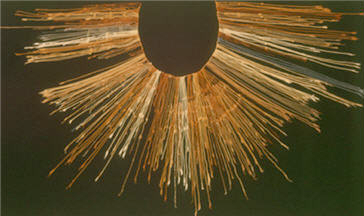
Khipu
I like this "Exode variation" on the end of Eternity (in which Noÿs dies far in our past at about the time when written language first appears on Earth) better than what I had originally imagined in 2009 for The Start of Eternity. It is fun to imagine ways that "ancient Interventionists" could have left behind cultural artifacts that have gone unrecognized. In what way could Noÿs have made a cultural impact about 10,000 years ago that could have persisted and transmitted information about our present times all the way into the 20th century?

Technological Intervention
Ancient lenses?
In the original Exodemic story I imagined that Interventionist agents showed Alexander the Great how to use simple lenses to make possible a system for microscopic writing. That technology for microwriting was discovered by the Overseers and they put an end to its use on Earth, but some of the lenses remained behind as puzzles for archeologists.

For Exode, we can ask how Noÿs might have arranged to have stories about the 20th century propagate across 100 centuries. Recognized evidence for writing that was preserved in stone and clay only goes back about 50 - 100 centuries. However, it is fun to imagine that we might some day discover evidence of unusually advanced artifacts at a 10,000 year old archeological site. Some forms of mnemonic aids that might assist in the propagation of stories through long periods of time might not leave clear evidence of their existence in ancient times. Noÿs is able to compare the ancient myths of the Noÿs Reality and the Buld Reality and notice a difference that she attributes to her own presence on Earth 10,000 years ago.


The Buld Reality
Sequence of Realities: Eternity, Foundation, Noÿs, and Buld.
Before the Huaoshy can cause the "Buld Reality" (which is the world as we know it) to come into existence, there is an intermediate "Noÿs Reality". In the Noÿs Reality the Huaoshy take control of their Base on the Moon at a point during the 20th century. In the Noÿs Reality, Noÿs lives out her life in the 20th and 21st centuries. Under the influence of Noÿs, advanced nuclear technology is developed and Earth never makes heavy use of fossil fuels and never goes into an age of serious global warming and catastrophic sea level rise. However, Earth suffers a nuclear catastrophe instead. The Huaosy show Noÿs that future and in so doing, gain the help of Noÿs for initiating another Reality Change. By sending Ekcolir back into the distant past at the end of the last glaciation the Huaoshy are able to keep control of Observer Base on the Moon and arrange for a Buld spaceship to arrive in the Solar System early in to 21st century. At the end of Exode, we are left wondering if Earthlings can make use of Buld technology to prevent catastrophic sea level rise.

My next blog post further sorts out the differences between the Noÿs Reality an the Buld Reality.

Mar 10, 2013

You Are Being Watched

CoversByRobin
Are some people naturally susceptible to mind control? I've never been able to "buy into" one of the popular myths of our culture: that an all-seeing God watches everything we do. The origin of such myths and the power that they hold over some people puzzles me. It is fun to imagine science fiction plots that might explain such puzzling features of human culture.

For stories set in the Exodemic Fictional Universe, Observers are a small group of humans who live at a secret base hidden under the surface of the Moon. The Observers believe that their job is to constantly observe events as they unfold on Earth; they keep a record of the past course of human civilization. They believe that their observations are of vital importance for the Overseers, an even smaller group that functions as a kind of police force on Earth.

Policing a Planet
From the perspective of the Overseers, the worst crime possible is for members of some advanced extraterrestrial civilization to visit Earth and provide the Earthlings with new technology or knowledge that will alter the course of development of human civilization on Earth. According to the Rules of Observation, the people of Earth must be allowed to develop at their own rate and they must not be told certain truths: 1) Earth was first visited by space aliens millions of years ago, 2) there are humans living on other planets, 3) humans are "domesticated primates" that evolved under artificial conditions on distant worlds, 4) Earth is under constant observation.

Cherie Logan
In the story Exode, the Observers are not actually needed for making observations: the alien Huaoshy have a fully automated system for observing events on Earth. However, the Overseers do need the services of the Observers. In much the same way that you cannot look directly at the Sun, the Overseers cannot tap directly into the "Bimanoid Interface" that is available to the Huaoshy. The Observers function as a kind of filter that provides a "low fidelity" interface for the data stream from Earth; essentially, the data that reach the Overseers is restricted to just the information that the Huaoshy want the Overseers to have. By controlling the fidelity of the Observer data channel, the Huaoshy can precisely regulate the efficiency with which the Overseers can do their police work.

Of course, the Observers and the Overseers have no real understanding of the Huaoshy. What the Overseers do know is that in the Galactic Core there are many worlds populated by humans. They also know that there is an almost irresistible temptation for some of those extraterrestrial humans (the Interventionists) to visit Earth and try to alter the course of development of human civilization on Earth. This puts the Earthlings at risk of being rushed along towards an advance technological civilization before they are ready to make wise decisions about the use of powerful and dangerous technologies. The Overseers believe they are protecting the people of Earth from such dangers.

Cheryl Pelkey
So, within each human on Earth there is an invisible swarm of zeptoscale devices integrated into our brains. That swarm constitutes a "bimanoid symbiont" that is actually an integral part of the artificial lifeform that is the alien Huaoshy. Using that "bimanoid interface" the Huaoshy can monitor everything we do and think. Is there any way for we humans to make use of our bimanoid symbionts for our own needs and purposes?

In Forward the Foundation, Asimov described how Wanda and Stettin Palver discovered their "mantalic" ability to communicate telepathically. In Exode, humans can communicate by means of nanite-mediated telepathy, but for the most part the information that is exchanged is processed by unconscious brain activity. The Huaoshy have been designing a new primate species as a planned replacement for humans, the Prelands, who have mostly abandoned spoken language in favor of telepathy, but they are only mentioned within the Exode story...the Prelands remain off stage. In fact, the Prelands are only tentative, at best, as a species. They are at the border between biology and artificial life and cannot reproduce without the help of the pek.

Thus, we are all very close to having direct, two-way communication with the god-like aliens who have watched over us for millions of years, but the Huaoshy view we humans as primitive creatures. The Huaoshy are as interested in the lives of individual humans as we are interested in the individual blades of grass in a pasture.


Noÿs the time traveler
Noÿs
But what about Noÿs? Noÿs arrives in the 20th century from the future and she carries within her a type of nanite that is only available in the distant future of Earth. I imagine that her special nanites give Noÿs some capacity to tap into the "Bimanoid data stream" of Humanity...this gives her a chance to stay a step ahead of the Overseers and complete her mission in the 20th century.

Part of that mission is to pass important information on to her daughter, Gwyned, who will in turn share knowledge of the future with Parthney. At Lendhalen, Gwyned is asked to make a written record of her experiences on Earth. In Chapter Three of Exode, Gwyned passes along to Parthney an account of a strange story that Noÿs told to Gwyned shortly before Gwyned was teleported off of Earth. Noÿs never explicitly told Gwyned about time travel, but Noÿs hinted about the idea that certain myths and legends might contain meaningful information about Overseers.

Noÿs spends more than 30 years in the 20th century and near the end of that time she finally gets to meet an Overseer. Noÿs is briefly given full access to the "Bimanoid data stream": she learns the point in Earth's past when the Earthlings began to develop and use written language. That closely corresponded to the point in time when a Buld spaceship began its 15,000 year journey to Earth. Noÿs believes that it is her advanced nanites from the future that give her access to the "Bimanoid data stream", but the Huaoshy "step in" to the Overseer and give Noÿs access to the data she is seeking.
Joseph Finley

A few years after Gwyned leaves Earth, the Interventionist agent named Ekcolir travels through time, going back to near the end of the last glacial period. Noÿs is sent back only about half as far into the past where she tells stories to the primitives about the fateful decision that must be made for Earth: will humans have the chance to develop a technological civilization or will the humans simply be thrown into the trash heap of evolution, replaced by the Prelands?

One of the central myths of humanity is derived from their stories of the future. Their description of how sea level rises when glaciers and ice caps melt in the future gets warped into tales about a great flood of the past. Noÿs helps get the ancient Earthlings started towards using written language. 10,000 years in our past is when Interventionists start frequently arriving on Earth; new gene combinations are made available on Earth that might help the Earthlings survive in a technologically advanced civilization.

After Noÿs and Ekcolir reach their destination in the stone age, the Huaoshy pull the plug on Eternity. But that is another story.

Robert Henry Charles

Fallen Angels
One of the major plot elements in Exode is the process by which genes are transferred to Earthlings from worlds of the Galactic Core. Last summer I staked out my position: There are no angels in science fiction. However, it is amusing to hint in Exode that that various human ideas like "angels" might have been influenced by visitors who came to Earth from other planets. How would stone age humans make sense of someone like Noÿs telling them stories about trying to introduce gene combinations into the human population of Earth so that Earthlings could survive entry into a coming age of science and technology?

The text of Exode only hints at the possibility of time travel. When Parthney arrives on Earth he tries to find Noÿs, but Noÿs is gone by then; she went into the past, to a time about 10,000 years in our past.

I'm having trouble deciding if Parthney should become infected by the nanites that Noÿs brought to the 20th century from the future. Right now, I'm thinking that only Deomede carries those nanites and not Parthney. However, those nanites somehow need to be "smuggled" into Observer Base on the Moon.

The Great Flood
Noÿs is from a Reality in which human-induced global warming melts the Antarctic ice cap and causes the sea level to rise 200 feet above current levels. She is also allowed a peek into the future of our Reality (the Buld Reality) and she knows that Earth is at risk of suffering a technological disaster. It is fun to imagine that stories told by Noÿs to stone age humans might contribute various "flood" stories that become converted into ancient myths about a great flood in the past. Noÿs lives out the end of her life on Earth during a warm period about 10,000 years in our past. The rising sea levels of that time are hardly noticed by stone age humans.

As told in Asimov's The End of Eternity, Noÿs was able to view alternate Realities. Her goal was to go back in time and cause a new Reality to come into existence, one in which there would be no further time travel. At the end of Exode, hints are given suggesting that with the help of the Buld and information passed from Noÿs to Gwyned and on to Parthney, it might be possible to prevent the Antarctic ice sheet from melting.

In general, the "Bimanoid symbionts" that are inside everyone on Earth automatically prevent anyone from "spilling the beans" and informing Earthlings about the existence of Genesaunts. Noÿs is an exception, since she is from a future time when Earthlings have the technological means to liberate themselves from their "Bimanoid symbionts". While living in to 20th century Noÿs is amused by certain ancient myths that she suspects came into existence because of things she will tell stone age humans before she dies.
________________________________

See: Prophecy by Time Travel, my next blog post, which describes how Noÿs helps to bring our Reality (the Buld Reality) into existence.

Bimanoid Interface. For more about the Bimanoid Interface see my blog post about the  "Kac'hin".