In my
previous blog post I mentioned Randall Garrett's story "Blank?", in which the fictional chemical diazotimoline is used to shift minds through time. However, when Bethleman self-administers some diazotimoline, he is also quite drunk, so Dr. Kamiroff must wonder if the "mental time travel" experienced by Bethleman is due to the combined effects of ethanol
and diazotimoline.
The Chemistry of Time Travel. First published in 1800, "Peter Klaus" or "Peter the Goatherd" featured wine drinking and a 20-year-long sleep for Peter. This story was followed in 1819 by Washington Irving's "Rip Van Winkle". While squirrel hunting in the mountains, Rip finds an odd troop of men and samples their liquor. He falls asleep and wakes up 20 years later.
Fourth Dimension Powder. In the Winter 1930 issue of Science Wonder Quarterly was another story of chemically-induced time travel, "Into the 28th Century" by Lilith Lorraine, pen name for Mary Wright, a poet and author of several science fiction tales.
 |
Dream Dimensions. Part of "The Acolytes" (1946), a poem by Mary Wright (source)
|
Alternatives. Not being a fan of
Howard Lovecraft, I had to look up the meaning of
Yuggoth. Ever since I read
Jack Vance's novel
Trullion, I've been intrigued by science fiction story tellers who include "dead stars" or "dark stars" in their fiction. Vance described
Alastor Cluster as having 30,000 "live stars", but also dark stars and "planetary oddments of iron, slag and ice" which were available sites for the bases of space pirates. I love the idea of "
dark matter" which might point towards the existence of non-baryonic, as-yet-undiscovered particles. Maybe most of the universe is made of
hierions and sedrons. In any case, it is part of the science fiction lifestyle to always be looking for alternatives to conventional ideas and thought processes. However, I'm not sure that I can join Lilith Lorraine in her apparent enjoyment of an alternative fantasy world without our familiar stars.
 |
Figure 0. In the 28th century: Anthony and Iris.
|
"Into the 28th Century" begins in 1932 when the happiness of the protagonist, Anthony, depends on a "fourth dimension powder" that was developed by Professor Peter Holden, a chemist. Anthony gets caught in a strange kind of time loop. Mary lived in Corpus Christi and she made that city a part of her tale of the future.
Motor-boat Time Machine. "Into the 28th Century" is told from the perspective of Anthony, who served in the Navy from 1928 - 1932 and then returned home to Corpus Christi. He buys a motor-boat and while out motoring he is suddenly sent into the future about 800 years. Arriving in the future, Anthony is told that he was accidentally plucked out of the past.
 |
Anthony is sent into the future; page 1 illustration for "Into the 28th Century" by Frank R. Paul
|
 |
Figure 1. Why nobody in the 28th century grows old.
|
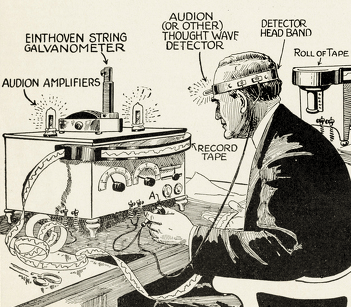
President Therius. Two people of the 28th century who Anthony soon meets are Therius and Iris. Therius explains that "thought-transmitters" were developed soon after the age of radio. Another story published by Mary Wright in 1929 was "
The Brain of the Planet", which begins in 1935 when Harry Maxwell builds a "thought wave" transmission station and quickly transforms the world into a social and economic utopia (see
the next blog post).
 |
the battleship returns to Corpus Christi, A.K.A. Nirvania
|
The new materialism. Other future inventions included a disintegration ray, a re-integration ray and, Therius further explains, the "
summit of human achievement was attained in the so-called 'creation of matter' through the materialization of thought". Therius casually notes that 28th century life is powered by thought-focusing crystals of the Orient which perfectly unify science with metaphysics.
Therius looks like a young man, but he is the 95-year-old president of Nirvania University which uses a well-preserved 1980s battleship to give students a tour of the world. Science of the future eradicated all disease-casing germs and repaired all genetic defects, leaving only mental problems to plague Humanity. But even those problems were solved, as shown in
Figure 1, above.
At this point, Iris, a student of history, takes over the story, explaining to Anthony that by 1955 a Great Revolt had been completed by means of a Disintegration Ray that was used by the younger generation to kill everyone in the older generation who was a supporter of Mammon. Then, under the benevolent sway of Socialism, a sexual revolution was accomplished, liberating women. This was aided by the "new immortality", which freed women from the hardship of childbirth.
 |
28th century history: the triumph of eugenics
|
Race to the Future. Iris merrily mentions in passing that removal of genetic defects from the human population involved removing "
undesirable racial strains by wholesale sterilization". It would be interesting to know how Mary Wright felt about eugenics in later life after seeing how it was implemented in
Germany.
 |
Figure 2. Anthony has the future vibration
|
Space Age Vibe. Iris casually mentions in passing that Earth of the 28th century has recently "
established communication with Mars and Venus". Anthony is infatuated with Iris, but he is worried that he might be too primitive for her futuristic refined tastes in men.
 |
Figure 3. Trouble in paradise.
|
Iris assures Anthony (see
Figure 2) that the device which plucked him from the past and brought him into the 28th century used a "thought-net" that can only capture people already having the correct "thought vibration rate" that is suited for the future. Iris takes Anthony to one remnant of the past, the castle of the Mad Inventor (see
Figure 3).
 |
Fig. 4. The secret of Peter's Fourth Dimensional Powder!
|
Vibrations of Thought. Inside the castle (see
Figure 0, above), Anthony discovers the museum-like laboratory of Professor Peter Holden.
Soon enough, Anthony opens a metal vial and takes a sniff of Holden's great chemical discovery, the Time Powder™. Then, POOF! "exactly 48 hours" after arriving in the 28th century, Anthony is returned to the past and he meets Holden. Professor Peter explains the secret of his great chemical discovery, the Fourth Dimensional Powder (see Figure 4, to the right).
Back to the Future. Peter will need three weeks to synthesize enough of the correctly formulated time travel chemical that is needed to send Anthony back to the waiting arms of Iris in the future. Anthony writes an account of the 28th century and gives it to his aunt (presumably she is Mary Wright), expecting her to get the story published, maybe in a science fiction magazine, if nothing else.
I have to wonder if a young Isaac Asimov read "Into the 28th Century" and if it influenced his later stories about the imaginary chemical "thiotimoline" that was able to "move" along the Time axis in an unusual way. As described in my previous blog post, Randall Garrett used diazotimoline in a 1957 story to "project" a man's mind 2 weeks into the future, which seems tame compared to "Into the 28th Century" where a mere whiff of the 4th Dimensional Powder moves Anthony hundreds of years through time.
 |
Immortal Ameboid Alien. Interior art by Gould.
|
Mary Wright also published a story called "The Jovian Jest" in the May 1930 issue of Astounding Stories. In "The Jovian Jest", an ameboid alien arrives on Earth and explains that in most of the universe, life is quite different than Earthly life. Through his career, Asimov often explored the idea that the way life had developed on Earth might be unusual or unique. For example, in "What Is This Thing Called Love?", an asexual alien visits Earth and discovers that the complex organisms on Earth reproduce sexually, but the alien scientist is not able to convince his fellow aliens that sexual reproduction is possible.
 |
| editorial blurb for "Into the 28th Century" |
In the
September 1983 issue of "Isaac Asimov's Science Fiction Magazine", Asimov had an essay called "Nowhere!" in which he stated his opinion that stories about both utopias and dystopias were boring. Mary Wright's "Into the 28th Century" (described above on this page) concerned a future utopia and the only drama in the story is the unanswered question: can Anthony get back to his beloved Iris in the future? To do so, Anthony needs the help of Professor Peter Holden, the inventor of the Fourth Dimensional Powder. While asking for this favor, Anthony diplomatically tells Peter, "...
you'll send me back or I'll kill you!"
At the end of 1935, Mary Wright published "The Isle of Madness" in Wonder Stories. For this story, Wright depicted a kind of alternative Reality in which "Edson" was the last inventor of the early 20th century. His great invention was the thought-machine "whose vibrations played upon human minds and moulded them to the will of the Iron Masters".
Asimov once suggested that it might be possible to trace many of his story ideas to the stories of other writers that he read while growing up. Try to imagine a young Isaac Asimov who might have read about Mary Wright's "thought-machine" in 1935 and then later wrote his own stories about devices like the the
visi-sonor.
Machine Men of Machine World. As told in "The Isle of Madness", some time after 1940, the world split into two cultural divisions. Most of Earthly civilization was dominated by those with their Higher Brain disconnected from their Lower Brain by the "thought-machine". These people behaved like machines and lived as "machine men" within the "machine world". The remaining free-thinkers of Earth were all exiled to an island, where after 10 generations, Ulthor (he frequently hears a voice in his head) leads the Party of Expansion.
When the Expansionists finally leave their island, they find that the civilization of the Machine World has collapsed. I've long been puzzled by the many Asimov stories that feature characters who have mysterious powers of intuition, even without hearing mysterious voices.
Oriental Drugs.
Figure 5 shows a sentence from "The Isle of Madness" which may have influenced Asimov's thinking about intuition. I have not been able to find out very much about Mary Wright's education. It would be interesting to know if she studied any science subjects such as chemistry. What were her sources of information about "Oriental drugs" (see
Figure 4, above)?
I have no idea if Wright ever read "A Tale of the Ragged Mountains" however, this article describes the influence of Edgar Allan Poe on the science fiction genre and on other writers such as Howard Lovecraft. "A Tale of the Ragged Mountains" implies a morphine-fueled time travel trip experienced by Augustus Bedloe (or maybe Bedlo) during which he goes from 1827 to 1780.
Related Reading: time crystals
Next: the thought wave transmitter