Showing posts with label Durdane. Show all posts

Sep 15, 2014

Lost Worlds

In my previous blog post I praised the skill that Jack Vance displayed in his creation of the protagonist (Kirth Gersen) in the Demon Princes saga. I've also previously admitted to enjoying Vance's depiction of the other-worldly character Ifness in the Durdane Trilogy. Here, I want to explore the differences between the Durdane Trilogy and Vance's other science fiction.

The various novels by Vance that I've read were published over a 40 year span:
The Languages of Pao (1958) [at the time, Vance was 42 years old; this was the year before I was born]
Star King (1964)
The Killing Machine (1964)
The Palace of Love (1967)
Emphyrio (1969)
The Pnume (1970) See this blog post.
The Anome (1971)
The Brave Free Men (1972)
The Asutra (1973)
Trullion (1973)
Marune (1975)
Wyst (1978) [the year I discovered Vance; he was 62 years old]
The Face (1979)
The Book of Dreams (1981)
Araminta Station (1989)
Ecce and Old Earth (1991)
Throy (1992) 
Night Lamp (1996)
Ports of Call (1998) [Vance was 82 years old]

Lost Worlds
There are several "lost worlds" that Vance used as settings in science fiction stories. The entire Durdane Trilogy concerns a planet that was colonized by humans, then cut off from contact with Earth, then ended up being secretly observed by agents of Earth's Historical Institute some 9,000 years after having first been settled. Ifness is an agent of the Historical Institute, studying the mysterious events that occur on Durdane. On the far fringe of known space, the planet Durdane functions like a "canary in a coal mine", attracting a bizarre alien invasion that can be observed -and countered- by Earth's secret agents.

The protagonist of the Durdane Trilogy is Gastel Etzwane. Vance's plots for the science fiction novels listed above were generally designed around coming of age stories told through the experiences of a young male character such as Gastel (see Gersen, Glinnes and Glawen).

Aliens crop up in other Vance stories, but usually they are not the stuff of Hollywood invasion flicks. For example, on the planet Marune, humans peacefully coexist with the natives (the Fwai-chi). In contrast, the Asutra are parasitical creatures who take control of their human hosts. The planet Durdane is subjected to an invasion by two kinds of alien creatures, one (the Roguskhoi) that impregnates human females causing them to give birth to a clutch of additional aliens and another (the Asutra) that can take up residence inside a human body and take control of the person's brain.

In his Demon Princes series, Vance introduced two other "lost worlds" on the fringe of known space: "Teehalt's Planet" and Thamber. The general idea is that when humans went out into the galaxy and settled distant worlds it was fairly easy for some of the colonized worlds to either be forgotten or kept secret after their initial discovery. In Vance's fictional universe, it is common for terrestrial planets to have intelligent life forms (such as the Fwai-chi) or be discovered holding the ancient ruins of a dead civilization. Vance really liked to play around with the "lost world" literary plot device. Stories about lost civilizations pre-dated the SciFi genre but lost planets provided Vance with settings for several interesting SciFi adventures.

Parasitical Aliens
The science fiction genre has long been parasitized by horror themes. I'm not a fan of horror and most SciFi parasites are not biologically plausible. The idea that two organisms evolved on different planets can meet and quickly establish a host-parasite relationship is silly. In The Asutra, Vance tried to depict the ineptly rampaging Roguskhoi as an experimental bio-weapon, but the whole Durdane Trilogy comes off as an unlikable mixture of vampire fantasy horror jumbled together with a rehash of another of my least favorite types of SciFi stories: an alien invasion where inexplicable alien incompetence assures that blundering humans will survive. The invading Roguskhoi are transported to Durdane by spaceships then they proceed to terrorize the human inhabitants with their swords.

Fwai-chi
Vance's imagined aliens are often biologically implausible, but in small doses they can add an amusing element to a planet. A good example are the telepathic Fwai-chi who can secrete drugs that erase or return human memories. I can easily imagine them as an ancient species with hidden nanotechnology. To defend themselves against the avaricious Kaiark Rianlle, the Fwai-chi assist Efraim, providing him with an elixir that returns his lost memories.

Gastel Etzwane
Gastel
How does Gastel compare to other Vancian protagonists such as Gersen, Glinnes and Glawen? Vance had fun depicting Gastel as a musical prodigy. I suppose we can imagine that on the planet Durdane the entire social system allows for efficient selection of gene combinations that make possible a caste of talented musicians who have an independent nature. Most other residents of Durdane seem to accept their miserable lives while they suffer under the absurd rules of their local district and cower before the Anome, their supreme ruler who can, at any time, press a button and kill anyone who breaks a law. Without a revolutionary like Gastel on the planet, might the alien invasion have been successful?

Roguskhoi
Vance's protagonists are often propelled to success by luck rather than by talent. Gastel's brother is depicted as unwilling to conform to the absurd social conditions of his world, but he is punished for his disobedience and ends up dead at a young age. Why is Gastel lucky enough to survive?

Swordpunk Fantasy
Vance's writing ranges across multiple genres from mystery to horror to science fiction to fantasy. As mentioned above, the Roguskhoi use swords, which for me is a warning sign that a science fiction author has probably drifted into the domain of fantasy. Vance asks us to believe that if we deliver human colonists to the surfaces of distant planets then the settlers of those worlds are likely to regress and their descendants will undergo social degeneration and end up living in medieval civilizations. In my view, this is just an excuse that allows Vance to slip sword and planet fantasy into a SciFi story.

source
Vance would probably be upset by my tendency to patrol the boundaries between horror, fantasy and science fiction. Does it matter if there are fantasy elements in the Durdane saga as long as readers are entertained?

Gersen kills Bel Ruk
Probably not, but for me there is a difference between Kirth Gersen having a knife fight at the end of Hadaul game with the evil henchman Bel Ruk on the planet Dar Sai in The Face and space age warriors being equipped with swords during an alien invasion of a planet.

The Two Vances
The blues.
In my opinion, the Durdane Trilogy along with Night Lamp and Ports of Call fall flat in comparison to other Vance works like the Demon Princes saga, the Alastor Cluster novels and the Cadwal Chronicles. For me, there is a tipping point that can be reached whenever Vance allowed a story to become too darkly filled with unpleasant people and places that I would never want to visit.

Gastel Etzwane remains a mystery to me. He is an emotional cripple, the product of an absurd people (the Chilites of Canton Bashon) who have rigidly defined roles for men and women. All the women are prostitutes, including Gastel's mother and sister.

Swordpunk
The most interesting character in the Durdane Trilogy, Ifness, dispassionately expresses his intellectual delight in the uniqueness of the Chilites. One moment Gastel is disgusted by the detached attitude of Ifness towards the misery of the people of Durdane such as the Chilites, and then the next moment Gastel returns to his music, apparently himself willing to let the people of his world continue to suffer in dark age misery. He has to keep reminding himself that his mother is still a slave and he should do something about it.

light and play
In fact, this is almost how the story ends after Gastel has learned that Earth is not just a legend and there are many human worlds that enjoy advanced technology and wonders like space travel. What is left for him but his music? He can live out his life playing the blues and lamenting the sad fate of Durdane.

source
At the end of most Vance novels I want to know what happens next....I'd like to spend more time in the imaginary world that Vance created. In the case of Durdane and Gastel I've never felt a desire for more. Some ports of call are better off lost, or reserved for those who perversely enjoy the dark and gritty side. I prefer adventure stories that minimize the blood splatter and err on the side of light and playfulness.
_____________________
Related Reading: grimdark

May 30, 2013

Jack Vance

The Moon Moth
In 1977 I read The Moon Moth and I have not stopped reading Vance's fiction since. At that time, The Moon Moth was an effective gateway drug since it was in story collections that could be slipped into a university curriculum without a "pulpish" cover to get in the way.

Star King
I'm not a big fan of short fiction, so after reading The Moon Moth I was pleased to come across several of Vance's science fiction novels including Trullion, Emphyrio and Star King.

Alastor Cluster
see
Of course, Trullion and Star King were gateways to the hardcore Vance....they were just the first novels in the Alastor Cluster and Demon Princes series. With time the Cadwal Chronicles also came along. Those three series of novels are my favorite Vance works. Today I found out that Jack Vance died this week at the age of 96. I was thinking he might last an entire century here on this world, but...no. 😢

click map to enlarge (source)
I have a love of maps and I was thrilled to open up my copy of Trullion and find a map of the Fens. It is always a pleasure to think of the parade of Vance's characters traversing the waterways of the Fens:
source
"Squire" Glinnes Hulden of Rabendary island, the golden Karpoun sheirl Farero... marooned on an island off shore from Welgen with Glinnes, pirates like Sagmondo Bandolio, Lempel and Alonzo "Ice Devil" Dirrig....the later pretending to be Lord Ambal, freakish Fanschers like Junius Farfan, gypsy-like Trevanyi such as Duissane Drosset, the Connatic -ruler of Alastor Cluster- in the guise of journalist Ryl Shermatz, Janno Akadie the mentor at his fine five-towered manse on Rorquin's Tooth, Chief Constable Filidice compliantly doing dirty work for the scheming lord "Tammi" Gensifer and young girls like Sharue...one wrong step away from being dragged under water by the merlings.


When Glinnes reaches the frustrating and futile end of his struggles he is assisted by the mysteriously appearing and reappearing Shermatz. Sitting across the central square in Welgen from the executioner's prutanshyr, Glinnes complains to Ryl, "Akadie may well be inserted into the cogs of yonder mincing machine."


Shermatz, puzzled by the lack of evidence against Akadie suggests, "A few words with Chief Constable Filidice might be worthwhile."

"Return to your seat," said Glinnes. "He won't see us." Glinnes has already been thwarted by Filidice who is corruptly wielding the force of Trill law and bureaucratic obstruction in support of lord Gensifer.

Trullion
Finally Shermatz reveals his secret..."I think he will. I am something more than a roving journalist, as I hold the commission of Over-Inspector in the Whelm." After long fruitless effort, suddenly all of the many problems facing Glinnes are resolved and he walks off into the a bright new future with Duissane. Or does he?

Marune

In Marune: Alastor 933, Efraim, the young Kang of the House of Benbuphar in the Rhune Realms, is drugged senseless and sent off across space. To recover his memories and learn his own identity he visits the Connatic's Hospital on the planet Numenes. Efraim also visits the Connatic's "palace" -a soaring tower built upon foundations set within five islands- where upon seeing the display chamber for the planet Marune he begins to recall some of his past on his own home world.


Most of the story takes place in the Rhune Realms of Marune where almost always at least one of the suns is in the sky. About once a month darkness falls. During the dark of Mirk strange events often occur. Efraim survives a murder attempt, but his friend from Port Mar, Lorcas, dies at the hands of the vicious Destian and Agnois, First Chamberlain.


Efraim, still struggling to recover his damaged memories, renews his acquaintance with his childhood friend Maerio -daughter of the scheming Kaiark Rianlle- and falls in love again. With the help of the mysterious native Fwai-chi, Efraim regains his memories and control of his kingdom. But have his off-planet experiences destroyed is ability to fit in with Rhune society?

Wyst
The third Alastor Cluster novel begins and ends on Zeck, the home planet of Jantiff Ravensroke, but most of the story unfolds on the planet Wyst where Jantiff befriends a Wierdlands Witch who he calls Glisten. He saves her from the witch-hunting Booch and his dogs, but then she is lost in the forest along the shore of the Moaning Ocean.


Ryl Shermatz, again appearing in the role of "the Connatic's agent", ultimately finds the lost waif Glisten and reunites her with Jantiff on Zeck.

The bulk of the story concerns the odd culture of the vast cities of Wyst and how Jantiff's presence stimulates a vile plot by the devious Esteban aimed at taking control of the planet. Ultimately Jantiff helps Shermatz diffuse the plot and he save's Ryl's life, earning an offer of a position in the Connatic's service.

In all three Alastor novels the protagonist gets the girl and survives great travails, but we are left wondering what happens next in their lives.

The Demon Princes
In a recent blog post I reflected on some of the people and places in The Star King and other novels in the Demon Princes series. Last year I counted up the number of evil-doers that Kirth Gersen must kill and the number of damsels in distress that he rescues.

Gersen faces the rather grim work of murdering the five Demon Princes who had killed and enslave his family. The bloodshed is off-set by the many ingenious tricks that Gersen employs to thwart the plans of his adversaries. 

The Palace of Love
In the pages of book three in the series, Vance paraded the clones of Jheral Tinzy before our "eyes". These clones were created and manipulated by the nasty Vogel Filschner in attempt to produce a copy of the adorable Jherel who would return Vogel's love. To hunt down and approach Vogel, Gersen buys the magazine Cosmopolis and plays the role of a journalist.

Of course, Vogel's great plan never works out. The mad poet Navarth's ward "Zan Zu" instinctively dislikes Vogel even when he is disguised as Henry Tanzel of London. Clone Drusilla IV was kept in isolation until rescued by Gersen. Gersen is the first man she has ever seen and she calls him "wonderful". She later sees Vogel and comments on his foolish wicked face. Drusilla III was trained to worship a statue of Vogel, but she did not like the face and chipped it away.

The Killing Machine
In The Killing Machine, Gersen and Kokor Hekkus trade sly tricks. Hekkus imprisons Gersen at Interchange, but then Gersen escapes with 10,000,000,000 SVU of Hekkus' money and leaves Hekkus holding counterfeit cash that is worthless.

Hekkus has long been tricking the entire population of the planet Thamber, using that world as his fantasy playground. When Gersen arrives on that hidden planet it takes him a while to penetrate Hekkus' disguises, but Gersen ultimately tricks Hekkus into exposing his true identity as a hormagaunt. Hekkus is destroyed and Gersen rides off into the sunset with Alusz Iphigenia Eperje-Tokay.

The Face
In The Face, the Darsh rachepol Husse Bugold plays a devious trick on Gersen. Before blowing up a spaceship, Bugold takes out insurance from a company that Gersen owns.

While in pursuit of Bugold, Gersen falls in love with the endearing Jerdian Chanseth. However, Jerdian's father Adario is a wet blanket on the flames of their ardor. Jerdian realizes that as a Methlen, there can be no future for her with Gersen. However, in the end, after long struggles to get his hands on Bugold, Gersen gets the last laugh.

At the climax, after telling Bugold that he takes pleasure in preventing his greatest trick from being realized, and after Bugold dies a horrible death, Gersen realizes that he shares the same motivations to implement Bugold's fantastic trick. Gersen triggers the explosives that Bugold has planted inside the moon Shanitra, transforming it into a great copy of Bugold's face, a face that will now shine down over planet Methel and, particularly, over the garden wall of Adario Chanseth.

The Book of Dreams
In The Book of Dreams, the last book in the series, Gersen has achieved mastery of his trickish ways. He devises an Extant magazine contest that draws Howard Hardoah into the open. Gersen sneaks into the high school reunion of Howard and, disguised as a musician, he manages to shoot Howard, unfortunately the injury is not serious.

After obtaining Howard's beloved Book of Dreams, Gersen uses it to lure Howard to his doom. Along the way to Howard's demise, Gersen falls in love with Alice Wroke. In Alice, Gersen has finally found a woman who shares his motivations for destroying evil men. Alice, Gersen and the Cleadhoes, two more of Howard's victims, trap Howard on the wild planet Bethune Preserve for a final showdown. In the end, his own "inner demons" finish off Howard.

Cadwal
Doug Beekman cover art
The Alastor Cluster and Demon Princes series came to rather unsatisfactory conclusions...I want to know what happens next to Jantiff, Glisten, Efraim, Maerio, Gersen and Alice. The Cadwal Chronicles seemed more complete. I can imagine Glawen and Wayness living out their days in relative calm after their travails as young adults during the epic struggle to preserve the Cadwal Conservancy. It might be fun to know what trouble Chilke and Flitz get into while roving around the galaxy.

Before Glawen Clattuc ever meets Wayness Tamm, his young heart has been entangled with the charming Sessily Veder. That Glawen and Sessily are under a lucky star is revealed when they go into the wilderness of Cadwal to collect butterfly wings for her Parilia costume. Sessily is to play the role of a butterfly and she wants to decorate her costume with real butterfly wings.

While out collecting the insect wings they are nearly killed by a Muldoon tangle-top. Their terrifying escape leads to discovery of a plot against Araminta Station, timed to occur during the Parilia celebration. General tragedy is averted, but Glawan is devastated by the mysterious murder of Sessily minutes after her on-stage performance. Sadly for Sessily, the lucky star was only actively shielding Glawan.

Only years later does Glawen learn the identity of Sessily's murderer: Kirdy Wook, who played Glawen false, leading to his imprisonment by the perverse Zadine Babbs at the Monomantic seminary on the planet Tassadero. When Gersen escapes and returns to Araminta Station, he is attacked by the murderous Kirdy, but Kirdy drowns in the ocean during the attack.

After their dangerous search across space for the lost Cadwal Charter, Glawen and Wayness can finally turn their attention to the satisfying task of constructing their new home on a plot of land granted to them under the new Charter. Who knows what tales of adventure they will hear from Chilke and Flitz when they gather for the opening of Lewyn Barduys' new Bainsey Castle Lodge on the planet Rosalia.

John Holbrook Vance

John Holbrook Vance, who often publishing his writings and science fiction as Jack Vance, was born in 1916. He became a published author after World War II, his work ranging from mystery to horror to fantasy and science fiction. Assisted by his wife Norma Ingold Vance, his output of stories was prolific and much appreciated by his many fans. We can still wonder what other worlds he might have shared with us had we a better way of supporting our artists and promptly and efficiently treating, or better yet, preventing conditions like glaucoma.
__________________________________
His blinded eyes registered a watery gray blur...Shermatz spoke to Jantiff: "I have specified a treatment to restore a certain fraction of your vision."

Jantiff felt a cool sensation across the front of his eyes...the blur before his vision began to dissipate as if a wind blew through the optic fog. Jantiff once more could see, with almost the old clarity. Jantif thought: In later years, when I look across my life, I will mark well this moment in the Old Groar Tavern at Balad on the planet Wyst...
______________________________
source
More commentary on the science fiction of Jack Vance.....

The death of Jack Vance: One Year Later, Two Years Later, Four Years Later
The origins of Jack Vance
Vale of Xian
Jean Parlier
Emphyrio

Cadwal Saga
     Araminta Station
     Ecce and Old Earth
     Throy
The Demon Princes
    Smade's Planet (Star King), Llalarkno and Brinktown
    The Face
   The Book of Dreams
   Evil Henchmen and Damsels in Distress
   Kirth Gersen: the 6th Demon?
  The Palace of Love
  The Killing Machine

Fleharish Broad
Alastor Cluster
     Trullion (see also) (and)
     Wyst
     Marune
The Languages of Pao
The Durdane Trilogy
___________________________
Related Reading: re-reading the novels of Jack Vance 
A tribute to Vance by Fernando Salazar
New to Vance? Start here.

visit the Gallery of Book and Magazine Covers
 

Jan 29, 2012

The Asutra


I previously mentioned (see this blog post) the fact that I've thought about a fan fiction sequel to Jack Vance's novel The Book of Dreams. Today I saw a blog post by Patrick Hudson about Vance's novel The Asutra in the Durdane series.

Patrick wrote about Vance novels ending on a "down beat note" or "a sour note". Which do you prefer? That a character you have followed through a trilogy reaches a happy ending, you close the book and never give a thought to what might happen next.....or.....you finish the trilogy and you can't stop imagining what the protagonist will do for the rest of his/her life?

Patrick wrote, "Etzwane longs to travel the universe, see Earth, but Ifness dismisses him as he might dismiss a bumpkin.....Etzwane even refuses to join his old musical band."

Etzwane has struggled mightily against the horrors inflicted upon the people of his world, Durdane. The Durdane trilogy progressively shows us the expansion of Etzwane's understanding of the causes of these horrors. At first, it seems that his woes are due to a freakish religious cult that controls the small community where he grows up. When he runs away from home, he learns about the bizarre political system of his nation, a "system" by which the ruler, The Anome, can instantly kill any of his subjects. Then things get bad. Durdane is attacked by space aliens. Finally, even after the alien attack is beaten off, Etzwane is left with the knowledge that people from the distant planet Earth watch Durdane and those observers (such as Ifness) from Earth do nothing to prevent the horrible cultural degeneracies of Durdane such as the the religious nightmare that set Etzwane on his path in life.

I love the fact that Vance ends his story in such a way that we are left wondering what Etzwane will do. In a similar situation, in his novel The Killing Machine, the people of a lost world that is similar to Durdane -cut off from Earth and technologically degenerated- decide that they must rejoin the community of human worlds that have space travel technology. At the end of the trilogy we are left wondering: can Etzwane bring Durdane back into the community of space-faring worlds? It would be against his nature to just rejoin the band and forget about Earth.

There are other memorable endings to many Vance novels. In Trullion: Alastor 2262, Glinnes and Duissane, after much adversity and conflict, find themselves with vast wealth at the end of the story. We wonder what their future will be like as they walk off together down the beach. In Marune: Alastor 933, Efraim and Maerio survive their challenges and become the rulers of a "mountain realm". However, they are not comfortable with the restrictions of the culture they grew up in and at the end of the novel we are left wondering about their future life together and what changes they will bring to their world.

Efraim: What shall we do?
Maerio: I don't know.
Efraim: I don't know either.

I particularly enjoy the Durdane trilogy because Vance manages to position Human Observers from Earth in the role that I usually assign to aliens in my "Exodemic" stories.

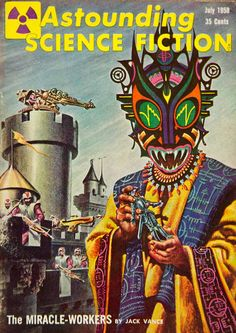
Images. Top: cover art by Peter Dama scanned from my copy (1978) of The Asutra. The "flying boat" is the property of Ifness; it allows him to move around Durdane and pretend that his flying machine (he does not let the natives see it fly) is no more sophisticated than the primitive technology of Durdane (sailing ships). Lower: Cover of Marune: Alastor 933.

I was looking for the cover image that is on my 1975 Ballantine Books copy of Marune: Alastor 933 (see above) and came across a bunch of other cover art for other editions of the novel.

The image to the right seems to be an artist's conception of Sthelany, who played with a toy puzzle while waiting for her brother to kill Efraim. However, in the story, she never saw Efraim looking in through a crack in the window that had been shuttered during Mirk.

The image to the left is apparently an image corresponding to the book cover for a foreign language version of Marune: Alastor 933. I can't imagine what the image has to do with the story unless the young lady is just supposed to be one of the display pieces in the Marune chamber of the Ring of Worlds.

I suppose that science fiction publishers have an equation that predicts how many thousands of book sales you can expect for each breast on the book cover.

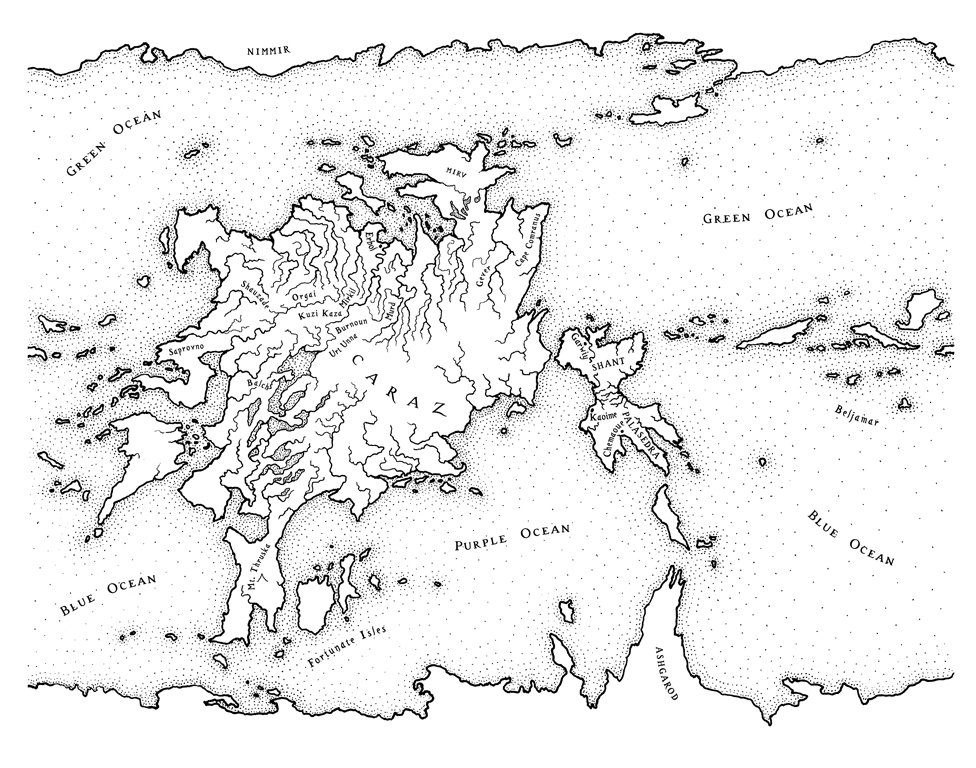
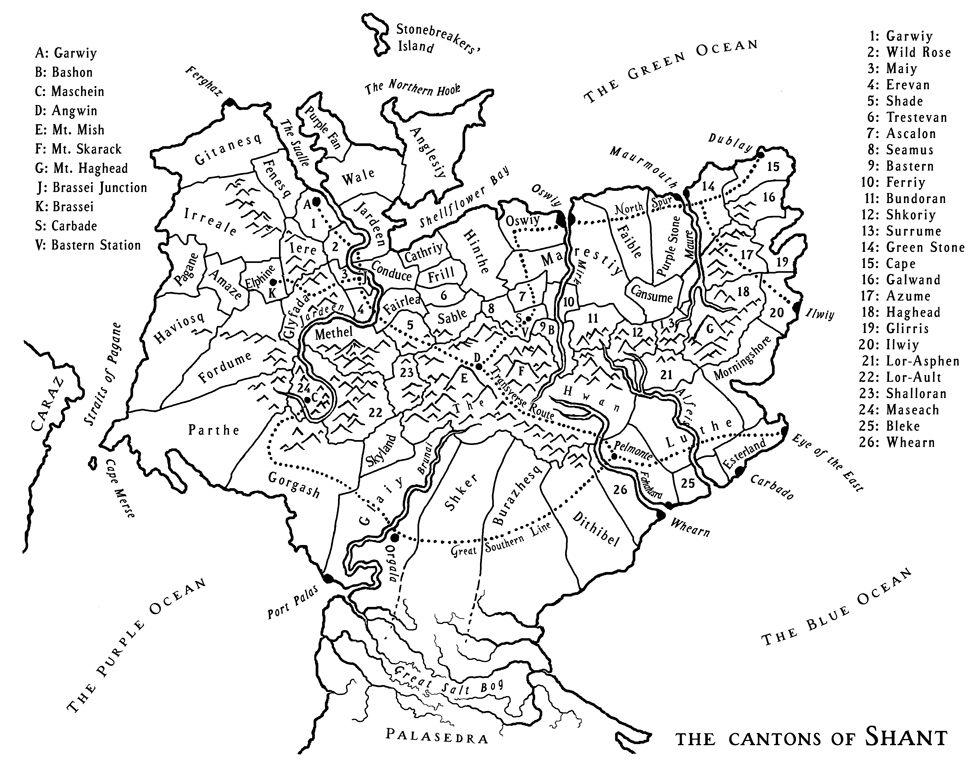
Related eye candy: map of Durdane.

Below, a map of Shant
(from www.jackvance.com)
(full size)