|
| The original comic. |
This is the fourth post in
a series where I search for evidence of interesting aliens in Summer 2012 SciFi flicks. I've been reading online about the plot of
Men in Black 3, one day after its release. (I have not seen the movie.) But first, some background....
The origins of the Men in Black are mysterious, but the secret organization was formed to deal with rumors of alien contacts.
I like to imagine that there have been alien visitors coming to Earth for a very long time, but in the 1950s humans began to have technology that would allow alien visitors to be detected. In 1961 there was a secret arrangement forged between some aliens and the Men in Black.
 |
| Agent K |
There are nasty wars going on "out there" among the stars, and planet Earth is a kind of refugee center for displaced aliens. Most Earthlings would freak out if they knew the truth, so the Men in Black must recruit a special breed of Agents who will do what must be done: cover-up all evidence of alien visitors on Earth. In the 1960s, Agent K is recruited into the Men in Black and he must abandon his dreams of a normal life with his girl.
 |
| Agent J |
1997. In the original
Men in Black movie we see Agent J as a superhuman cop and perfect fit for the Men in Black organization. Soon after Agent K recruits Agent J into the secret organization, Agent K is actively planning his own retirement. What is so special about Agent J? How can he so quickly replace the vastly experienced Agent K?
 |
| Laurel |
While working on his first "MIB must save Earth" mission, Agent J meets Laurel Weaver and he is attracted to her and concerned for her mental health. Her job frequently brings her in contact with aliens and she has repeatedly been
neuralized in order to make her forget what she has seen.
 |
| Agent L |
Agent J recruits Laurel to be his MIB partner and we can imagine a happy future for them as the dynamic duo (Agent J and Agent L) of the post-sexual revolution Men
and Women in Black.
However, in
Men in Black II we find that the "Agent J and Agent L live happily ever after" idea never worked out. Apparently Laurel and none of the other Men in Black can meet Agent J's standards. Why does Agent J have "the right stuff" while other Men in Black recruits often wash out?
Also, Agent K's retirement plan (to re-unite with his long-lost-love) has not worked out and he comes back on duty. Is there something special about Agent K and Agent J that makes it inevitable that they be Men in Black?
 |
| Laura Vasquez: half human & half alien? |
Laura Vasquez comes into Agent J's life and he is attracted to her. We learn that Laura is the daughter of an alien, Queen Laurana of Zarthan. Laura must leave Earth to fulfill her destiny on Zarthan. Is there some secret backstory, was there a relationship between Agent K and Queen Laurana? We have to start wondering: can aliens like Laurana mate with humans?
My original introduction to the concept of an alien living on Earth among humans was by way of seeing
Superman on television in the late 1960s. When aliens appear who look just like humans we need some backstory. Are the aliens shape shifters who take on human form? Are these "aliens" actually a branch of the human species with a long history of travel between Earth and other worlds?
MIB3. In
Men in Black 3 we start to learn some of Agent J's backstory. At the age of 5, his father died (in 1969), killed by an alien (Boris). Agent K was there and apparently arranged for the young boy to have a fairly normal childhood (not letting the boy know that his father had been killed by aliens), eventually growing up to become Agent J. What do we learn about the mother of Agent J?
Boris is the standard Evil Alien (yawn).
 |
| K (left) - Griffin (center) - J (right) |
The most interesting alien in
MIB3 is "Griffin". There seem to be some tips of the hat in
MIB3 to
Back to the Future. In
Back to the Future, time travel is only possible if the time machine reaches a speed of 88 miles per hour. Apparently there is a similar speed gimmick in the "time jumps" for
MIB3. Is Griffin named in honor of
Griff Tannen?
Griffin, as an alien, can apparently view many possible timelines and futures. This reminds me of Noÿs Lambent, a character in Asimov's time travel novel
The End of Eternity. Noÿs is a woman from the far future, from a time when humans have the technological means to view alternative Realities (timelines) and select among them in order to achieve the best outcome for humanity.
 |
| So many evil aliens, so few Men in Black |
Intriguingly, it sounds like Agent J also has the ability to perceive alternate Realities. Near the start of
MIB3 when the Evil Alien (Boris) goes back in time and kills Agent K, it is somehow possible for Agent J to remain aware of the previous Reality. Is it possible that Agent J has "alien blood"?
Chocolate milk. In MIBII Agent K used some clues/tricks that allowed himself to recreate the story of the "Light of Zartha" even after having been neuralized. As a biologist, I can't swallow the idea that changes in the timeline just happen to induce a physiological craving for chocolate milk in the star of a movie.
 |
| Give me the milk! |
However, if some Arcadian "time police" had tried to make the Men in Black forget about time travel, they might have planted a clue/trick that would trigger key people such as Agent O to recognize the clue as a an indication that time travel had taken place. Some people have suggested that part of the charm of the Men in Black films is that the heroes are ordinary people. I think it would be a better story if Agent J is a human-alien hybrid with some special powers, but I might be letting my own desires for an interesting backstory leapfrog over the actual aspirations of the MIB script writers.
When first seen in MIB3, the younger Agent K is yet to have an experience that will change his personality, making him more like the older crusty Agent of the future.
 |
| Crusty old K |
Based on the reviews I have read, it is not clear that the full basis for this "personality change" becomes known to the audience during
MIB3. Is it only that Agent K ends up feeling responsible for the death of Agent J's father?
Time Travel Paradox: Meeting Yourself...or not
Due to the wonders of time travel, towards the end of
MIB3 there are two "copies" of the alien bad guy in 1969: 1) the one from 1969 and 2) the one from the future who traveled back in time to 1969.
During the climactic fight scene, to save himself from being killed, Agent J "goes back in time a few seconds" and -poof- apparently there is still only one of him, remembering the future and saving himself from death. I put "goes back in time a few seconds" in quotes because it might be that Agent J is half-alien and has the ability to "see" future events. I'm not confident that the puzzled reviewers of
MIB3 (
example) are accurately reporting what happens in the movie. Alternatively, maybe the creators of the movie just "threw in the towel" and did not bother to make their time travel device work the same way all the time (boo!).
 |
| Surprise! You've been cast as the evil alien in MIB3! |
|
|
|
|
|
Time Travel Paradox: Hollywood Director Controls All Time Travel by Saying "Action"
Isaac Asimov summed up the place of time travel in science fiction: we simply cannot resist creating time travel stories....they are so much fun that science fiction authors often just cannot let slip away a chance to make one.
For me, a major issue is that if time travel technology were invented, allowing people to travel into the past, then we would always be wondering: is anything we experience "final" and "real"? Won't time travel always be used (again and again) to alter the course of events? We must confront this issue and put some constraints on time travel.
Isaac Asimov wrote time travel out of
The End of Eternity (after he had his fun with it), imagining one final Reality Change that would make time travel impossible. In
Back to the Future, the
Doc decides that time travel is dangerous, so he apparently goes ahead and builds a second time travel machine, but only uses it to go to the future, acquire advanced technology and then live happily-ever-after with
Mary Steenburgen.
What kind of time travel constraints exist in
MIB3? Apparently Agent J has only 24 hours in the past before his magic time machine turns back into a pumpkin.
Time travel in MIB3
 |
| YAAIM |
Many time travel stories degenerate into "time wars" where "time police" have to constantly struggle against "time bandits".
MIB3 seems to adopt this kind of time travel plot. Evil Aliens can use time travel to save their alien invasion forces from destruction....but only once....and just for a chance to make YAAIM (Yet Another Alien Invasion Movie). Apparently the Men in Black normally enforce a ban on time travel, but when the movie director says "action" they will go ahead and use time travel to reverse the effects of Evil Alien time travel and prevent today's alien invasion of Earth. Hooray!
Why is there a ban on time travel? Maybe because it creates "alternate timelines" and that makes Griffin's head spin?
Alien Invasion Paradox Number 23: Why does the alien invasion always wait until the hero is ready and able to defeat the aliens?
 |
| Why do alien invasions always fail? |
Some commentators on
MIB3 have lamented the brief screen time devoted to the impending alien invasion. Others (
example) have asked: why does Agent J have time to respond and stop the alien invasion? Why doesn't the invasion come in 1975 or some other time before "Agent J" is even aware of the Men in Black and before he becomes a MIB Agent and before time travel is even invented? Answering this question takes us deep into time travel paradox and how the story-teller imagines that time travel would work. If you feel that it is a waste of time to expect the plot of a Men in Black movie to make sense, then skip the next 1000 words.
In science fiction there have been many proposals for how time travel might work. In
Men in Black 3, what kind of
time travel rules are in play?
 |
| Will Marty be erased? |
In
Back to the Future, Marty has to deal with the problem of "being erased" when he travels back in time. If he does something that prevents his parents from getting married then -poof- he was never born and he is "erased" from existence (after having traveled through time into the past). The timeline is altered from that point. There is no "alternate parallel Reality" where the Marty of the future continues to grow up and is able to travel back in time: that future is destroyed and replace by a new timeline. Marty's appearance in the past and his actions that result in his mother never giving birth to him are a time travel-induced miracle that defies our conventional concept of causality. In Back to the Future it is also imagined that Marty can be in a kind of "temporal interphase" where he is
half erased. Call this "
Version A" time travel.
In
The End of Eternity, Asimov imagined another kind of time travel. In order to prevent their own "erasure", Asimov's time travelers (the "Eternals") lived in an artificially constructed bubble universe (Eternity), where they were safe from the alterations of Reality that could be caused by time travel. Within Eternity there is no causal linkage to time in the bulk of the universe, instead there is a local "P-time" within the bubble universe where the Eternals live and they experience an independent causality. When traveling outside of Eternity and venturing into conventional time/space, the Eternals wore a protective device (a portable "P-time field generator") that enveloped them in a localized extension of the protective bubble universe of Eternity. In the climax of the story, a time traveler in the past alters the historical timeline and destroys Eternity itself, but he (and his girl friend, Noÿs Lambent) is protected from "erasure" by wearing a protective P-time field generator. Call this "
Version B" time travel.
 |
| Time travel device. |
Does
MIB3 assume "
Version B" time travel? It sounds like Boris and Agent J carry a time travel device. Does that device function like Asimov's P-time field generator? I've read nothing indicating that
MIB3 uses this kind of time travel. However, commentators such as
LondonFilmFan seem to assume time travel in
MIB3 allows you to go back into your past and create time paradoxes such as being able to kill your mother before you are born. Is that a safe assumption?
In
MIB3, how many timelines for Earth's history are there? Three?
1) a timeline where Boris never travels through time (yawn, no
MIB3 movie)
2) a timeline where Boris travels through time and kills Agent K and Earth is invaded by Evil Aliens (Boo!)
3) a timeline where Boris and Agent J both travel through time, Agent K survives and there is no alien invasion (Hooray!)
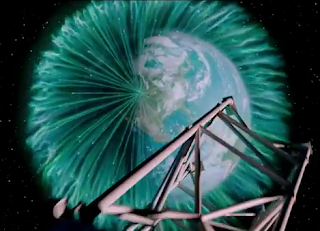 |
| ArcNet deployment |
In order to make the movie, Boris must create timeline #2. He has a task to complete in the past: prevent Griffin from providing the protective "ArcNet" that will block the alien invasion of Earth. There is a timeline with altered events in 1969 where Boris is able to do this (in the movie, the audience sees the alien invasion starting). However, the audience never sees all the events of
that 1969 and the years leading up to the alien invasion. I assume that in the unseen timeline "Boris from the future" prevents Agent K from capturing "Boris of the past" and in so doing prevents Agent K (and anyone else) from installing the ArcNet. What else happens in that timeline? Agent K is killed in 1969, but, strangely, the Men in Black (and Agent J) are still working in 2012.
How can that be? Why wasn't there an alien invasion of Earth soon after Boris from 2012 went back to 1969 and prevented Agent K from protecting the Earth with the ArcNet? Imagine a new timeline (#2a) where the Evil Alien invasion is completed and humans on Earth are under alien domination by say, 1975. In such a #2a timeline maybe Obadiah Price would never invent time travel and Agent J would never grow up to join the Men in Black. Aliens would rule Earth. However, that does
not happen in the movie. Why not?
 |
| Boglodite in drag. Is Boris bad enough? |
There is yet another type of imagined time travel. In "
Version C" time travel, there can be no time travel paradoxes. Time travel to the past is possible, but you can't do some things such as go back in time and prevent yourself from being born. If
MIB3 assumes "
Version C" time travel then "future Boris" can go to 1969, but he can't change 1969 in a way that would prevent himself from traveling through time. Maybe in timeline #2 "future Boris" kills Agent K in 1969 but Obadiah Price must still invent time travel so that Boris can travel back through time from 2012 to 1969.
 |
| James, I am your father. |
We never see the details of timeline #2 (in which Agent K dies in 1969) but we must assume that Boris would not be able to kill Agent K unless Obadiah Price invents time travel close to 2012. Thus, I assume that the alien invasion is delayed until 2012, giving Agent J the chance to grow up and join the Men in Black. I assume he is destined to do so because of his super-human abilities (such as seeing alternate Realities), even if Agent K dies in 1969. Maybe in the absence of Agent K (timeline #2), Agent O makes sure that
James grows up and joins the Men in Black. Eventually, as shown in the movie, Agent J goes back to 1969 and creates timeline #3, saving Earth from the Evil Aliens just in the nick of time. (Hooray!)
If, as
LondonFilmFan seems to do, you assume that
MIB3 uses the same kind of rules for time travel as were used in
Back to the Future then it makes no sense that Agent J has a chance to stop the alien invasion. However, we do not have to make that assumption.
Men in Black 4?
So, who was Agent J's mother, someone like Griffin who has the ability to be conscious of past, future and alternate Realities? Are there other planets where human-like aliens live out their lives until they need to hide from a bad guy alien, come to Earth and make a Men in Black movie?
 |
| MIB4, anyone? |
While slumming on Earth, do the human-like aliens mate with Earthlings, thus creating the next generation of Men in Black agents? Will
MIB3 bring in enough $$$ to justify making MIB4? If so, will we get to meet Agent J's mother, is there more to say about Agent K's backstory or will the story shift back to Agent J's future? Will Agent J find the half-alien of his dreams?
At the level of meta-analysis, is there a reason why Earth is a crazy bin of oddball aliens? I mean, besides the obvious goal of people in Hollywood trying to make money?
Griffin
When I was discovering science fiction novels in the 1970s, I had to read
Slaughterhouse-Five in school. I found the idea that
someone might become "unstuck in time" very disturbing.
The
Tralfamadorians were always saying, "So it goes," and at the time (age about 14) I had read too much
Plato and it offended me deeply to think that people (or aliens) might adopt a
fatalistic attitude.
However, about that time I was also reading some of
Ed Smith's novels where he wrote about the
Arisians who could imagine future events in precise detail. (I've seen a few web pages indicating that
Griffin is an Arcadian.) I started doing "thought experiments" where I tried to imagine a future in which humans developed a new attitude about time that allowed them to adopt a new language in which distinctions were not made between past, present and future. I eventually came to the conclusion that even if the universe were completely deterministic and if free will were an illusion then we humans should still behave as if we have free will because we had evolved so as to function best if we are continually striving for a better future. Is Griffin on Earth to make sure that we Earthlings remain unaware of aliens, that we keep building our own future?
 |
| A bag full of galaxies. |
Apparently Griffin can not only see into the future, but he can also (telepathically?) share his visions of other times with nearby humans. Lucky for we Earthlings, Griffin seems to be on our side and willing to provide the Men in Black with advanced technology (ArcNet) to keep Earth safe from the Evil invading Boglodites. (Whew! What a relief!)
I'm intrigued by
Clarke's Law: "Any sufficiently advanced technology is indistinguishable from magic". Are the seemingly magical abilities of Griffin due to some kind of advanced technology? So far, the Men in Black movies have never really explained the science behind the idea that there can be an entire galaxy that is the size of a marble. What kind of advanced technologies are available to folks like Griffin?
 |
| Agent J out on the town for sushi |
In the
Exodemic Fictional Universe I imagine that the
Huaoshy have
advanced science and technology that allows them to work with forms of matter where the individual particles are much smaller than atoms. The Huaoshy have also discovered that there are
additional spatial dimensions beyond the conventional extended dimensions that we are aware of via our human senses.
If there are alien visitors on Earth who have technology that is a billion years more advanced than the primitive technology that we have developed here on Earth
AND if those aliens act to protect Earth from Evil Aliens then why do the poor Men in Black have to run around working so hard? I mean, besides the comic effect of
Will Smith battling giant slimy fish and bugs?
If we were treated to
Men in Black 4 would we get any answers, anything like a coherent backstory or just a continuing frenetic effort to throw every available SciFi plot device into the mix? By playing fast and loose with time travel in
MIB3 are the Men in Black creators in danger of "
jumping the shark" and leaving audiences behind, frustrated by apparent incoherence of the plot?
 |
| Visions of the Future |
Alternatively, is it only in the context of a comedy that Hollywood can introduce some science fiction themes? In a serious science fiction story would audiences become bored and impatient with explanations of complex SciFi plot elements, but when watching a comedy most viewers are not going to think too hard...they just want a fun ride for two hours?
The bottom line
I think I'm hooked. I hope that
MIB3 does well enough ($$$$) that there will be another movie in the series. I'd like to hear about Agent J's mother and learn that she was/is some kind of human variant from a distant world, possibly a visitor to Earth who, like Griffin, lends a helping hand to we Earthlings. Given the way that characters in the Men in Black movies can morph, unzip, dress and undress for success, it might even be that Griffin turns out to be Agent J's mother.
 |
| Gary and Isis |
Been there, done that
In
Assignment: Earth, Gary Seven and the shape-shifting Isis had to get up close and personal with a rocket just before launch in the 1960s. We got to witness that because the crew of the Enterprise went back in time and kindly arranged for the filming of Gary Seven for an episode of Star Trek.
 |
| MIB3 |
Similarly, the climactic scene of
MIB3 takes place at the top of the Apollo 11 rocket just before launch. The world-saving ArcNet must be sent into outer space in order to stop an alien invasion.
 |
| NASA video |
The idea of people (and cats) on top of rockets in the 1960s is upsetting to some people. Why didn't anyone notice? NASA made video recordings of the Apollo launches, so why would it be possible for various people and aliens to be up there changing critical flight control circuits and attaching alien devices?
In Hollywood everything becomes possible, even mandatory, when you need a dramatic visual scene for the big moment of the television episode or the Summer popcorn flick. "It looks cool" always trumps "this should make sense".
Many commentators have also wondered why the Men in Black would have to make use of something as primitive as an Apollo moon rocket when they have buddies like Griffin. I think it is safe to say that in 1969 the Men in Black can't just ask some convenient alien to take the ArcNet into space. Did things later change? Who built the prison to hold Boris on the Moon? Who was kind enough to fly Boris and all the guards (not to mention
Nicole Scherzinger) to the Moon? Maybe
Steven Spielberg gets group discount rates for space travel....maybe Spielberg is an alien.
Next blog post in this series:
Ancient Aliens.
Some famous Aliens in Drag
Scarlett Johansson in
Under the Skin
 (right; upcoming movie [update])
From
Earth Girls are Easy,
Jeff Goldblum,
Damon Wayans,
Jim Carrey (below)
 |
| Jeff |
 |
| Damon |
 |
| Jim |


 (right; upcoming movie [update])