I
often refer to
The End of Eternity as "Isaac Asimov's time travel novel". However, in 1947
Asimov wrote a first draft (~40,000 words) of a story in which Joseph Schwartz travels through time from 1949 into the Galactic Era, a future time when humans have spread through the galaxy and established an Empire ruled from the centrally-located planet Trantor. This setting is in the same "future history" as the
Foundation Saga that Asimov had been incrementally constructing one story at a time for publication in
Astounding during the course of the 1940s.
The story of Joseph Schwartz's adventures in the far future was later published as a 70,000 word version called
Pebble in the Sky (first printing in 1950, three years before he started work on
The End of Eternity). After arriving in the future, Schwartz is viewed as a hairy and dim-witted evolutionary throwback and given a "brain boost" with an experimental
synapsifier, a high tech device created by Affret Shekt.
The Stars, Like Dust, which became the first novel of the "
Empire Series", was originally published in the first three 1951 issues of
Galaxy magazine under the title "Tyrann". I read
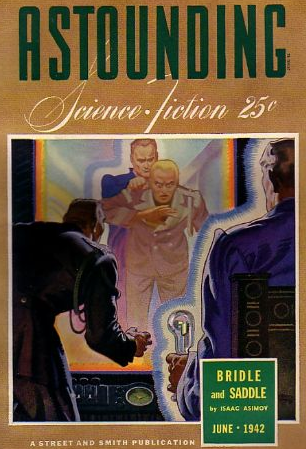
The Stars, Like Dust in novel form about 40 years ago and before today I'd never seen the illustration that is on the
January issue's cover.
After 4 decades it is interesting to note the scenes from
The Stars, Like Dust that stayed in my memory...Biron's departure from Earth and preparation for a "jump" through hyperspace, the "spirited wench" Artemisia's skill at horrifying her father...
Asimov introduced the Visi-Sonor in 1945 (
The Mule) as another high tech device, one that could interact with -and amplify- "brain waves". In
Tyrann, Asimov introduced the inventor of the visi-sonor, Gillbret, who is part of Artemisia's extended family. After being subjected to the influence of the visi-sonor, Biron becomes intensely aware of a strong desire to posses Artemisia.
 |
| page 45 illustration for Tyrann |
With the help of Gillbret and his visi-sonor, Biron escapes arrest. Artemisia has been desperately resisting a political marriage to an elderly and repulsive Tyranni and she wants Biron to pilot a spaceship and help her run away. Biron and Artemisia begin a search among the stars for a long-lost document that can save Humanity from the tyrannical war lords who seem to endlessly exercise power over the human-settled worlds of the galaxy.
Exode
In the
Exode Trilogy, Asimov is a character who is in the "wrong place at the wrong time". He find himself caught up in a mysterious struggle between positronic robots and space aliens. Asimov is invited to give a talk about science fiction at the
Triversity. This is part of an effort by
Thomas to make Asimov accept the idea that the Earth has long been visited by
Genesaunts. In particular,
Peter carries genes that originated in selective breeding projects carried out on distant worlds by the
pek.
Asimov as a character
After his speech to the Triversity science fiction club, Asimov takes an interest in Toni Killian and starts flirting with her. Asimov's playful behavior ends up creating the conditions under which "
the editor" of the Exode Trilogy can be "discovered" and eventually, many years later, be given the task of telling the story
Exode.
"
Asimov to some extent cultivated an image of himself as an amiable lecher." Along with Artemisia in
Tyrann, Asimov populated several of his science fiction stories with young girls who were dodging the unwelcome advances of older men.
In "--And Now You Don't" (later published as Part 2 of Second Foundation:
Search By the Foundation) 14 year old Arcadia Darell is confronted with the prospect of becoming the First Lady to a soldier, the belligerent Lord of Kalgan.

To the discomfort of some (including the long-suffering Trevize), Asimov later elaborated a romance between the 52 year old Janov Pelorat and the youthful
Bliss, who was only in her early 20s. Trevize can't figure out what Bliss sees in Janov.
 More of Asimov's Characters
Joseph Schwartz is 62 when he steps into the future and through his exposure to the synapsifier he develops a kind of telepathic ability called "Mind Touch". Affret Shekt's daughter Pola, is a university student and assistant in Affret's lab. Pola is impressed by Dr. Arvardan's seemingly heroic fight against an Imperial officer. With time, Arvardan decides that Pola is the most beautiful girl he's ever seen, so he'll do anything for her, even unseat the Emperor.
In
The End of Eternity, Andrew Harlan, an
Eternal who is married to his work, falls in love with Noÿs Lambent and becomes her tool, eventually destroying Eternity, Earth's time travel device. Similarly, Dr. Arvardan has never been in love before meeting Pola.
Mentalics
Asimov had fun playing with the idea that telepathic abilities might provide a selective advantage if they could be used to control the emotions of others. In
Nemesis, Marlene inherits "mentalic" abilities from her father Crile. Crile is like
Raych, able to use his mentalic powers to make other people like him. Raych's daughter
Wanda is able to "read minds" and along with Stettin Palver, with whom she can share thoughts and a strong emotional bond,
she founds the Second Foundation.
 |
| Trysta viewing Realities |
I imagine that positronic robots with telepathic powers were helping
Noÿs maneuver
Andrew into helping put an end to Eternity. Any time we see one of Asimov's characters suddenly having a strong and uncharacteristic emotional outburst be have to wonder if mentalic abilities and/or devices like the visi-sonor are involved.
Visualizations
When I saw John Bunch's cover illustration for
Tyrann I was reminded of
the cover I had made for
Trysta and Ekcolir. I've made several previous attempts to depict the viewing of
Realities and even the use of the
Prime Radiant.
In
The End of Eternity, Noÿs explains to Andrew how using their advanced technology, people of her time, some 10 million years in our future, could view alternative Realities. When Noÿs is living out her life in the Primitive, I imagine that her nanorobotic symbiont endows her with a limited capacity to view Realities. When she collaborates with
Grean, she is provided with advanced Reality Viewing technology that even allows for the exploration of
Reality Chains.
In the Primitive, Noÿs uses the name
Trysta Iwedon. Trysta must look for an alternate Reality Chain in which the human species is not replaced by the
Prelands. Sadly, almost all Realities in which humans are allowed to develop a technological civilization on Earth and spread outward to the Stars result in a dramatic catastrophe for Earth.
Asimov described the fate of Earth in his Foundation Saga: Earth is rendered uninhabitable because of high radiation levels. Trysta and Grean are frustrated in their attempts to find a Reality in which nuclear disaster is avoided on Earth. They find that Earth is in the sway of a strange attractor. If the course of history is altered so as to keep radiation levels on Earth low, some other disaster then occurs, usually involving anthropogenic climate change and catastrophic sea level rise.
 |
| Trysta and Grean view the Buld Reality |
A related "future technology" is the
Bimanoid Interface. Fundamentally, this is an interface between a brain and the
Sedronic Domain, a kind of cognitive amplifier that might at first seem similar to the Visi-Sonor. However, the Bimanoid Interface does not amplify telepathic or "mentalic" abilities. Rather, the Interface allows a connection to be established between our mundane world of three dimensional space and the higher dimensional Sedronic Domain.
The
Huaoshy use the Interface to make contact with the
Kac'hin. The Kac'hin are a special type of human that was designed by the pek to allow the Huaoshy to exercise some control over events on Earth. However, the Interface is really a two-way communications conduit, so people with the right combination of Kac'hin or
Asterothrope genes can use the Interface to tap into the vast information content of the Sedronic Domain.
 |
| Nereid |
My current conceptualization of the technology for Viewing Realities is that it is an advanced variant of the basic Bimanoid Interface that is made available to Earthlings like Angela through the meddling of
Nereids in the history of Earth.
When Grean first notices the
Buld Reality thon pays little attention to it. Grean is looking for a Reality Chain that will allow multiple Reality Changes, as needed, to remove the influence of
Gohrlay from Earth and return control of Humanity's fate to the pek. Grean is at first puzzled as to why the Buld Reality has no connections into Reality Chains. Slowly, Grean realizes that in the Buld Reality the Huaoshy alter the
dimensional structure of the universe and make further time travel impossible.
 |
| The Reality Chain that leads to the Buld Reality, the world as we know it. |
Reality Reviewing
Once the Buld Reality was established and further time travel was made impossible, the technology for viewing alternative Realities could only be used to observe previous Realities. That was what
Angela did, using her limited command of the Bimanoid Interface. At first, the information that she accessed from previous Realities was very confusing to Angela.
What Angela could "see" in Deep Time only started to make sense in light of key information that was provided in the form of infites. Thomas and Izhiun gave their infites to "the editor". Thus, the true depth and meaning for the story of past Realities could only be told after Ivory began to function as a communications channel between "the editor" and Angela.
 |
Editing the flow of Time.
|
2024. Ten years after making the blog post, above, I've been trying to make use of AI-powered image generating software to illustrate my science fiction stories (see the 2024 blog post
The Time Travel Game). The image to the right was generated by
WOMBO Dream and in my imagination it hints at the ability of a time traveler to reach into the past and alter their own behavior. Imagine a cloud of
infites that you could send into the past and use to alter your own behavior, preventing something terrible from happening. Creating images to illustrate invisible plot elements like infites is challenging.
Related Reading:
Pebble in the Sky
The Currents of Space
The Caves of Steel
Next: the end of the world