Showing posts with label altternative history. Show all posts

Dec 24, 2013

Cambridge Computing


Alan Turing
Alternate History
Alan Turing was born in 1912 and showed an early interest in the natural world. He studied mathematics at Cambridge University and established himself as a mathematician with a unique perspective and original approach to certain fundamental issues in mathematics.

By the age of 24, Turing had devised the idea of a "Turing Machine", a simple logical device capable of computing all mathematical formulae and numbers that can be computed by a finite algorithm. Turing had also contributed to the solution of the famous Entscheidungsproblem (decision problem), showing that no computational system (such as a Turing Machine) can decide as being either true or false every possible theorem of arithmetic.

Soon after recognizing the computational power of a Turing Machine, Turing became interested in the pragmatic task of learning how to use electronic circuits to build computing devices. As an inititial example and test case for mechanical computation, Turing selected one of the most famous computational problems of mathematics, the approximation of the values of the zeros of the Reimann zeta function.

During World War II, Turing applied his knowledge of mathematics and computing devices to British efforts in military code breaking. In 1946, Turing returned to Cambridge and joined an interdisciplinary program to explore the mechanization of mathematical computations, theorem discovery and proof, and the relationship between formal systems and human thought processes. This program became the influential School of Cambridge Computing.

 Introduction
 Alan Turing was one of the pioneers of discovering how to mechanize thought. He lived most of his life in England, but did spend a few years in the United States of America. In the alternative history Cambridge Computing, Turing stays longer at Princeton but has the chance to start collaborating with Ludwig Wittgenstein during World War II.

Wittgenstein
Wittgenstein was a relentless critic of conventional thinking in mathematics and psychology. Before World War II he was Professor of Philosophy at Cambridge and lectured on the foundations of mathematics. Like Turing, Wittgenstein was concerned with the algorithms by which human thoughts are produced and communicated.

In this alternative history, Wittgenstein and Turing develop a constructive relationship and begin a collaboration on algorithms for machine learning. After the war, they establish an interdisciplinary program in Mind, Machine and Mathematics at Cambridge and also a private company, AD Computing (Analog/Digital Computing).

The personal relationship that develops between Turing and Wittgenstein is critical for their mental and physical health, allowing them both to have long and productive lives. When they become sources of support and strength for each other, they are able to begin participation in the growing movement for revision of British laws related to homosexuality. By the year 1963 they help Great Britain decriminalize homosexuality.

by Stephen Andrade
Wittgenstein dies in 1968, but Turing continues their work into the age of integrated circuits and increasing computational capacity. AD Computing markets its first commercial autonomous learning robot in 1975. Turing dies in 1989, the same year that a model AD-417 becomes world chess champion. Turing's 1950 prediction that the dawn of the new millennium will be witnessed by thinking machines is realized at the turn of the century.

Contents
Moritz Schlick, 1936 .... Kurt Gödel .... meets Turing, Summer 1937 coversations with Wittgenstein deflects to zeta function for Turing's Ph.D. project.
Princeton The building of Alan Turing's first computer (1938-1940).
1939 lectures on philosophy of mathematical logic by Ludwig Wittgenstin.

Summer 1937, Cambridge England. Wittgenstein and Turing have made plans to go see a flick (Secret Agent).
The calculus of contradiction

Cambridge Computing
Turing arrives in the hallway outside Wittgenstein's rooms just as the door opens and a flock of philosophy students depart from their session with Wittgenstein. Turing stands aside and listens to the very loud voice of Wittgenstein from inside, "You cannot doubt just this and that. It is the number of things that you cannot doubt that you can count on one hand."

The voice of the student is hard to hear, something like, "Well, I doubt that."
Wittgenstein laughs and looks out the door, sees Turing. "Here's Turing! He's a mathematician, he believes an infinite number of things....he cannot even write a proof that does not include infinity."

Turing nods to the student and does an little dance as they both try to go through the door at the same time. Wittgenstein is striding around the room pushing furniture back into place and standing folding chairs in corners. Turing knows from experience that Wittgenstein will be in no mood to talk until he quiets the bubbling thoughts that arose during the session with the students. Finally, all the furniture has been pushed multiple times and Turing realizes that Wittgenstein is looking for something. Turing picks up a piece of paper from Wittgenstein's writing table. On it is a sketch.


duckrabbit
Wittgenstein notices what Turing is holding and he asks, "What is the most wonderful thing for a mathematician?"

Turing replies, "Finding a simple solution to a problem that has been thought to be difficult."

"And how can anything first appear difficult and then be found to be easy?"

"You just find the right way to look at."

Turing lets the image of the duckrabbit flip between being a duck and a rabbit in his mind a few times then puts the paper on the desk. Wittgenstein is still looking around the room. "If searching your room fails to reveal your coat, what's another way of looking at THAT problem?"


"Turing, good man, I was just waiting for you to confirm the EXISTENCE of my coat. Now we can attack the problem of how to find it." Wittgenstein still can do nothing but look around the room.

Turing goes to the door and holds it open for Wittgenstein. "It's almost worth testing you to discover if you would stand there an infinite amount of time waiting for the coat to rematerialize, but I saw that your coat is downstairs in the common room when I came in."
They leave Wittgenstein's rooms and collect his coat then head out into the warm evening. Wittgenstein asks, "So have you agreed to dump your ridiculous Ph.D. project?"

A week before, Turing had described his meeting at Princeton with Gödel and Gödel's ideas for how to (or not) formalize the process of finding an infinite set of axioms that would be an infinite basis for mathematics. Wittgenstein had been outraged and had sputtered, "A complete waste of effort, Turing! An infinite set of axioms is oxymoronic. Let Gödel find some other lackey to do his dirty work. If you want to waste your time you should waste it on something that you want to do."

Turing had decided to formulate a proposal for a new Ph.D. topic. "What I need is a mathematics topic that can be solved by a computing machine."

Wittgenstein guffawed. "Applied mathematics at Princeton? Is that allowed?"

They were walking along River Cam towards the Botanic Garden and would end up at the newly opened Regal theater for the flick. "The Ph.D. project would be demonstrating an improved approximation method for the zeta function. Of course, my real goal is to do the actual calculations by machine."

They left the shore of the Cam and turned up towards the Gardens. Wittgenstein asked, "Is there really a different approach that you would take to the zeta function if you were going to have one of your machines do the calculations?"

Turing replied. "I would be happy to use an existing formula for zeta, but producing electronic circuits to perform the calculations and hold all of the calculated values during the calculation is a serious technical problem. An available trick is to use a Fourier transform and to put the problem into a form in which approximations could be made by analog computing components....sets of interconnected wheels. This would greatly simplify the amount of electronic components to be constructed."

They walked through the Garden in silence until Wittgenstein said, "I'm surprised that nobody has ever solved the Fourier analysis of the zeta function."

Turing shrugged, "It is not widely known that you can explore the distribution of prime numbers in terms of harmonic frequencies. The zeros of the zeta function constrain those frequencies."

Wittgenstein turned to Turing and put his fists on his hips. "Turing, you are becoming a scientist! Mathematicians cannot prove the Riemann hypothesis so you have to build a piece of equipment and collect experimental data? Do the first 100 zeta zeros fit your prediction? Do the first 1000? No matter how long your calculator runs, you will never know ALL of the zeros. Its not even science. Its something between science and mathematics."

They started hurrying out of the Garden so as not to be late for the flick. Wittgenstein said, "What I want to know is if your computing machines will ever be able to perform a mental transformation. If you made a machine that could recognize a duckrabbit as a duck, would it ever be able to also see it as a rabbit? What changes in your mind when the image remains the same but your perception shifts? If your machines cannot see both aspects, they will never do mathematics, they will just be calculating slaves. What is the formal system that defines creativity?"

Turing had been asking himself such questions with increasing frequency. He could only dimly conceptualize a 50 year process in the future during which computing machines would be built and tested, revealing the details of their mechanics and testing if they could replicate all of human thought.

They approached the theater and Wittgenstein elbowed Turing, "Creativity must be a secret agent. A secret agent in the brain."

Princeton

Princeton University, 1938
When Alan Turing is nearing completion of his Ph.D. dissertation in 1938 he is offered a job by John von Neumann. If Turing returns to England, he can continue on his research fellowship at Cambridge. While trying to decide if he should accept von Neumann's offer, Turing's research adviser (Alonzo Church) shows Turing a copy of Claude E. Shannon's journal article describing the key results from his Masters degree thesis. By this time, Turing has begun working in Princeton's physics department workshop on key electronic components for a prototype computer circuit. Shannon's work on how to do Boolean algebra using electronic circuits is clearly an example of how to put into hardware the logical subsystems of a Universal Turing Machine.

Turing arranges for Shannon to visit Princeton and give a lecture on his thesis work. Turing shows Shannon the partially completed electronic computer components that he has been building and explains the concept of a Universal Turing Machine. Shannon decides to do his Ph.D. research in Princeton working with Turing. Shannon first completes the digital calculating circuit that Turing has already started to construct then builds the special purpose computer to calculate the Riemann zeta-function, a calculating device that Turing has long dreamed of constructing. In order to continue working with Shannon on this computer, Turing takes the job offer from von Neumann, delaying his return to England until after England enters the war.

The ability of Shannon and Turing to quickly produce a functioning electronic computer depended on support from Shannon's masters thesis adviser Vannevar Bush and Turing's new boss, von Neumann. It was only after the defeat of Nazi Germany when Turing learned the fact that Shannon already had a U.S. government security clearance as Bush's student. While at Princeton, the electronic components Shannon explained as coming from "the electronic shop at M.I.T." were actually from U.S. corporations working under government contract on military electronics research. For most of the electronic components used by Shannon and Turing, a request from Shannon to the office of either Bush or von Neumann would result in delivery of the items within a week, often by military carrier. The physical nature of the silicon carbide circuit components was a military top secret. It should be noted that Turing was able to recognize the silicon carbide components because of his familiarity with European crystal radio technology. John von Neumann arranged that the physics department workshop was also quickly provided with six new research assistants who worked under Shannon assembling and testing the analog circuits of Turing's zeta function machine.
______________________________________________


The Shannon-Turing ZZ-1 special purpose computer that was built by Shannon and Turing in 1938 used electric circuits to generate the harmonics required in the Turing formula for the zeta function.

The diagram to the right shows the basic analog oscillator element of the Shannon-Turing ZZ-1. 3600 of these oscillators were constructed at Princeton from April to November 1938. _____________________________________________

Cambridge England, 1939
In 1939 at University of Cambridge Wittgenstein lectures on the nature of the foundations of mathematics and logic. Wittgenstein's work on the philosophy of mathematics was of interest to several mathematically trained students who decide to attend Wittgenstein's lectures. In particular, Donald C. MacPhail establishes a relationship with Wittgenstein, becoming the "star pupil" in Wittgenstein's 1939 lectures.

MacPhail, stimulated by Wittgenstein's iconoclastic views of logic, devises a "calculus of contradiction". This new branch of mathematical logic is basically a method for working with a large system of theorems, some of which are contradictory. MacPhail and Wittgenstein realize that MacPhail's methods for dealing with mathematical contradiction are applicable to the semantic networks that form inside human brains when children learn. MacPhail applies Markov chains in the "calculus of contradiction" and publishes a paper on the subject with Wittgenstein: "Population Dynamics of Logical Atom Fields Containing Contradictions". This article attracts the attention of Turing, eventually leading to constructive interactions between Turing and Wittgenstein during World War II. Ultimately, this leads to profound changes in the development of machine learning and autonomous robots with significant progress towards human-like artificial intelligence.

Return to Tar'tron
Neurodiversity
I never pushed Cambridge Computing past the events described above for the year 1939. Still, it is fun to imagine how the history of our world would have been different if people like Turing and Wittgenstein had been free to be themselves, if they had not been tormented by forced confinement in a culture where being different and thinking unusual thoughts was treated as a crime.

Related reading: Alan Turing's pardon.

Next: Dr. Jeppson and Thomas Iwedon


Visit the Gallery of Book and Magazine Covers.

Jul 13, 2012

Death, Take a Holiday

I recently blogged about death in science fiction stories and that got me thinking about death of science fiction authors.

When I was young (probably around 1970) I was just discovering science fiction and I read about Halley's comet. 1986 seemed so far in the future (further away than the number of year I had yet lived).

When 1986 finally arrived, the comet was a flop and I started treating the turn of the century as the next great calendar milestone to be anticipated. Haley's comet was a visual flop, but its arrival corresponded to a true disaster...the start of a long chain of deaths among science fiction authors I knew.

1986. By 1986 I had been reading science fiction novels at a fairly good rate for more than 10 years. I was going to school at the University of Washington and there were some people I knew who treated Frank Herbert like some sort of guru...they'd stay up all night playing the Dune board game. I had read Dune, but I was not inspired to read the entire series and I did not see the movie. Still, it was a shock when Herbert died in 1986 at the age of 66.

1988. Then in 1988 it was Robert Heinlein who died. Heinlein was among the first science fiction authors that I read (Orphans of the Sky). I also rediscovered Heinlein in his late period of science fiction writing through The Number of the Beast and Friday. Since he was one of the "big three" science fiction authors I felt a certain obligation to read his work. However, for me, he came in third behind Asimov and Clarke. I wonder how much longer he might have lived and how many more stories he could have shared with the world if he had not smoked.

1990. When I was first starting to buy science fiction novels I would often look for the DAW logo. It was through DAW that I came to know many science fiction authors such as Andre Norton, John Brunner, M. A. Foster, C. J. Cherryh, Robert Trebor, Tanith Lee, and Jack Vance. Donald A. Wollheim died in 1990,  having been one of the most influential people in science fiction publishing.

1992. When Isaac Asimov died in 1992 I felt betrayed. I still wish that he had lived long enough to create a sequel to Foundation and Earth. Alternatively, we can make one ourselves.

1995. John Brunner died. When I was young I enjoyed his stories such as Born Under Mars.

Contact
1996. Death took a holiday in 1994, but while I was still recovering from Asimov's death, Carl Sagan died in 1996. Somehow he was able to push Contact to the brink of completion before he died. I wish he had lived long enough to bring us the needed sequel. However, I'd settle for a Contact television series.

1998. In 1998 Michael Crichton suffered his Hollywood death with the release of Sphere.

The first Crichton movie I saw was The Andromeda Strain, which was also the last Crichton movie I wanted to see. I actually had to buy the novel in order to see if it was better than the movie. As a budding biologist I was astounded by the idea of a lifeform from outer space that just happened to be perfectly suited to infect and kill humans, and it can also digest plastic! It is amazing how evolution by means of random mutations can work out just right so as to make possible Hollywood horror movie$.

After Sphere crashed and sank, Carlo Cavagna wrote, "Michael Crichton is a hack. He comes up with innovative concepts, but his characters are cardboard cutouts. Given the psychological foundations of the story, that's an egregious flaw, and the ending is absurdly dissatisfying." Siskel and Ebert, along with the rest of the world, gave Sphere a thumbs down (see the video below):


1999. James White died in 1999. When I was very young I read one of his Sector General medical science fiction stories. It was amazing that patients were treated and cured...that is, with distractions like nurse Murchison around. There is an amazing website devoted to White's Sector General Saga.

Alien cook book.
 2000. L. Sprague de Camp died in 2000. His novel Lest Darkness Fall was influential for time travel fiction and alternative history. It would be interesting to know how much this one novel influenced other authors such as Asimov (both his Foundation saga and The End of Eternity).

2001. Gordon R. Dickson died, the man who taught me to dislike military science fiction.

2002. Damon Knight died in 2002. His 1950 story To Serve Man became a famous episode of the Twilight Zone. In addition to his short story writing skills, Knight had the luck to be married to Kate Wilhelm who wrote stories such as Where Late the Sweet Birds Sang.

2006. In 2004, Death again failed to take any science fiction authors who I've come to know during my life time. Stanislaw Lem died in 2006. His story Solaris was one of the first science fiction novels I read and it remains one of the most disturbing first contact stories I've ever read. It would be interesting to know how much influence Solaris has had on authors such as Asimov (Nemesis).

2008. Arthur C. Clarke died in 2008. The City and the Stars was one of the first science fiction stories I read. Many others followed including Rendezvous with Rama and The Fountains of Paradise. Clarke is best known for the film 2001: A Space Odyssey, which I'd like to see remade.


2009. Philip José Farmer, author of Riverworld. Online story: The Biological Revolt.

2010. When I was young I enjoyed the early novels of James P. Hogan such as Inherit the Stars and The Genesis Machine. By the 1990s Hogan had "jumped the shark" in novels such as Paths to Otherwhere. I'm not sure that anyone was really sad when Hogan "retired" in 2010.

2012. Ray Bradbury died about a month ago. Of all the dead science fiction authors discussed on this page, Bradbury was the only one that provided assigned reading when I was in school: Fahrenheit 451 and The Illustrated Man.


So many authors who have been important to me died in even-numbered years. Strangely, 1984, 1994 and 2004 were exceptions. I'm ready for death to take another holiday in 2014. With any luck, no other science fiction authors will die before 2016. Mr. Vance, this means you, in particular.
___________________________________
May 30, 2013.
John Holbrook "Jack" Vance died May 26, 2013.
http://foreverness.jackvance.com/

Related Reading: Jack Vance,  reflections

_____________________________

June 9, 2013.
Iain Banks died.
I've read quite a bit about his Culture Series, but I've never read any of his work, mostly due to a long standing personal dislike of military science fiction. Maybe I should skip over Consider Phlebas and find a less war-oriented entry into The Culture.

May 6, 2012

SciFi Summer 2012

Thanos.
Here we are in the weekend of the US launch of The Avengers, Men in Black 3 is still about three weeks out and Prometheus will follow soon after.

Alien Invasion. Mr. Thanos is your evolutionary cousin, one of the branches of humanity that was created by the Celestials about 5 million years ago. As an Eternal, Thanos might be expected to protect Earth against the Deviants, but some how his mother was unable to pass the correct genes to him and so Thanos has some Deviant genes. Thanos is in love with Death, and is apparently involved with the alien invasion that forms the basis for The Avengers movie.

Men in Black 3
Is there any chance that future Marvel movies will expand on the exodemic-like plot elements of The Avengers (humans originated from the work of aliens who carried out genetic engineering on proto-human apes) or will those movies simply give us more conventional Hollywood good guys vs bad guys who run around blowing up things and each other?

Men in Black 3 has a time travel plot in which evil aliens must be thwarted. Apparently there are some interesting constraints on time travel such as a 24 hour limit when going back in time. I wonder if there will be any attempt to explain who gets to travel through time and for what purpose or if this will just be yet another example of someone in Hollywood saying, "we wanted to have a story back in the past so we just did it." In the Exodemic Fictional Universe the Huaoshy control all time travel and they only use it for special problems that arise on primitive planets.

Star map.
Last Summer I was titillated by the possibility that Hollywood might be catching on to the possibility of making movies about sneaky extraterrestrial visitors to Earth who would be here for reasons other than those depicted in typical alien invasion movies. I had high hopes for Prometheus, but it looks like little more than a re-do of Alien. Possibly a miracle will occur and there will be some explanation for how it was possible for "ancient astronauts" to leave a "calling card" (a star map) on Earth and then have nothing to do with Earth for thousands of years.

So there we have it, three Summer SciFi movies for 2012 that will be scooping up hundreds of millions of dollars, and all three of these movies had/have a chance to tell us something interesting about alien visitors to Earth. So far, The Avengers only has an evil dude using mind control to launch an alien invasion of Earth. Of course, the good guys beat back the attack....leaving room for the next movie in the $erie$.

Alien life from Prometheus.
Two chances remain for something interesting to slip out of Hollywood this Summer, but I'm not holding my breath for anything but more of the same tired old $tuff from Prometheus and Men in Black 3.

Here is my best-case scenario for Prometheus: maybe the aliens (for lack of a better name I'll call them the Slime Masters) who long ago visited Earth, have spent the past several thousand years developing their own entertainment industry. Fascinated by their own horror movies, the Slime Masters abandoned space travel and devoted all their creative energies to a genetics program resulting in the creation of armies of slime-dripping alien creatures that are good for thousands of years of Hollywood-type horror movies. When the Prometheus arrives at the home world of the Slime Masters, the aliens recognize a great marketing opportunity and rush back to Earth to license their slime-dripping creatures for use as props in Hollywood. To their great dismay, they realize that Hollywood has its own armies, thousands of geeky CGI programmers who do nothing but dream up new monsters for Hollywood productions. Dismayed and demoralized, the Slime Masters go back to a time (1975) when they can sell their slimy creatures to the highest bidder...resulting in the inspiration for the original Alien movie. Writers for The New York Times, The Wall Street Journal and Forbes will write long articles about the deep significance of Prometheus as social commentary about capitalism. The movie will become required part of business school curricula across the country. The Occupy Movement will make use of the slime-dripping aliens of Prometheus as icons of the super rich.

Have a nice Summer!

This (above) is the first of a series of blog posts about my Search for Interesting Hollywood Aliens (SIHA). Here are links to the other SIHA 2012 blog posts:
Disney and Entertainment and Science Fiction, Oh My!
Horror, Comedy and SciFi in the Woods?
Aliens in Drag
Ancient Aliens
The exciting conclusion to the 2012 Search for Interesting Hollywood Aliens
Promethean Rorschach Test

Mar 10, 2012

Franny

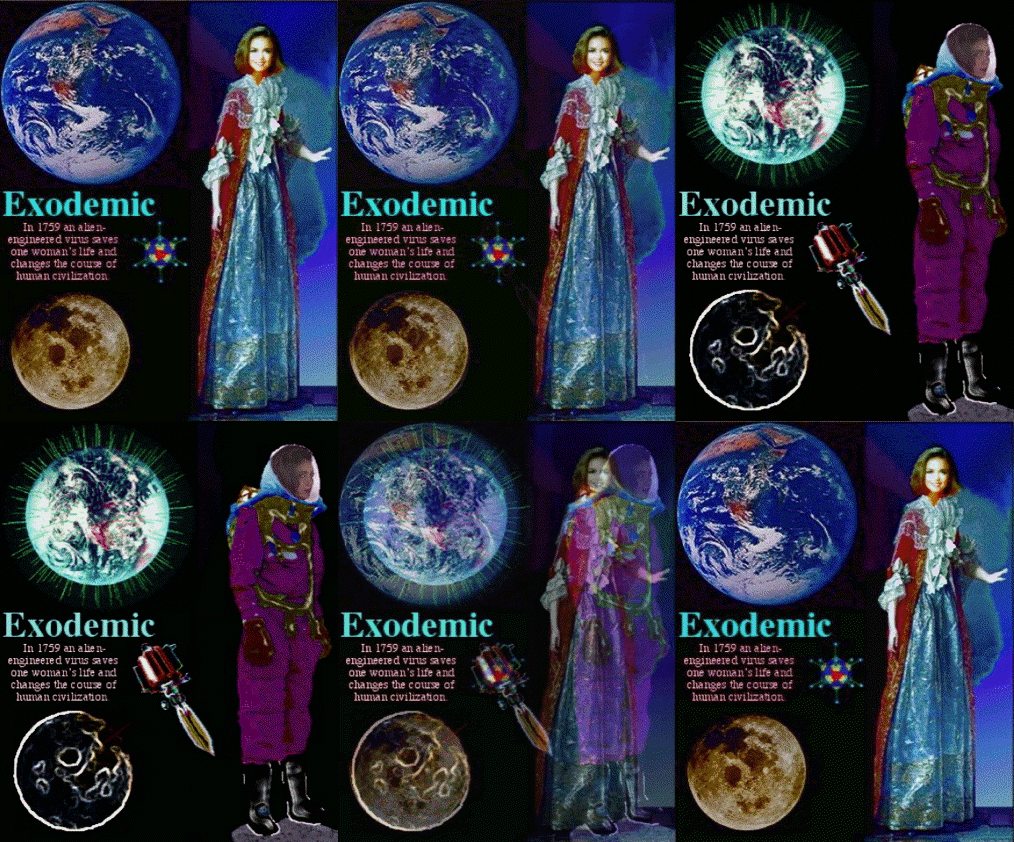
Cover art for Exodemic.
In my previous blog post I mentioned Exodemic, the first story set in the Exodemic Fictional Universe. The image at the top of this blog post (to the right) is the back cover of Exodemic, but I envisioned the novel as a ebook with an animated "cover image" (see below) showing Judy Renshaw morphing from the garb of a woman living on Earth in the 1700s into a space suit-wearing member of Genesaunt culture.

2019 update. I made a video account of how the stories of Isaac Asimov inspired me to write Exodemic. See the end of this blog post.

animated cover
Judy is the first person who the "exodemic" saves from an early death caused by the smallpox virus. Judy's extended life is part of a series of fortunate events that greatly alter the development of human civilization, leading to an alternative Earth that is better than our world.

The exodemic starts with Judy's mother, Kate, who grows up near a volcano and who is almost killed during an eruption. Kate is taken off of Earth by an Interventionist agent (image, just below, to right) and trained for a return mission to Earth.

A nanorobotic artificial life form.
Back on Earth and living in England, Kate becomes the friend of Donald Miller. Don was born at a hidden base inside the Moon and is a secret Genesaunt agent, one of the Observers. The Observers only watch events on Earth, but the Interventionists want to intervene into the course of human civilization on Earth. Working like a police force for the Observers are Overseers who enforce the Rules of Observation, rules that forbid any alteration of Earthly events by Genesaunts. Overseers are always looking through data collected by the Observers and watching for evidence of Interventionists. Eventually Kate is recognized as being a tool of the Interventionists, but not before Judy is born. Kate and Don are taken off of Earth, but Judy remains in England, believing (along with the readers of the story) that Kate and Don died in a shipwreck.

Observer Base
Judy becomes friends with Howard Miller, who takes over Don's position as Observer in England. Judy becomes infected by a virus that is carried to Earth by Howard. By the Rules of Observation, Observers must be genetically similar to Earth humans, and when they are stationed on Earth they need protection against microbial diseases that exist on Earth. Normally, the viruses that are used to immunize Observers can't infect the people of Earth, but Judy carries a gene that allows her to be infected by engineered Genesaunt viruses. Rather than die, Judy survives her smallpox infection. Further, she carries a gene that allows for interaction between her egg cells and Howard's sperm cells. Judy gives birth to Franny who eventually becomes one of the first female medical doctors in England. Among other changes to the course of history caused by Franny, Mary Wollstonecraft does not die young and has a son named Ralph. Eventually, Ralph forms the first computer manufacturing company with Faraday and Babbage.

Overseers
The Overseers eventually discover that Franny is Howard's daughter and so at that point, long after the damage has been done, Judy, Howard and Franny are taken off of Earth. At that point in the story, the reader finally becomes aware of the fact that Howard and Don were born on the Moon and worked on Earth as Observers. Also, Judy is reunited with her mother, Kate. Within Genesaunt culture there is a sophisticated nanotechnology and life extension technologies. A still youthful Kate meets Judy and Franny and welcomes them into Genesaunt culture. Judy and Franny go on to have interesting lives within Genesaunt culture and the reader learns most of the "backstory" of how there came to be Observers on Earth and what the Interventionists hope to accomplish.

The Rossi Intervention
Mary Shelley lived in the age when it was common for children to die young and women to die from infections soon after giving birth. Still in her teens, already with her first born child dead, Mary began writing Frankenstein. Mary's mother had died when Mary was just a few days old. In looking for a horror story topic, Mary needed to look no further than the horrors of everyday life....and death. Mary lived in a time when scientific study of biology and medicine was starting to make some progress, but there was often one step backwards for each step forward.

In 1816 there was no shortage of men who were able to get themselves into trouble by over-confident application of one small piece of knowledge. In Mary's time, there were doctors who would apply electric shocks to patients in the wild hope of getting lucky and curing some medical problem. There was a long struggle between the tradition of midwives assisting at home births and male doctors promoting deliveries in hospitals with supervision by male physicians, particularly for unusual high-risk pregnancies. It was not until half a century later that systematic analysis of birthing records by people like Florence Nightingale finally clarified the risks and benefits of hospital delivery. Adequate sanitation was finally recognized as the key to preventing the type of maternal death suffered by Mary's mother.

Before the late 1800s, the emerging discipline of microbiology was unable to systematically isolate and identify and characterize the microbes that cause infectious disease. When Ignaz Semmelweis demonstrated in 1847 that hand sanitation could greatly reduce the type of maternal death suffered by Mary's mother, the medical profession was not yet ready for the "germ theory" of disease and scientists were only just starting to think of the human body in terms of a collection of cellular subunits.

In the absence of any understanding of the microscopic cellular components of living organisms there was a vast amount of speculation about hydrological, magnetic and electrical mechanisms in an attempt to understand bodily functions (a nice account). When Mary Shelley wrote Frankenstein, the Age of Enlightenment was over and European intellectuals were often reacting against the bumbling enthusiasms of natural philosophers and their primitive efforts to reduce even life itself to a collection of mechanistic processes.

Following behind Mary Shelley, it has been hard for dramatists to resist the temptation to create a spiffy reanimation scene with lightening and electricity jolting dead body parts back to life. In our current age of video, science fiction stories are routinely contaminated by silly efforts to create a dramatic visual moment, often built around some recent scientific discovery or popularized buzzword. Think of the role of antimatter in the movie Angels and Demons. We get an emotional rush from a dramatic light show that is triggered by the antimatter, but no real intellectual stimulation.

One of my goals in writing the Exodemic alternative history novel was to show a version of Earth where the Age of Enlightenment never ended. The fact that Judy Renshaw was not killed by smallpox not only led to a long life for Mary Shelley's mother but also prevented the French Revolution. In Exodemic the USA never forms and the British colonies in America remain as part of a British Union where slavery is abolished and Lincoln never has to fight the Civil War. Similarly, France and its colonies develop into an economically powerful collective of nations that bring the continent of Africa into the Enlightenment.

One of my goals for Exodemic was to achieve early discovery of the non-human apes in Africa and depict the creation of successful efforts to protect animal species that are endangered in our world. In the Exodemic alternative history, the ranges of the great apes are turned into parks, not farmland. In Exodemic, philosophical Romanticism quickly gives birth to an effective environmentalism movement. Similarly, the Exodemic plot shows that Mary Wollstonecraft and like-minded people are able to liberate women and bring effective birth control to the world a century earlier that in our version of history.....world population peaks at 4,000,000,000 and most of the people alive today never have a chance to be born.

In Exodemic, Franny is a recognizably modern woman, well educated and practicing medicine and conducting scientific research...all a century before such things were possible in our world....all made possible by the sly Interventionists and the way they were able to alter the course of human civilization by slipping a few fast ones past the Overseers. When Franny is taken off of Earth, she has no trouble merging into Genesaunt culture and sets about trying to understand the dynamics of the planet-wide chess game that is played by the Interventionists and the Overseers.

The Overseers are descendants of Neanderthal-like humanoids who were taken off of Earth hundreds of thousands of years ago, even before modern humans had evolved. Overseers are no longer biological life forms; they are composed of nanoscopic nanite subunits and can morph their external appearance to match the human body form. In this image, the spaceship's staircase is also composed of nanites and is being constructed before Kate Renshaw's eyes within a suffocating volcanic cloud that is killing Kate during the eruption. This scene is the "teaser" for Exodemic, a kind of "alien abduction" in the 1700s that is never explained to the reader until much later in the novel. As an Interventionist agent, Kate is kept under tight surveillance by the Overseers when she is taken off of Earth (the second time she leaves Earth, after the Overseers finally recognize her as a tool of the Interventionists).

the Huaoshy
Franny has never violated the Rules of Observation. She is given the option to leave Earth with her parents and she goes. She is free to explore Genesaunt civilization which has been spreading away from Earth to nearby star systems. Genesaunt civilization does not have access to faster-than-light space travel, so it is not easy for Genesaunts to travel between the stars. However, the alien Huaoshy arrived at Earth millions of years ago and they have the technology that allows for faster-than-light space travel. The Huaoshy are few and far between and most Genesaunts never interact with the Huaoshy. The Huaoshy make use of assistants that are nanorobotic artificial life forms and some Genesaunts do have interactions with those assistants, much in the way that a few humans on Earth (such as Judy) interact with Observers (such as Howard). Some of the Huaoshy assistants play roles similar to the Overseers in that they function as a kind of police force for Genesaunt civilization.

Just as Judy got herself into trouble and was taken off of Earth and inserted into Genesaunt civilization, sometimes Genesaunts are extracted from Genesaunt civilization and are allowed to join the vast intergalactic civilization that has been created by the Huaoshy. In Exodemic, Franny is insatiably curious about how it has been possible for Earth to be secrely under Observation for millions of years. She manages to make contact with the Interventionists, but she is being followed by the Genesaunt "police", which allows the Huaoshy to uncover a plot by which the Interventionists were being given illegal access to advanced technology in violation of the Rules of Intervention. Franny has never violated the Rules of Intervention, but she is given the option of having her hard-won knowledge of the Huaoshy erased from her mind or being extracted from Genesaunt civilization. She decides to rise another "level" and allow herself to be taken away from the Solar System in a faster-than-light space ship. Franny goes on to learn about how the Huaoshy colonize galaxies like our own over the span of millions of years.

More about Franny and her interactions with Genesaunts.

Related Reading. Comments about the prelude to Exodemic. There is more about Exodemic in my next blog post.

2019 video. Watch the Exodemic teaser video on YouTube.