Showing posts with label Hal Clement. Show all posts

Jan 1, 2022

Submicroscopic

interior art for "Proof" by Paul Orban

 Ten years ago I came close to reading a science fiction novel by Hal Clement, but it was only recently that I finally read Needle. This is "hard" Sci Fi and the story begins with two alien spaceships crash-landing on Earth. The image shown to the right is from 7 years before the 1949 publication of Needle; this is an illustration from "Proof", a story by Clement that I discussed in my previous blog post. Both Needle and "Proof" are about strange alien life-forms that were imagined by Clement.

Not an Alien Invasion. I love science fiction stories about alien visitors who arrive on Earth and do something more interesting than run around like a crazed Dalek shouting "Exterminate!"

splash-down; interior art for
Needle by Paul Orban

Oops. I read the original version of Needle as published in the May and June 1949 issues of Astounding. Clement got off to a rather shaky start by depicting two super-technologically advanced space-faring aliens both being clumsy enough to crash on Earth and destroy their spacecraft. However, these aliens are shape-shifters, so I suppose forces powerful enough to damage your standard Acme X72 interstellar spaceship might only give these aliens a mild case of whiplash. Clement's 1942 story "Proof" featured aliens from inside the Sun who built their spaceships out of super-strong neutronium, but neutronium did not find its way into Needle.

cover by Paul Orban

Submicroscopic. What is special and memorable about the alien creatures in Clement's story Needle? The aliens in Needle only weigh a few pounds each and are small enough to fit completely inside a human. All of Part 1 concerns "Hunter", the alien that arrives on Earth and takes up residence inside the body of Robert, who is 15 years old. "Hunter" was hot on the trail of a criminal when their two spaceships both crash-landed on Earth. The story is called "Needle" because "Hunter" has no idea where the criminal is; he could now be living inside any large haystack animal.

Fictional Cell Biology. Although "Hunter" is small compared to a human, "he" has thousands of times more cells than are found in a human body. Each of the alien's cells is very small. Since this is 1949, we don't hear about molecules like DNA. 😒

interior alien art for Needle
What dominates the beginning of Needle is the fact that these aliens are shape-shifters. "Hunter" can magically form "his" cells into new assemblages that take on any needed form. Clement never describes how this is possible.

Junior detective Robert. "Hunter" quickly learns English and is soon communicating with Robert. "Hunter" can briefly inactivate cells in Robert's retina, creating dark zones in the shapes of letters (see the image shown to the left). "Hunter" can hear spoken words and when needed can construct its own eyes, but while inside Robert, "Hunter" makes use of sensory signals from Robert's retina. Soon enough, Robert knows the mission that "Hunter" is on and starts helping in the hunt for the alien criminal.

T4 virus -assembly of proteins

Viruslike Cells. At the start of part 2, readers learn that Robert's family lives on a "power island" where assorted carbon compounds are fed to bacteria that then produce "useful hydrocarbons". What other futuristic science was included in Needle? Clement advanced the theory that a virus is a large protein molecule and maybe you could make a complex organism by combining large numbers of viruses instead of large numbers of cells. When Needle was published, there was already evidence that DNA was a genetic molecule and some bacterial viruses were known to contain both protein and DNA. I like Clement's idea of imagining a fundamental building block of life that is smaller than an Earthly eukaryotic cell. However, the largest viruses are similar in size to the smallest cells, so the whole alien-with-virus-like-cells idea crumbled in Clement's hands. Now it is well-known that viruses need to use a host cell in order to replicate the viral nucleic acid, but Clement was not concerned with such details of virology in 1949.

in the Asimov Reality
 Why Should We Care? At the end of this blog post are some quotes from folks who reviewed Needle back in 1950, but one of the most detailed reviews of Needle is from 2020 by Mark R. Kelly. Kelly asked, "Why should we care?" and he seemed bothered by the fact that it does not really seem to matter if "Hunter" ever finds and punishes the alien fugitive that he is chasing. I think Kelly missed the whole point of Needle and he should read about MacGuffins.

Hard science fiction is a literature of ideas and a central idea of Needle is the issue of what I've called Hunter's ability to magically morph into new shapes or quickly grow a new organ like an eye upon demand. I'll admit, most readers don't care about the mechanism of Hunter's morphing; shape-shifters have long been featured in many fantasy stories where readers are expected to just accept the magic of morphing. However, as a hard science fiction story teller, Clement did not want magic in his story and he obviously gave a lot of thought to explaining the weird biology of his alien shape-shifters. 

from "Tachyon Rag" by Tim Sullivan
 Nanotechnology. In 1949, Clement was struggling to come to grips with the nano-scale components of living organisms. He seemingly had the concept of self-assembling proteins and so he ran with the idea of his aliens being composed of submicroscopic virus-like components that could magically assemble into any needed form. Sadly, Clement could not run very far with this glimmer of an idea. Later, in the 1977 issue of Unearth where Clement's story "Proof" was reprinted, Tim Sullivan "explained" his shape-shifting aliens with the concept of "cellular elasticity" (see the text excerpt, above, right), also known as "handwavium".

Figure 1. image source
During embryonic development, cells can transition from being part of a well-formed epithelial layer into migratory mesenchymal cells which upon reaching a particular destination can form a new tissue or organ. Tentacle-like axons can also grow through the tissues of a body to distant locations, but these kinds of cellular movement processes take a long time.  Clement's imagined morphing aliens could very rapidly reshape big collections of cells in their bodies. 

Odo
This kind of rapid body shape change might be possible with some sort of super high-speed molecular motors, perhaps similar to what are used to move pigment granules around in chromatophores (see Figure 1, above).

40 Years of Morphing Magic. We should never count on Hollywood to reveal any interesting fictional science. In the 1990s, Star Trek deployed the morphing Changelings who used magical "morphogenic enzymes" (another form of handwavium) to quickly change shape.

In the case of the fictional science in Needle, the major problem that I have trouble wrapping my mind around is the idea of quick conscious re-programming of cell behavior by a shape-shifter. Sadly, Clement tells readers very little about the nervous system of his aliens (see Figure 2, below).

Figure 2. alien communication
Speaking of viruses, "Hunter" admits that it is theoretically possible for a virus to harm "his" health. However, "Hunter" is depicted as a chemistry wizard who can almost instantly defeat adversaries such as the cells in Robert's immune system, so don't worry that "Hunter" will be driven out of Robert's body like a rejected tissue transplant.  

SPOILERS. Needle was crafted as a detective story, so if you want to read it without knowing the "thrilling conclusion" then stop reading here. 

In Part 2 of Needle, readers learn that back on their home planet (Allane), the "criminal" being tracked by "Hunter" previously killed several host organisms "for purely selfish reasons". 

in the Ekcolir Reality
 The Game is Afoot! Then, just when it seems like the "Hunter" is going to be forced to carry-out a laborious search through the bodies of every human on Earth (the titular "needle in a haystack"), the great detective "Hunter" deduces that it is none other than Robert's father who is now acting as host to the alien criminal. 

Keep your enemies close and your friends on Allane. Having located his crafty adversary, the "Hunter" extracts himself from Robert's body and pays a visit to dad's bedroom. Since this is 1949 and Clement was writing for kids, "Hunter" patiently waits outside mom & dad's room for a long time, until dad is finally asleep. "Hunter" quietly slips a probe tendril into dad and makes physical contact with some of the criminal's cells. This tentacular physical contact instantly allows the two aliens to have a conversation in which it is revealed that the "Hunter" is the "friend of Jenver" and the criminal is the "friend of Trang the Mathematician". Got that? There will be a test later. 😜

toasted alien
 Elementary, My Dear Friend of Trang. It was possible to determine that the criminal was inside dad because -WARNING, Major Spoiler- he had begun acting similar to Robert: unconcerned with activities that caused personal injury. The aliens reflexively repair small wounds in their hosts and the hosts start to feel invincible and display increasingly reckless behavior. 

Allane. Readers learn that the criminal nearly killed poor Trang during "experiments in personal control". The detective "Hunter" chastises the criminal for being foolish enough to try to escape: "You were foolish to flee Allane." After the detective "Hunter" is done bragging about about his own cleverness in finding the criminal, he slinks away, having to admit that he has no good way of extracting the criminal from the body of dear old dad.

Robert prepares to be punished
Robert tricks his father into thinking he is trapped in a burning building. Then when the flames threaten the criminal, it crawls out of dad's body. Robert then dumps oil on the alien and burns it up. 🔥

Casual Child Abuse. You might imagine that this is the time for Robert to reveal the existence of the aliens to everyone on Earth, but NO. The "Hunter" will secretly remain inside Robert. All ends well, Robert is cool with housing an alien inside his body, but Robert has one request: he wants the alien's help in protecting his tender skin from the whipping he will receive from dear old dad for his having started the fire.

cover art by Clyde Caldwell

 Bottom line. Can I recommend Needle for reading by science fiction fans in 2022? I feel obligated to issue one warning and mention one regret.

Warning. Needle was intentionally written for young readers by a school teacher. I always want to congratulate any writer who takes on the task of creating stories that will attract and please young readers. However, anyone over the age of 12 is probably going to feel a bit cramped by the constraints that Clement put on his own writing when he crafted Needle.

Regret. I believe that the science fiction genre needs a systematic way to preserve and update old stories. I'd hesitate to hand a copy of Needle to my own child because what Clement wrote about viruses back in the 1940s would only confuse a young person who is worried about Covid-19. Someone should publish a new edition of Needle with an introduction written by a cell biologist or possibly a microbiologist.

the view from 1950
Mystery. I absolutely adore the Sci Fi idea of submicroscopic probes, devices and endosymbionts hidden inside unsuspecting people, so I'm a complete sucker for a story like Needle. I'm also intrigued by how writers like Asimov and Clement sometimes intentionally mixed together elements of the detective/mystery story genre in a science fiction setting.

 Other views. Fred Pohl reviewed Needle in the May 1950 issue of Super Science Stories along with Isaac Asimov's Pebble in the Sky. Pohl labeled Needle as "... a first-rate detective story and fine fantasy reading". Pohl added, it "will keep you guessing all the way through, and won't let you down at the end."

A review in the July 1950 issue of Startling Stories had this to say about Needle: "the story becomes almost pure mystery and suspense, winding up in about as taut a few fatal minutes as any more orthodox story of crime, pursuit and punishment".

In the Ekcolir Reality. Original art
by Kelly Freas and Chesley Bonestell

In the November 1950 issue of Astounding, L. Sprague de Camp called Needle, "a good sound entertaining yarn".

In the August 1967 issue of Analog, P. Schuyler Miller described Needle as Clement's most popular novel. I wonder if that was based on actual book sales.

I like to imagine how science fiction stories could have turned out differently in alternate Realities like the Ekcolir Reality. I always suspect that there must be an interesting reason for the delay when a sequel comes after a long delay. Clement did not get around to publishing a sequel to Needle until 1978. After reading this commentary, I lost my interest in reading "Through the Eye of a Needle". If anyone knows what finally motivated Clement to write the sequel story, please let me know.

Part 3
 Related Reading: The comments on Needle, above, are part of a series of blog posts. Part 1 of this series: Clement's story "Proof".                 See Also: The Brains of Earth and award winning fantasy aliens

Next: Part 3 of this series, Needle in a haystack context

Ver'la from Mars. Visit the Gallery of Posters and the Gallery of Book and Magazine Covers
Ver'la image made with The Other Side Of Nowhere
by Rocket787 and see this NASA image - available under CC BY-NC 3.0
.


The Sun People

1957 Avon cover
 This is the first of three blog posts here at the start of 2022 about the science fiction stories of Hal Clement [born 30 May 1922]. I waited until the hundredth year after his birth to finally read a Clement novel: Needle. As shown in the image to the right, Needle was also published in book format under the title "From Outer Space". I'll discuss Needle in my next blog post, but first..... 

Warm up. Let's warm things up by taking a look at the Sun People who achieved a strange kind of First Contact with Earthlings in "Proof", which was the first story ever published by "Clement".

"Clement" is in quotes as a reminder that his real name was Harry Clement Stubbs. In 1942, Stubbs was studying astronomy at Harvard. Like Isaac Asimov, Hal Clement took his educational background in science and moved in the direction of being an educator, more specifically in Clement's case, he became a high school science teacher.

cover by Steven Gildea
I have no idea how many folks with an astronomy degree tried their hand at writing science fiction during the 1900s. In the previous generation before Stubbs, there was William Christie who used a pen-name (Cecil B. White) when publishing science fiction. Others include Fred Hoyle, Joe Haldeman, Alastair Reynolds and David Brin. Also, see R. S. Richardson, here.

Hal Clement ends up on lists of "hard science fiction" story tellers. As a fan of hard science fiction, I'm tempted to conclude that only those writers who studied science in college are likely to write hard science fiction. Working astronomers like Christie and Carl Sagan did not have the time to write very many science fiction stories. As far as I know, Hal Clement never worked as a professional astronomer, so he had spare time and was able to publish many science fiction stories. 

a painting by Clement (image source)
Clement also found time to paint and for a short time he was the "science editor" for the short-lived magazine, Unearth. As the science editor, Clement wrote a column called "Science for Fiction". In the spring 1977 issue of Unearth, "Proof" was republished and accompanied by an essay describing how Clement came to be a published author. In that essay, Clement denied being a professional science fiction writer and declared his only true profession to be "high school science teacher". He admitted to having discovered science fiction when he was in his own personal golden age (12) for science fiction.

another paining by Clement

 Hot Times. Clement traced his story "Proof" back to his having read the 1935 story "Islands of the Sun" by Jack Williamson. Isaac Asimov also admitted to having been influenced by the stories that Williamson wrote. For "Islands of the Sun", Williamson imagined that the planet Earth originated inside the sun. In Williamson's story, there is an imaginary form of matter, okal, which is a magical crystalline form of carbon and the secret to atomic power. Using the power of a giant okal crystal, the planets are released from their "etheric spheres", lifted out of the sun's photosphere and placed into their proper orbits around the Sun, exactly where we now know them to reside.

Clement's thoughts were provoked!

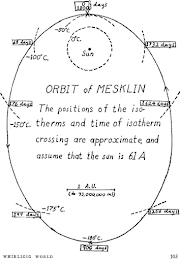
the eccentricities of Mesklin
 The Science Fiction Game. In an essay called "Whirligig World", Hal Clement suggested that science fiction should be approached as a game being played by a writer and the readers. What are the game rules? "...for the reader of a science-fiction story, they consist of finding as many as possible of the author's statements or implications which conflict with the facts as science currently understands them." I'm not going to be able to resist dabbling in this game while I read Clement's stories.

cover by Herpai Zoltán
That's Cool Cold. Clement is probably most famous for his novel Mission of Gravity. That story features intelligent alien creatures who can survive on a planet (Mesklin) with high gravity, hundreds of times higher than the gravity on Earth's surface. In addition to getting a degree in astronomy, Clement later got a chemistry degree. Some chemists have a real blind spot when it comes to anything as complex as a living organism and I find it hard to accept Clement's imaginary life forms. Don't get me started on my objections to the silly idea of intelligent life in liquid methane. But who knows, maybe the exoskeleton of a Mesklinite is made of neutronium.

"The Doomsday Machine"

 Neutronium. In "Proof", Clement imagined life arising inside stars. I recently mocked science fiction story tellers who imagined that life could exist on every planet, moon and asteroid. Many writers who enthusiastically imagined life arising on planets even with environmental conditions as harsh as those on Mercury, drew a line at the Sun. If you restrict your imagination to life forms composed of water-containing cells, then it is hard to imagine life on (or inside) the Sun. 

unimaginable neutronium-based life from "Proof"
But wait! What about life based on another physical substrate? How about neutronium? I was first exposed to the science fictional substance neutronium in a Star Trek episode. The neutronium hull of the "Planet Killer" in "The Doomsday Machine" was very stable, having traveled to our galaxy across a vast inter-galactic distance. What are the fictionalized properties of neutronium in Clement's story?

Unimaginable Life. I get nervous when Sci Fi story tellers try to describe unimaginable things. As shown in the excerpt (image above and to the right), Clement imagined intrastellar life-forms with a core of neutrons surrounded by an electrostatic field being sustained by a "matrix of electrons". 

neutron star
 The Matrix, 1942. I suppose Clement learned about neutron stars and degenerate matter in an astronomy course at Harvard, but what was he thinking when he imagined a "matrix of electrons" that could convert radiation into neutrons? Not only does the "skin" of these Sun creatures (the hero of the story is named "Kron") surround a core of neutronium (held in the creature's "nucleus"), but the "skin" can convert energy from the environment into new "particles of neutronium" that are then guided by magnetic fields towards the body core. Yummy! Apparently, this process for creation of new neutronium is how a creature like Kron "feeds".

photosphere
Force Fields. Spacecraft can carry Kron from city to city in the Sun's photosphere and even to distant stars, but there must be a "mini-sun" inside these sorts of craft to provide the passengers with the "fierce energy" they need to survive. Kron can use the stored neutrons in his body's core as an energy source, much like humans using glycogen. To interact with and control objects in his environment, Kron taps some neutrons from his core and converts the stored energy into "projected beams and fields of force".

interior art for "Proof" by Paul Orban

 Alien Thought. Mr. Kron has senses that can detect electromagnetic fields, but Clement also told his readers about a whole bunch of additional senses of the Sun People that were used for detecting other "energies still undreamed of by human scientists" that exist inside the Sun. Mr. Kron and his people now live in the Sun's photosphere because deeper inside the Sun are dangerous sand Sun worms creatures that like to eat the Sun People. However, Kron's species originally evolved deep inside the Sun where, according to Clement, there is a good supply of neutronium. Much of the backstory for "Proof" is provided during a conversation between Kron and an alien visitor from Sirius. 

in the Ekcolir Reality
Clement told his readers that this conversation between Kron and the scientist was made possible by beams of energy that could carry "clear thought" from person to person. Maybe this was a form of technology-assisted telepathy.

B Sirius! The visitor from Sirius is a scientist who has conceived a startling theory. The Sirian scientist tells Kron about a strange hypothesis: that at low temperatures (lower than the temperatures found inside stars), collections of atoms might form solids, much like neutronium. Kron then tells the tale of how a spaceship was once destroyed under inexplicable circumstances. 

Neutronium: it even brightens teeth! The flying craft of the Sun People and the buildings of their photosphere cities are composed of neutronium. During interstellar voyages, neutronium is also used as a fuel to power the spaceships of the Sun People. 

the speed of thought
Near the end of one interstellar voyage, the returning spaceship crashed into an object with mass, but it was a mysterious object that did not emit any radiation that could be detected by the senses of the Sun People.

an alternate universe
The narration of "Proof" shifts at this point from Kron to the perspective of a man on Earth who is witness to the neutronium spaceship from the Sun as it crashes into Earth. Then, for the end of the story, we return to Kron's account of the lost spaceship, which is actually proof of the strange hypothesis of the scientist from Sirius.

 Game Score. Part of the rules for Clement's science fiction game is that (in the interest of creating a fun story) science fiction story tellers are allowed to include imaginary future science in their stories. For example, even if most physicists believe that faster-than-light travel or time travel are physically impossible, a science fiction story can be set in a future time when Dr. Miracle from Cal Tech has invented the hyperdrive... so off we go lickity-split to the far stars.

cover art by Don Dixon
What about changing the physical properties of the universe (the "laws of physics"), is that also "fair game" for science fiction story tellers? In the first science fiction novel I ever read (The Gods Themselves) Asimov imagined an alternate universe which had its own laws of physics. However, Clement did not mention any alternate laws of physics for his story "Proof". The danger of using know particles such as neutrons, electrons and positrons in your science fiction story is that you take on the baggage of everything that scientists know about such things.  

in the Asimov Reality
The Cure-all: Neutronium. In the case of neutronium, there is no evidence that neutrons can exist all packed together as a solid mass except possibly inside big stars where a powerful gravitational force contains the neutrons. Should I view Clement's use of neutronium to make possible his imaginary Star People as a variation of Williamson's trick, with "okal" simply renamed to "neutronium"? Maybe Clement should have explicitly paid tribute to Williamson by calling his imaginary stellar solid "okalonium".

probability 0 in the Asimov Reality
I often imagine alternative science fiction stories that might have been written in an alternate Reality such as the Asimov Reality. Here in our Reality, late in 1942, Clement published a "Probability Zero" very short story called "Avenue of Escape". In that story, Clement used "alternate reality math" to prove that it is safe for soldiers to walk through machine gun fire. Alternatively, he could have simply equipped his soldiers with neutronium uniforms.

First Contact from "The Green Sphere"
 In Case You Missed It. In that same issue of Astounding was "The Green Sphere" by Dennis Tucker, a story set in the year 2021. Dennis only went as far as to say that the mysterious green sphere was composed of "very dense matter"; clearly this was another story "crying out" for neutronium.

in the Asimov Reality
Selecting a specific date in the future for the setting of your science fiction story is another way of tempting fate, just like using a known particle like the neutron for your magical stellar solid. Eventually the real world and real science can make your story obsolete.

Is "Proof" obsolete or can a Sci Fi fan of 2022 still enjoy the story? I'm glad that I read "Proof" simply for Clement's sheer audacity of trying to imagine an ecosystem inside a star. My next destination: investigating the strange morphing aliens in Clement's novel Needle.

Tetrahedra of Space

 Related Reading: Fred Hoyle's 1957 novel The Black Cloud has more impossible space aliens who can't imagine life on planets And an Asimov story set in 2021.

Related Social Media: #VintageSciFiMonth  

Also: a red sphere-shaped creature in Fredric Brown's "Arena"

Next: Clement's novel Needle.


cover art by Richard Hescox