Showing posts with label creative commons. Show all posts

May 28, 2014

Deviant Me


"May Queen" by Marcus Ranum
(click image to enlarge)
Is this Sarah Ellis?


I finally decided to look into the deviantART online community. The "straw" that finally broke this camel's back was a Google image search that I did for elements that I could use for a fantasy genre book cover (to pick up the trail of that search, see this blog post). My image search kept turning up interesting images that led me to the deviantART website. I was intrigued by mention of dA "stock" images that photographers have made available for other people to use.

I've long been impressed by people who, while trying to make a living with photography or other artistic skills, post some of their work on the internet and invite other creative folks to use their photographs or art work. Some people engage in this practice as a form of advertising: "use my works as you like, but just make a link back to me". In the case of Marcus J. Ranum, it sounds like he set out to have some fun at the deviantART community.

deviation by Ana Fagarazzi
Here is what Marcus wrote on his website: "Recently I've been amusing myself by producing stock images for other artists to play with. For that purpose, I have opened up a stock account on deviantArt. It's great fun: I post stuff and other artists make composites from what I posted. Some of the results are absolutely amazing!"

In the past seven years his photographs on the deviantART website have been viewed about 7,000,000 times and variations (deviations) of the original "stock" photographs can now be found all over the internet. For example "signs of spring" was made by Ana Fararazzi starting from the "May Queen - S - 7" photograph.
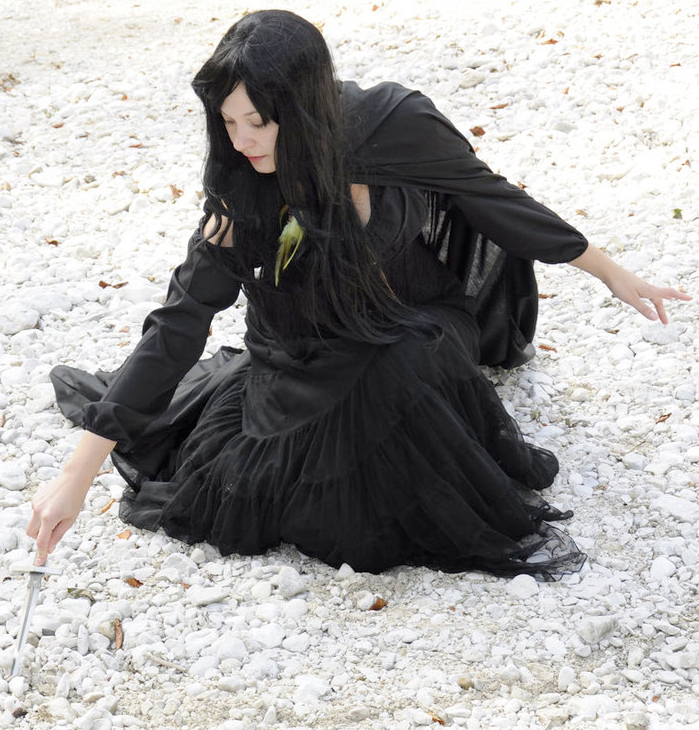
"Blackbird 10" by Janna Prosvirina
In the cover art for the fantasy novel Daveed the Luk'ie, I want to depict a pek in the act of performing some magic (specifically, conjuring Daveed into the Hadronic Domain). My first problem is that the pek are a type of artificial life that can take on any convenient shape. However, since Daveed is a guy, I want the pek to be using a female form, as the pek tend to do when visiting primitive planets like Earth. I would not mind giving the pek character in the book cover image a slightly non-human morphology. My other concern is that I want the pek to be doing something interesting and have a natural pose. In "signs of spring", I think Ana did a great job constructing a scene that matched the particular pose that Marcus had photographed.

Janna's DA fantasy stock photography
"Blackbird 10" shows the kind of magical pose I'm looking for. Janna Prosvirina's deviantART stock photography gallery contains many photographs that strike me as examples of realistic or naturalistic poses. I love the black cloth with the white stones, but for my purposes, I was thinking about this figure being on or near water. However, this photograph has me imagining all sorts of alternatives....sadly most are more suited for science fiction than fantasy.

This "Goddess of Earth" is Kayla Jane
Photographer: Heiko Warnke
In addition to the gorgeous pose, "Goddess of Earth" is even a great name for the pek character that I am trying to depict. Every goddess of Earth should carry a big stick.

I can picture Daveed taking her hand and being pulled from the Hierion Domain into a new existence on Earth. Also see "Goddess of Wind".

Kayla's deviantART journal has a thank you message to other folks for "the amazing art you create from my stock images".

For how I used this image of Kayla in cover art for the imaginary book Daveed the Luk'ie, see my next blog post.

Goddess Deviations
Here are some deviations for "Goddess of Earth".

"A gift for my friend"
"A gift for my friend" by Mark Frost. Is that a dragon egg?

"An Offering" by Keith Mathis. Great horny skulls!
"An Offering"

"Maga" by Ricardo Esparza. I like the luminous helix zapping around the stick.
"Maga"

Photographer and Model Preferences
source
One of the interesting aspects of deviantART is that the users sometimes post rather long and detailed accounts of the conditions under which their photographs and images can be reused. For example, Kayla Davion wrote these instructions: "Feel free to use my Stocks for creating Art BUT ... 3) do not mutilate them/me in any degrading or perverted way".

When I'm making whimsical book and magazine covers, I like to "mutilate" human figures by substituting alien features for the human features of the people in the photos, people who are usually celebrities or models. For The Sedron Monopoly, I tried to depict two alien-looking passengers in a spaceship by removing the human heads and Photoshop splicing alien heads into the image.

Leymaygn and Vozgrow (source)
Maybe some models would be offended by having their image altered so as to make them look "alien". For my Exode character Vozgrow, I needed to create an image of an old and partially alien human who is slowly taking on Fru'wu physical characteristics.

This depiction of Vozgrow (image to the right on this page) might well annoy the model whose image was altered to create an alien-like feel for the imaginary Vozgrow character.

As stated here: If I'm using one of your images without attribution, please let me know, I'd love to give you credit. If my use of your work is offensive (or, in your view falls outside of the "fair use" domain), let me know, I'll remove your image from my blog.

source
 Deviant Dozen
Follow these links to some of my blog posts with more "Deviations":
Robots and Hybrids
Imaginary Book Covers
baseball in 1941
illustrating Trysta and Ekcolir
illustrating Foundations of Eternity
To Live for Anney
rise of fantasy
other futures
The Phasian Elf
Lieserl Einstein
The Urak Intervention
Searching Earth
Time Travel Television
Replicoid Secrets
Marta
Nereids
Nicotinic Anney
Image Attribution Project
Visit the Gallery of Book and Magazine Covers.

Aug 10, 2009

Free fiction war?

This blog post was the result of me seeing "Hot, Hot In The Summertime And Hot Under The Collar!", a blog post by Rob Shelsky. I'll start by saying that I am sympathetic to the plight of professional writers. I'd be more sympathetic if a larger fraction of the money I have spent on books actually ended up in the pockets of the writers. I think we all have to ask if the print publishing industry is worth saving.

Let's face it. Printing books is technology from a past era. It was a great idea 500 years ago, but all things change. News flash: we are now in the computer age. Information was once expensive and text was once tedious to work with. However, computers increasingly make information cheap and text easy to sling...and copy. Get used to it.

Image generated by Leonardo
Rob wrote: "...those people who write 'just for the fun of it,' all the time, and who say they don't care about any monetary proceeds and just give it away consistently, in my opinion are not helping the author community as a whole."

Okay, that comment is targeted at me, so here is my reply....

Imagine this comment from 1850: "...those people who try to make machines for picking cotton are not helping the institution of slavery." I'm sure that people who made a living from selling slaves were "hot under the collar" when the Southern Slave Economy collapsed, but should anyone have shed a tear for them? Now, in this analogy, Rob is more like a slave than a slave master. His plight reminds me of former slaves who were made uncomfortable by the need to become self-autonomous when the Civil War ended and they were no longer a slave.
Image generated by Grok.

I think what we need is a unified internet-based system for making fiction accessible to readers. Some fiction content inside that system will be free and some will be available for a fee at download. Some writers will likely only make teasers available electronically and will continue to force readers to purchase "hard copy". I'd like to see a system where authors get the vast majority of what readers pay for fictional works. Editors and publicists should work for authors and come to authors looking for work...."I'd be thrilled to edit your next novel for a small fee".

We need to explore new ways to channel money to authors. I'd like to see a culture "tax" that allows people to check a box on their Form 1040 and donate to a fund for creators of free culture. We need to get busy creating an electronic system that will allow the creators of free cultural works to be compensated according to the value of their contributions to society.

Systolina in the sleep lab.
Image
generated by
Leonardo

 Note: free culture does not have to mean "free as in beer"...free culture is mainly about the freedom to share and use intellectual property...there are still ways to profit within an information economy that rewards sharing. I think such a system for rewarding intellectual creativity would require that each person in the information economy have a unique personal electronic identifier. If I download and read a work of fiction, my unique personal signature would be credited towards the author of that work. The author would be paid a share of society's free culture fund.

Rob wrote: "...we may end up with so many rank amateurs who want to give away their poor quality work free, that the discerning reader simply can't find what's good anymore, can't wade through the dross to find the gem, because it is buried in an ever-growing mass of what's bad". 

Image generated by Grok.
Yes, a fundamental problem of the information age is finding "the good stuff". This is nothing new. I've suffered my entire life with the problem of sorting through the ocean of "what's bad" and published. Within Science Fiction Publishing there is a pattern: ignore all authors until they start to sell. Then publish everything that author ever writes, including all the crap they ever write.

I think the internet has the potential to host great oceans of "what's bad", but it also has the potential to provide us with tools for searching and finding "what I like", which for me seldom matches what the publishing industry likes to publish. So I say, rather than bitch about all the crap on the internet, let's all pitch in an make the tools that are needed to sort what we like from what we want to ignore. 

Image generated by Leonardo

Let the internet flower, let the fiction flow...the more the merrier. Let's find new ways to help creative people receive monetary compensation for their work. Let's not mourn for the fact that the old print publishers have new competition.

Related blog post at Book Oven.

Will authors of the future need publishers? by Nathan Bransford

Future of self-publishing by thinkfeel

Top of page image. Source. GFDL.

Next: setting the tone in fiction.

Sleep lab images generated by Leonardo. Visit the Gallery of Movies, Book and Magazine Covers

Jun 21, 2009

New License, new Text Editor, new Collaboration


New License. A funny thing happened on the way away from the forum. Back in April I saw no evidence that Wikia would switch from the GFDL to the CC-BY-SA license, but the switch did take place (switched to CC-BY-SA).

People can do a
Google search for "free" content
. For example, this blog comes up if you search for free content on the web that mentions the story VirileMail. Hopefully Fiction Wikia pages will start showing up in such searches soon.

New Text Editor
. Another change for the Fiction Wikia is that a rich text editor is now available. Hopefully this will help make it easier for people to participate at the Fiction Wikia.

New Collaboration. Fiction Wikia has long had One-word-at-a-time. We recently started One-paragraph-at-a-time. The first story being made using this format is I'm not you.

Apr 13, 2009

Licensing wiki fiction


Back when Wikipedia started, the GFDL was a good choice for a copyleft license. The fiction wikia (Novelas) uses the GFDL, but it would be possible to switch to a different license. The alternative is the similar Creative Commons Attribution-ShareAlike license (CC-BY-SA).

If these licenses are very similar (and they are) then why bother switching? The creature to the right is an extinct arthropod, a member of the class Trilobita that existed for hundreds of millions of years then died out. In the ecosystem of the internet, survival times are typically much shorter...and the GFDL may be driven to extinction by the more robust Creative Commons family of copyleft licenses.

If you make the decision that you want your work of fiction to be freely shared with the world (free to copy, free to modify) then why not use the most popular license available for that purpose? As far as I can tell, CC-BY-SA is better supported and more widely used than the GFDL and that trend will only continue to grow. See: Forum:Change the license.