Showing posts with label Leymaygn. Show all posts

Apr 26, 2015

Lendhalen

Leymaygn and Vozgrow
Lendhalen is where Parthney was trained for his mission to Earth. When Parthney arrives at Lendhalen he has no appreciation for the conditions under which Interventionist agents operate while stationed on Earth. He is alarmed to learn that humans are viewed as a kind of disease organism by aliens and that the Interventionists must scheme and struggle in order to try to win a future for Humanity. It is not hard to win Parthney over to the Interventionist cause.
Exode table of contents

However, Parthney finds conditions at Lendhalen to be chaotic and it seems like nobody is really in charge. There are competing factions among the interventionists and Parthney can't judge which of the different views of Earth's future is most likely to be correct.

Some of the Interventionists (Pla'mak and Vozgrow) are intent on continuing to push forward the same agenda that has previously guided missions on Earth. Through the centuries, Interventionist agents have worked to accelerate the pace of human technological advancement on Earth. Parthney gets to meet several former residents of Earth who were teleported off of Earth by other "Thomas clones" who in the past served on Earth as Interventionist agents.

Pla'mak
Among those former Earthlings is Gwyned, the sister of Thomas. Gwyned is very much committed to the idea of pushing ahead the pace of technological advance on Earth. She tries to prepare Parthney to bring to Earth new technical knowledge related the development of fusion power, but he is not convinced that it makes sense to meddle with the pace of technological advances on Earth.

Pla'kau
Other Interventionists, (particularly Pla'kau) question the wisdom of helping Earthlings push towards new technologies. In fact, Pla'kau wants to send Parthney to Earth with ideas for solving the global warming problem

Syon the robot.
Pla'kau, Pla'mak and Vozgrow don't have direct contacts with Parthney. Parthney's training within Lendhalen is in the hands of Leymaygn, Syon and Gwyned.

Leymaygn is the Buld who is assigned the task of keeping Parthney with his nose to the grindstone. However, Parthney is not one to work very hard and he soon diverges from the rigorous training schedule.

Gwyned
Parthney ends up spending much of his time at Lendhalen with robots like Syon. He forms a new megepi and neglects his studies of Earth.

Pla'mak decides to work with Gwyned and help her study the technology at Lendhalen, most of which was provided by the Fru'wu. Gwyned makes little progress in understanding nanites, teleportation and hierions, but she does manage to crack the Fru'wu teleportation codes and she sends a "copy of Luri" to Earth with Parthney.

Gwyned's family
Gwyned is the daughter of Deomede and Trysta. She is the half sister of Thomas. Recognizing that Parthney is fascinated by the idea of finding human females to socialize with and not at all interested in having a physical relationship with him, Gwyned provides Parthney with the robot, Syon.

An Ek'col male and Asterothrope female.
Although nobody at Lendhalen knows it, Syon is a sophisticated artificial lifeform that originated as the Asterothrope who readers of the Exode Trilogy know as Trysta. Syon provides Parthney with the key piece of information that he needs to pass on to Thomas after being sent off on his mission to Earth.

In the next chapter of Exode ("Klyz and Earth"), Parthney completes his training at Lendhalen and is teleported to Earth. When Parthney is teleported away from Lendhalen, he is first sent the the Fru'wu base at Klyz where the artificial replica of Luri is waiting.

Mar 16, 2013

Prophecy by Time Travel

In my previous blog post I mentioned a strange story that is passed from Noÿs to her daughter, Gwyned. Noÿs is a time traveler from 10,000,000 years in our future, so it easy to imagine that she could tell some interesting tales to the people of the 20th century. Noÿs provides Gwyned with a warning about global warming, but this takes place in the early 1960s, before there is widespread recognition of the idea that human activity can alter the global climate.

How much did Noÿs know about her own future? According to the backstory for Noÿs that was developed by Asimov in his novel The End of Eternity, she made use of advanced technology from the future that allowed her to view alternate "Realities", alternative time lines that might come into existence. Speaking to Andrew Harlen, Noÿs says, "I studied the Reality in which....you and I, together, returned to the Primitive. I saw our lives together and they were happy...."

Captain Christopher's son will command the first
manned mission to Saturn. Left. Right: Kirk.
Does Noÿs have the power of prophecy because of her use of advanced technology that allowed her to watch her future self? I've hinted that Noÿs and the humans from 10,000,000 years in the future might be prophetic in another way: because of access to special knowledge by way of their contacts with the Huaoshy, an advanced alien artificial lifeform that has god-like powers. The Huaoshy are fanatical about keeping secrets from Earthlings, so anyone with special access to the Huaoshy will know things about Earth that nobody else on Earth can know.

Journey into the Primitive
For Noÿs, the "Primitive" means specifically the 20th century. In Exode, Noÿs arrives in the 1930s and she does live happily there with Andrew for a while and they have a son, Thomas, but then Andrew is captured by the Overseers. If she was able to see her "future" life with Andrew in the 20th century then why didn't Noÿs know that Andrew would be captured, why didn't she take steps to protect Andrew?

Assignment: Earth
As Noÿs explained to Andrew, "No matter how finely we focus on a given Reality...there are fuzzy spots. One fuzzy spot spoiled things." So, although Noÿs saw into her own future, the future that she helped to create was different in detail from the future that she originally saw, planned for and tried to bring into existence. Most importantly, as described in The Start of Eternity, the Reality that Noÿs brings into existence (what I call the "Foundation Reality") is one that ultimately allows the Huaoshy to discover that positronic robots on the Moon have invented time travel.

However, regardless of the differences between the version of the Foundation Reality that Noÿs tried to bring into existence and the Reality that was actually formed, I like to imagine that Noÿs did know that Andrew might have to be sacrificed to the Overseers even before she traveled with Andrew to the 1930s. However, she would have tried to bring into existence a Reality in which Andrew avoided that fate. Similarly, she tells Andrew, "There is a probability, not a certainty, of course, that that Earth will end up with a largely radioactive crust." Asimov later described how Earth did become so radioactive that it could no longer support human life (in Robots and Empire). I imagine that Noÿs believed it was desirable for Earth to be abandoned by Humanity, for the same reason that Giskard allowed Earth to become dangerously radioactive.

Noÿs views her future in the Primitive
I imagine that Noÿs and Andrew lived "happily ever after" in the "Foundation Reality" (see below), although Andrew died long before Noÿs, simply because of the extended life span enjoyed by Noÿs. The most interesting thing about the Foundation Reality was that it eventually allowed the alien Huaoshy to realize that time travel had been invented by robots living on the Moon. With that critical understanding finally achieved, the Huaoshy set about creating another Reality in which, when the time to sacrifice Andrew approached, I imagine that Noÿs discussed with Andrew the advantage to be gained from allowing himself to be captured and he volunteered to be taken to the secret Observer Base on the Moon. I imagine that Noÿs was aware of the possibility that Overseers might notice the presence of Andrew and Noÿs in the 19th century and in anticipation of being detected she had a plan that would involve allowing Andrew to sacrifice himself so that Noÿs could escape and continue her effort to establish a future that involved control of the galaxy by Humanity.

The Foundation Reality
In The Start of Eternity, I imagined that Noÿs works in the 1930s to bring into existence the Foundation Reality, a timeline within which events unfold as told in Isaac Asimov's fictional universe. However, despite the best efforts of Noÿs, the Huaoshy develop their own time travel technology which they use to put an end to the Foundation Reality and bring into existence the Reality that we know (for reasons described below and in Exode, I call this Reality the "Buld Reality"). Further, after regaining control of their secret base on the Moon, the Huaoshy put an end to all time travel. For Exode, I imagine that Noÿs, while living in the 20th century, is contacted by time traveling Huaoshy and her efforts in the "Primitive" are re-directed towards the task of creating our Reality.

Testosterone and brain sexual dimorphisms
The Noÿs Reality. When Andrew is captured and taken off of Earth (1949), Noÿs and her young daughter, Gwyned, escape from the Overseers and go to live in Australia. Andrew is the first father that Gwyned knows, but he is not her biological father. While living in Australia, Noÿs uses the name Trysta and she eventually marries Merion Iwedon. Upon reaching adulthood, Gwyned knows Trysta and Merion as her parents and Andrew fades from her memories. Gwyned never really knows Ekcolir, her biological father, very well. Ekcolir is an Interventionist agent from Hemmal and he is something of an absentee parent. Gwyned never understands why Ekcolir only occasionally shows up to consult with "Trysta" and only stays for brief visits. Thomas is Gwyned's half brother. Thomas grows up to be a writer of  fiction: science fiction stories that involve "alternative histories". I expand on the life of Thomas in my next blog post.


Temporal Inertia
One of the features of "Reality Changes" in The End of Eternity is the inertia of time, by which Asimov meant that even if a time traveler causes an altered course of events, time tends to "heal itself" and the course of events can return to its original shape after a limited period of time travel-induced alterations.

As a further example of the resiliency of time as depicted by Asimov in The End of Eternity, the main character, Andrew, visits a library in Eternity that has records for many alternative Realities. Among the library holdings for alternate Realities of the 575th century are 15 that included novels written by Eric Linkollew, "usually described as the outstanding writer" of that century. Each of the 15 different sets of "complete works" of Linkollew are different: "One set was noticeably smaller than all the others." Asimov never explained how many alternate Realities in a particular century could be brought into existence by Reality Changes while leaving most people unchanged, but since I'm using Asimov's version of time travel for Exode, I'll adopt this feature of time travel. The Reality that we know is slightly different from any that Noÿs "viewed" in preparation for her time travel to the 20th century, but most of the people that she viewed remain the same and have an existence in our Reality.

Noÿs brings nuclear technology to the 20th century
I imagine that when Noÿs "viewed" her own future in the 20th century she saw her son Thomas and her daughter Gwyned. Gwyned grows up as a gifted science student and starts a career in physics research. I imagine that in the Foundation Reality she played an important role in the development of fusion power.

As a biological product of her two unusual parents, Gwyned is not  typical Earthling. When Gwyned is teleported off of Earth (in the Buld Reality) and arrives at Lendhalen she provides Parthney with a rather perplexing introduction to the existence of a human female who is not sexually attracted to men.

For Exode, I imagine that Noÿs comes from the far future, a time when there is only one human gender. As described by Asimov in The End of Eternity, humans "just die out" at some point in time more than 10,000,000 years in our future. Noÿs is part of a project that is designed to put an end to Eternity, the time travel system on Earth. The mere existence of Eternity is blamed for the inevitable extinction of the human species in the Mallansohn Reality. For her mission back in time, Noÿs has been surgically engineered to have the appearance of a human female of our primitive age and she has some advanced nanites that facilitate her disguise. In the Buld Reality, Gwyned, as a biological hybrid between Noÿs (with the mono-gender genes of humans in the far future) and Deomede (a false Buld from Hemmal), is genetically unable to respond to males as potential sexual partners. Parthney is not particularly attracted to Gwyned, either. They are almost two different subspecies of humans.

Leymaygn on Oib
Gender Wars
Gwyned's sexual preferences come to the attention of Deomede and when he decides to teleport her off of Earth he is happy to so. Ekcolir (in the Noÿs Reality) and Deomede (in the Buld Reality), as Interventionists, are rather aggressive and militant in their efforts to make sure that heterosexual humans inherit the Earth rather than the hermaphroditic Prelands. Also, the Overseers are all genetically modified females, which further biases Interventionist agents on Earth (who are all males) against women like Gwyned. Their prejudice against the Prelands and the Overseers often extends to include humans who are not obviously heterosexual. Deomede does not trust Gwyned so he gladly teleports her off of Earth.

Spock: "Interesting experiences...." Smirking Kirk.
When Gwyned is on Earth, her mother (Noÿs)  talks to Gwyned about certain myths and legends and she hints that they are relevant to the future of Earth. Gwyned can't make sense of what Noÿs is telling her, but later, at Lendhalen, she passes along what Noÿs said to Parthney. When Parthney reaches Earth he "connects the dots" and realizes that Noÿs provided useful information about global warming and how the Buld, soon to arrive in the Solar System, can help the Earthlings deal with their technological adolescence and problems like rising sea levels.

Parthney comes to understand the concept of global warming because of Leymaygn's skilled interpretation of Gwyned's reports about events on Earth. Leymaygn is familiar with the on-going effort to warm Oib, and she correctly recognizes the cryptic warning from Noÿs about melting glaciers and rising atmospheric carbon dioxide levels on Earth. Leymaygn tells Parthney about the technology that is used by the Buld to transmit vast amounts of energy to Oib.

In The End of Eternity, Asimov showed the Eternals confronting the implications of people who, through the use of time travel technology, know their own futures. August Sennor proposes the theory that time paradoxes are impossible, that people cannot know their own futures: something will always prevent people from obtaining knowledge of their own future. Asimov does not adopt that conservative theory, but the people working within Eternity are depicted as having an almost superstitious aversion to even contemplating the idea of meeting yourself in time. Similarly, in Star Trek, allowing people to learn about their future was often just too much fun to avoid. In Tomorrow is Yesterday, the crew of the Enterprise tells Captain Christopher that in his future he will have a son. In Assignment: Earth, Spock and Kirk can't resist telling Roberta and Gary that they have interesting experiences ahead of them, together in their future.

The Start of Eternity: the first positronic robot.
Does Parthney go to Earth knowing his own future? Not really. He has some hints about Earth that help guide his actions, but it is only after he has made critical decisions and already acted that he realizes the meaning of the message that Noÿs provided to him by way of Gwyned. Still, with the help of Parthney that critical information persists in the Solar System and is available when Kach and Izhiun eventually arrive.

The Start of Eternity
Is Exode a sequel to The Start of Eternity? I'm not going out of my way to make sure that Noÿs can jump cleanly from the pages of The Start of Eternity into Exode. It was a happy coincidence that when I finally decided that Exode should start in the 20th century Noÿs was in the right place at the right time to play a role in Parthney's mission to Earth.

For The Start of Eternity I, originally imagined that the Huaoshy would terminate time travel in 1947. However, for Exode, I want Noÿs and Ekcolir to travel back in time, departing the 20th century from a time point in the early 1970s (possibly 1971, more than 20 years after the proposed end of time travel in The Start of Eternity). So, for Exode, I imagine that the Huaoshy put an end to time travel around 1971 rather than 1947. It might be possible to make The Start of Eternity consistent with this later date, but I'm not going to worry very much if the ultimate fate of Noÿs in Exode is slightly different. The Start of Eternity can end with events still taking place in the Noÿs Reality and Exode can be in the Buld Reality.

In The Start of Eternity I imagined that the Huaoshy lost control of their secret base on the Moon. For Exode, I imagine that when the Huaoshy allow a Buld spaceship to depart for Earth (shortly after the time when they lose control of their Moon Base in the Mallansohn Reality) doing so is part of how they create our Reality (the "Buld Reality"). This is part of the Huaoshy plan in which Ekcolir goes back into the past near end of the last glaciation where his  presence will allow the pek to prevent the positronic robots (including Gohrlay) from capturing the Moon Base that was established long ago by the Huaoshy. In exchange for her help in thwarting the revolt by positronic robots, the Huaoshy agree with Noÿs to give the humans a chance to create a technological civilization on Earth (what becomes the "Buld Reality").

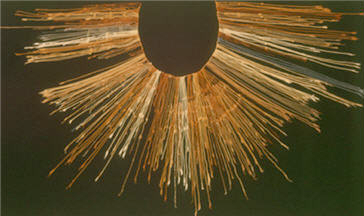
Khipu
I like this "Exode variation" on the end of Eternity (in which Noÿs dies far in our past at about the time when written language first appears on Earth) better than what I had originally imagined in 2009 for The Start of Eternity. It is fun to imagine ways that "ancient Interventionists" could have left behind cultural artifacts that have gone unrecognized. In what way could Noÿs have made a cultural impact about 10,000 years ago that could have persisted and transmitted information about our present times all the way into the 20th century?

Technological Intervention
Ancient lenses?
In the original Exodemic story I imagined that Interventionist agents showed Alexander the Great how to use simple lenses to make possible a system for microscopic writing. That technology for microwriting was discovered by the Overseers and they put an end to its use on Earth, but some of the lenses remained behind as puzzles for archeologists.

For Exode, we can ask how Noÿs might have arranged to have stories about the 20th century propagate across 100 centuries. Recognized evidence for writing that was preserved in stone and clay only goes back about 50 - 100 centuries. However, it is fun to imagine that we might some day discover evidence of unusually advanced artifacts at a 10,000 year old archeological site. Some forms of mnemonic aids that might assist in the propagation of stories through long periods of time might not leave clear evidence of their existence in ancient times. Noÿs is able to compare the ancient myths of the Noÿs Reality and the Buld Reality and notice a difference that she attributes to her own presence on Earth 10,000 years ago.


The Buld Reality
Sequence of Realities: Eternity, Foundation, Noÿs, and Buld.
Before the Huaoshy can cause the "Buld Reality" (which is the world as we know it) to come into existence, there is an intermediate "Noÿs Reality". In the Noÿs Reality the Huaoshy take control of their Base on the Moon at a point during the 20th century. In the Noÿs Reality, Noÿs lives out her life in the 20th and 21st centuries. Under the influence of Noÿs, advanced nuclear technology is developed and Earth never makes heavy use of fossil fuels and never goes into an age of serious global warming and catastrophic sea level rise. However, Earth suffers a nuclear catastrophe instead. The Huaosy show Noÿs that future and in so doing, gain the help of Noÿs for initiating another Reality Change. By sending Ekcolir back into the distant past at the end of the last glaciation the Huaoshy are able to keep control of Observer Base on the Moon and arrange for a Buld spaceship to arrive in the Solar System early in to 21st century. At the end of Exode, we are left wondering if Earthlings can make use of Buld technology to prevent catastrophic sea level rise.

My next blog post further sorts out the differences between the Noÿs Reality an the Buld Reality.

Feb 24, 2013

The Mask Slips

The Moon Moth, illustrated by Humayoun Ibrahim
I recently mentioned the fact that I discovered the science fiction of Jack Vance by way of his short story The Moon Moth. I'm not a big fan of short fiction, so once I found my way to Vance's novels I never looked back; I have not read The Moon Moth since 1978.

Last year an illustrated version of The Moon Moth became available, thus creating a new opportunity for another generation of readers to be introduced to the fiction of Jack Vance. The images to the right are by Humayoun Ibrahim; they convey the idea of a world where people hide their faces behind masks.

I recently started thinking about The Moon Moth while I was writing my previous blog post and imagining how Gwyned might disguise herself so that she could return to Earth. Gwyned is a character who plops into the middle of Parthney's life in Chapter Three of Exode. Gwyned was born on Earth, but she became disgusted by the way that nuclear physics, and nuclear physicists, had been sucked into the center of Cold War politics.

Gwyned managed to escape from Earth in 1964 and then she finds herself living at the secret Interventionist base called Lendhalen. When Parthney arrives to begin his training for a mission to Earth, Gwyned is deep into plotting a way to return to Earth. However, the Buld who run Lendhalen have no intention of allowing Gwyned to return to Earth; they simply want Gwyned to pass her knowledge of the current conditions on Earth along to Parthney.

Gwyned faces an interesting challenge at Lendhalen. She finds herself surrounded by fantastic technologies never seen on Earth. The Buld have been traveling between the stars of the Galactic Core for many tens of thousands of years. However, their spaceships were provided to them by aliens and it was not until 20,000 years ago that a small rebel faction of the Buld learned how to read and write and began the process of trying to understand the technological wonders that they had taken for granted for so long.

Progress towards that understanding has been slow. There have never been very many Buld rebels. The Buld have been engineered to require symbiotic nanites inside their bodies in order to reproduce. However, those nanites integrate into Buld brain tissue where they prevent the Buld from being able to use written language and even from being skillful tool users. The Buld rebels have made their choice: they live without nanites.

Among the rebels, a few Buld scientists seem to have made considerable technological progress in some areas. For example, about 5,000 years ago the Buld mastered the art of making humanoid robots. Lendhalen thus has a two-tiered social structure made up from the small Buld population and their more numerous robotic assistants.

The first person who Parthney meets at Lendhalen is a member of the Buld Clan named Leymaygn. Leymaygn has been tasked with teaching Parthney to read and write and also train him in self-defense and hand-to-hand combat. Leymaygn is amazed by how quickly Parthney begins to read and she is impressed by his skill as a fighter. When Parthney was a child on Hemmal his caretakers taught him to read at a young age and also rigorously subjected him to physical training. However, after the age of seven Parthney's interests actively centered on music and he did not make use of his reading, writing and physical skills again until reaching Lendhalen, more than 10 years later.

Upon meeting Parthney, Gwyned quickly decides that he is an ignorant, chubby and lazy kid who is not worth wasting time on. Rather appalled by Parthney's obvious interest in her as the only human woman at Lendhalen, she provides him with one of her robotic assistants, Robin. Parthney, who is twice the size of Leymaygn soon finds himself pitted against both Robin and Leymaygn in his daily physical training sessions.

Initially fascinated by his reading about Earth history, Parthney's thinking about Earth is soon dominated by disappointment. Having lived for 18 years on the well-planned and comfortable world of Hemmal, Parthney is revolted by the squalor and suffering associated with human life on Earth. He takes refuge in his enjoyment of music and begins to shirk the strict training regimen that is preparing him for a mission to Earth.

With time, Parthney comes to notice that Robin's behavior does not conform to the conventional behavior of the robots of Lendhalen. At first he thinks about Robin as being the Lendhalen equivalent of the pek so he does not question the sophisticated behavior of Robin. Only later does Parthney realize that Robin is exceptional. For a brief time he is frustrated by his inability to convince Leymaygn and Gwyned that Robin is special. When ever others are present, Robin displays only simple pre-programmed behaviors.

Parthney has an interesting conversation with Gwyned during which she admits that she tried to find the research records describing how the Buld learned to construct humanoid robots. Not only was Gwyned unable to find those records, she admits, "I can't see how the damned robots work. I took one apart and found nothing inside it that could function like a human brain."

Parthney comes upon Robin and Vozgrow discussing Earth
At that point Parthney has a change of mind and he decides not to "kill the goose that lays golden eggs". Why question the good things in life? He's happy and starts making plans to stay permanently at Lendhalen. He tries to forget the inconvenient truth that hidden behind her mask, there is something exceptional about Robin. Is she something more than a Buld robot?

The Mask Slips
Lurking unseen within stories that are set in the Exodemic Fictional Universe are the mysterious Huaoshy. In Exode, the term "Huaoshy" is used by Vozgrow to refer to hypothetical aliens who created the pek. I've previously suggested that some humans can come to wonder if they are puppets of the Huaoshy.

However, I want to also raise in the minds of readers the possibility that the Huaoshy might also instantiate themselves inside robots. What better way would there be for the Huaoshy to watch Parthney and influence his development as an Interventionist agent? Rather than read all of the available reports on Earth's culture, Parthney orders Robin to discuss those reports with him. Gradually, through his conversations with Robin, Parthney develops a realistic understanding of Earth's past and the unique challenge that will soon be thrust upon the people of Earth: first contact with the passengers aboard an arriving spaceship.

Robot lab at Lendhalen
Finally, after several years go by, Vozgrow realizes that Parthney's relationship with Robin is distracting him from his planned mission to Earth. Vozgrow has a showdown with Robin during which they openly discuss the looming crisis on Earth. At the end of the discussion the memories of Vozgrow and Parthney are adjusted so as to satisfy the ethical rules by which the Huaoshy interact with primitive creatures like we humans. Parthney abandons his plans for living out his life at Lendhalen. "Robin the robot" returns to her dull and boring robotic behavior.

Parthney is left with his memories of Robin and her unusual behavior, but he is unable to discuss what he has experienced with his fellow Interventionists. However, what he heard Robin tell Vozgrow and his inability to discuss it has become a powerful motivation for Parthney to go to Earth and help liberate the Earthlings from the lingering effects of the pek nanites that had been used to prevent Earthlings from developing a technological civilization.

The Ghost in the Machine
The humans and Buld at Lendhalen are all confident that they live free of nanites and so their behavior is not controlled by the pek. It is true that they are free of the relatively crude nanites that are used by the pek. However, unknown to them, the Huaoshy have even more advanced devices with structural components composed of sedronic matter. The Huaoshy can effortless equip the crude Buld robots with sub-zeptoscale components and control systems that cannot be detected by the Buld. Gwyned grows increasingly frustrated by her inability to understand the advanced technology of the Buld, but the Huaoshy have been careful to allow the Buld to use just those technologies that serve the purposes of the Huaoshy without allowing the Buld to actually develop an understanding of that technology or the power to explore other technologies without assistance from the aliens. When Gwyned decides that she can accomplish nothing significant at Lendhalen she decides to return to Klyz and try to establish a working relationship with the Fru'wu.

Feb 23, 2013

Collaborators at Lendhalen

I'm more than 8,000 words into Chapter Three of Exode and still trying to decide what to call this chapter. I had been leaning towards "The Conspirators at Lendhalen". However, I'm writing the scene for when Parthney and Gwyned first meet at Lendhalen and having trouble convincing myself that "conspirators" is really the right word to apply to folks like Parthney, Gwyned and Leymaygn and their struggle to prepare Earthlings for the shock of first contact. I particularly don't like the usual connotation that implies "conspirators" are trying to accomplish something nefarious.

The word "collaborators" is interesting because it can introduce an ambiguity that is appropriate for Interventionists. It is possible to "collaborate with the enemy" and Chapter Three of Exode highlights the self-doubt of Interventionists: they must wonder if they are really puppets of the Huaoshy. The Interventionists like to imagine that they have been working to thwart the plans of the Huaoshy, but they can never be sure about that. Possibly, just possible, the Interventionists are doing exactly what the alien Huaoshy want them to do. If so, then while striving to be rebels, the Interventionists might unwittingly be collaborating with the mysterious aliens who the Interventionists regard as the enemy.

Glawen and Sessily
In the Cadwal Chronicles by Jack Vance, the protagonist, Glawen, is pitted against a gang of evil conspirators who want to put an end to the nature Conservancy of the planet Cadwal. Glawen is sent off from Cadwal and into the depths of space to pursue a police investigation aimed at revealing the identity of the conspirators. It turns out that Glawen's partner during the investigation, Kirdy, is well motivated to betray Glawen. On the planet Tassadero, Kirdy warns Ordene Zaa that Glawen will soon arrive at the seminary on Pogan's Point. Zaa casually tosses Glawen into a dungeon, having been assured that no rescue party will come looking for him. Glawen later learns that Kirdy is actually the murderer of Glawen's girl friend, Sessily. With "friends" like Kirdy, Glawen does not need enemies. The main advantage that Glawen has is that his enemies can't avoid fighting among themselves.

Cover art by Boris Vallejo
Similarly, in Exode, the Interventionists are not all members of a single unified organization. There are multiple subgroups of Interventionists that are unable to work together closely in a coordinated fashion. Gwyned is called upon to help train Parthney for a mission to Earth, but Gwyned can't escape the feeling that to help Parthney is tantamount to doing harm to Earth. When Gwyned was on Earth she was not at all impressed by Parthney predecessor,  Deomede. Gwyned has to wonder: maybe Earth would be better off if she went back to Earth as the next Interventionist agent rather than Parthney. The Buld administrators of Lendhalen such as Leymaygn are horrified to learn of Gwyned's plan to take control of the teleportation pad at Lendhalen so that she can send herself back to Earth. Gwyned wants to go back to Earth while avoiding any oversight by the Fru'wu Interventionists, but Leymaygn and the other Buld have been collaborating with the Fru'wu for thousands of years. The Buld fear losing the of help of the technologically advanced Fru'wu, but Gwyned is willing to rely on her own technological proficiencies and she has no compunction about double-crossing the Fru'wu.

Dame Clytie and Simonetta
Original cover art by Edward Valigursky
In the Cadwal Chronicles, there are several factions aligned against Glawen and the Cadwal Conservancy including 1) the "peefers" at Stroma who are a political faction that want's to overthrow the Conservator, and 2) the Yips who want to win free of their squalid existence on the Lutwen Islands and invade the mainland of Cadwal, wild and pristine land that is protected by he Cadwal Conservancy as a nature preserve.

Lucky for Glawen and the Conservationists, the leaders of the peefers and the Yips can't agree on common goals. Dame Clytie (head of the peefer party) and Simonetta (who has made herself queen of the Yips) literally come to blows when they can't agree on a shared plan of action against the Cadwal Conservancy.

Finally, "Smony" decides that Dame Clytie and the peefers are in her way, so she tries to eliminate them in one quick and decisive action: blasting their home, the cliff-side settlement of Stroma into the sea.

Stroma
Smony's dastardly plan fails to eliminate Dame Clytie who then takes revenge by launching a murderous attack on the Lutwen Islands resulting in the death of most of the Yips.

In Exode, the reader comes to imagine that the only hope for Humanity lies with the rather bumbling efforts of the Interventionists. However, it is hard to have much faith in the Interventionists because it seems like no two Interventionists can agree on anything. While the Interventionists don't start attacking each other, some decide that it might not be wise or safe to keep pushing the Earthlings ever faster towards an uncertain future of rapid technology-powered cultural change.

In the second book of the Cadwal Chronicles, Glawen faces a similar problem. He wants the Cadwal police to take swift action to rescue his father who is being held captive at a secret base on Ecce. However, his supervisor is unwilling to risk precious resources on a dangerous rescue operation into enemy territory.

Glawen must heroically go on the rescue mission by himself with only makeshift resources at his disposal. Glawen is well aware of the danger he faces, so when he boldly goes off to rescue his father we have no difficulty viewing his actions as heroic.

In the case of the Interventionist agents like Parthney in Exode, they are not at all well informed. In fact, Parthney is quite naive about what he is getting himself into. He is intrigued by the opportunity to go to Earth and finally live among other humans, but he can't really bring himself to imagine that going to Earth might bring him personal danger. Gwyned tries to make Parthney so comfortable at Lendhalen that he will never want to go off and face the hardships of being stationed on Earth. Gwyned provides Parthney with a robotic assistant, Robin and she helps Parthney pursue his musical interests.

After Parthney grows too comfortable at Lendhalen something must be done! The Buld have to ratchet up pressure on Parthney to make him fulfill his destiny and go off to Earth. The reader might feel that it is foolish to not let Gwyned go to Earth instead, but she is unable to make progress in her attempts to take control of the teleportation equipment at Lendhalen. Frustrated in her attempts to reverse engineer the advance technology at Lendhalen, Gwyned eventually returns to Klyz and tries to strip away the secrecy that shrouds the Fru'wu. Gwyned is at Klyz when Hana arrives from Earth. Neither of them have good things to say about Parthney and Gwyned helps lead Hana towards the suspicion that Parthney is responsible for the death of Hana's husband.

Jan 29, 2013

Vozgrow and Leymaygn

Dryad
I've been sketching out character and plot details for Chapter Three of Exode. Previously I mentioned that Vozgrow and Leymaygn are two Buld at Lendhalen who train Parthney for his Interventionist mission on Earth. Everyone who lives at Lendhalen is free from pek nanites, but that makes it difficult for the Buld to maintain a stable population. I've decided that Leymaygn makes use of a type of "partial change" that has been developed by the lisden of Lendhalen to help the Buld Interventionists stabilize a small population of rebels. As described for Pla'va, by going through "partial change" Leymaygn can be rejuvenated and also retain some existing brain structure and behavioral patterns although most individual memories are lost in the process.

In contrast, Vozgrow has a long personal history of experimenting with medical nanites provided by the Fru'wu. Leymaygn has the typical youthful appearance of the Buld, but Vozgrow is ancient like Yandrey.  Yandrey shows some effects of extreme age, but since thon lives on Hemmal there are pek medical nanites in thons body that do a good job of preventing most of the deleterious consequences of old age. For example, Yandrey wears a wig to hide thons baldness and makes use of a kind of makeup made from nanite components. The Fru'wu medical nanites are not as efficient as the pek nanites and so Vozgrow does not have a youthful appearance. Parthney is rather shocked by Vozgrow's odd appearance and Gwyned tries to make him appreciate the fact that there are many old and disabled people on Earth. Where Parthney grew up on Hemmal, everyone is genetically perfect and kept healthy by pek medical nanites, so before seeing Vozgrow, Parthney has never really experienced a person with alarming physical features. I've been trying to decide just how hideous to make Vozgrow.

In the Jack Vance novel Star King an alien creature called a "Dryad" is described: "They are at least half plant...bipeds, with a peculiarly human torso and head structure...the head showed...purplish-green bruises which seemed to be eye spots." I'm amused by the idea of a sapient, bipedal plant-like creature and I'm imagining that Vozgrow has been shifted in that direction by the Fru'wu medical nanites.

Glimpsed image of a Fru'wu
The two alien species featured in Exode are the Fru'wu and the Nereids. The Nereids are fairly humanoid, but the Fru'wu have an alarming body form and so they avoid showing themselves to humans. I've previously hinted at the body structure of the Fru'wu. In my thinking, the original naturally-evolved body form of the Fru'wu is lost in the distant past, but we can try to reconstruct their evolutionary origins. The Fru'wu (more accurately, the distant ancestors of the Fru'wu) were an old species when the pek arrived in our galaxy seven million years ago. The Fru'wu are half biological and half artificial; a symbiotic hybrid construct of biological cells and nanite components. Although not complete shapeshifters like the pek, the Fru'wu can easily alter their surface features and it is doubtful that humans have ever seen their unaltered form.

Fru'wu home world
The Fru'wu provided medical nanites to the Buld, but the Buld have never had a very good grasp on biology. The Buld have never been able to make the required adjustments to the Fru'wu medical nanites to fully adapt them for use in humans. With time, Buld who make use of Fru'wu medical nanites begin to have some distinctive morphological features that reflect aspects of Fru'wu biology. I'm trying to imagine how to transform an elderly human part way towards a plant, something about 10% of the way towards Vance's Dryads.

Spoilers
The original planet where the Fru'wu evolved was significantly hotter than Earth, a world with a carbon dioxide-rich reducing atmosphere where oxygenic photosynthesis never appeared. An oxygen-containing atmosphere is poisonous to the Fru'wu and humans cannot survive in the type of atmosphere that is suitable for the Fru'wu.

The star of the Fru'wu home world produced mostly long wavelength light that could be used for a type of photosynthetic acetogenesis that allowed for efficient carbon dioxide fixation and a metabolism based on carbon compounds. Nitrogen fixation was accomplished on the Fru'wu home world by a second linked photosynthetic electron transport system with a specialized vanadium-iron nitrogenase complex.

Orbits of Oib, Hemmal and Clu'ten'iun around the star Koly. Positions of some Pla spacecraft are also shown.

When Parthney arrives at Lendhalen, he believes that he is on Oib. However, the interventionist base on Oib is just for cover...Lendhalen is actually located at the next planet closer to Koly than Hemmal: Clu'ten'iun. The conditions on Clu'ten'iun are not fully compatible with Fru'wu physiology, but the high temperature, high carbon dioxide, no oxygen atmosphere makes it a reasonable place for a Fru'wu base of operations in the Koly star system. When Parthney arrives on Oib he is secretly teleported to Clu'ten'iun. The readers of Exode do not learn about Clu'ten'iun until Parthney returns to the Koly star system after his mission Earth.
Leymaygn and Vozgrow.

Jan 19, 2013

Exode Back Cover

At the end of 2012 I made the first draft of a front cover for Exode. I've now made a back cover and a blurb that could go just inside the front cover of a print version of the novel.

For back cover images I used the images from Chapter Two. These images depict Parthney and Pla'va when they are approaching the planet Oib.

For the inner blurb I tried to weave together Hemmal, the pek, Prelands, the Creators, Earthlings, the Buld Clan, Kach, Parthney and the Nereids:

Exode - change your world...or else!
On Hemmal there were four types of people: the alien pek, a shape shifting artificial lifeform; the hermaphroditic Prelands, newly crafted by the Creators as the desired replacement of the barbaric Earthlings; the Buld Clan, engineered to have an extra chromosome that makes them suited for travel between the stars; and two mutant Buld, Kach and Parthney, genetically identical to Earthlings, but born 15,000 light years from Earth. Everyone has plans for Earth...the pek, the Buld, the alien Nereids, but do any of them care if humanity is erased, replaced, forgotten? Kach and Parthney, two false Buld, reached Earth in a last minute attempt to save the human species from elimination...but why bother? After all, aren't humans defective and obsolete? Wouldn't Earth be better off if it was populated by Prelands rather than Humanity? Could Kach and Parthney help the Earthlings change their world -change themselves- or was it simply time to get away, escape from Earth before the Creators swept the human species from the planet, the superseded humans neatly replaced by Prelands?


________________________________________________
Would it make sense to the average reader to have the Prelands described as hermaphrodites and then see the term "thon" applied to the Prelands, replacing "he" in the famous saying, "We have met the enemy and he is us"?

The Prelands are "humans, version 2.0", they are like we Earthlings (we barbaric Earthlings) only better: designed by the Creators to have a chance of surviving in a technological civilization.

I'm currently writing Chapter Three of Exode which describes how Parthney finally achieves a reasonable understanding of Earth and the primitive conditions under which humans live there. Parthney arrives for training at Lendhalen with a very naive view of Earth. While on Hemmal Parthney heard stories about Earth from Yandrey, stories that filled Parthney's imagination with ideas about what it might be like to live on a planet full of other humans. But then, while at Lendhalen, the more Parthney learns about Earth the less enthusiastic he is about going to live there. As Pla'va tried to warn him, "It is a terrible place, full of war and disease and death."

While living at Lendhalen, Parthney is trained by two Buld, Vozgrow and Leymaygn, and a human from Earth, Gwyned Iwedon. Vozgrow and Leymaygn are similar to Yandrey; they are ancient Buld who have lived for thousands of years. Vozgrow and Leymaygn have vast experience gained from studying Earth and training Interventionist agents like Parthney. Gwyned lived on Earth for 25 years then, when given the chance, took her opportunity to leave Earth and join Genesaunt culture at the Galactic Core.

image source
Gwyned is vastly more sophisticated than Parthney, who can't even read when he arrives at Lendhalen. Gwyned was doing research in plasma physics when she decided to leave Earth. At Lendhalen she is studying Buld spaceship technology and trying to apply modern scientific knowledge from Earth to understand Buld spaceship propulsion.  One thing that Gwyned and Parthney have in common is a love for music.

Guiding the training of Parthney for his mission to Earth are two Pla, Pla'kao and Pla'mak, who have begun to question the entire Interventionist plan for accelerating cultural development on Earth. Gwyned has brought word of the thermonuclear arms race on Earth (she leaves Earth in 1964). Pla'kao and Pla'mak have long been collaborating with the Fru'wu to to prepare Earth for the impending arrival of a Buld spaceship. However, by making it possible for Earthlings to develop a technological civilization will Earth face the same fate as the Fru'wu home world? As if the danger of nuclear war is not bad enough, Gwyned brings an additional warning about increasing levels of carbon dioxide on Earth. The Pla begin to realize that Earth is between a rock and a hard place. Is there no way to save the Earthlings from a technological disaster?

Apocalypse New

It is 1967 when Parthney arrives at Lendhalen
Long ago, before the arrival of the pek in our galaxy, the Fru'wu became a space-faring species. The budding interstellar civilization of the Fru'wu was destroyed by a technological disaster: nanites gone out of control. The pek managed to preserve and culture some Fru'wu on worlds of the Galactic Core. Similarly, the Nereids took some Fru'wu to the Andromeda galaxy where a distinctive Fru'wu civilization grew. It is these descendants of the original Fru'wu that have since come in contact with the Buld and participated in the development of the means by which human Interventionists like Parthney are sent to Earth.

Pla'kao and Pla'mak are the two Buld who have contact with the Fru'wu. Their Fru'wu contact is known as Fru'munu. Fru'munu hints to Pla'kao and Pla'mak that Parthney is needed on Earth for a special mission in advance of the immanent arrival of the Buld spaceship in the Sol system.