Showing posts with label biofantasy. Show all posts

Nov 4, 2021

Every Thing is Animated

Planet Stories, Spring 1942
Last month I blogged about the "The Infinites", a story published by Philip Dick in 1953. "The Infinites" (Planet Stories, May) depicted every planet and asteroid of the galaxy as being inhabited by living creatures. Searching for the origins of such beliefs, I recently read Conversations on the Plurality of Worlds. 

Who needs water? After summarizing the evidence from telescopic observations of the Moon, Fontenelle concluded that there was no water on the Moon. However, he claimed that since microscopic observation of Earthly rocks reveals that there are "worms" that eat rock, we should expect there to be rock-eating life on the Moon. Fontenelle wrote: "In short, every thing is animated; every thing is full of life." Having issued that grand assertion, Fontenelle was then quick to imagining intelligent beings on the Moon who gaze up at the Earth and contemplate visiting Earth.

original art by Alfonso Williamson
 Fantasy biology. What about life on other planets? Fontenelle next speculated about life on Venus. Might the surface of Venus be too hot for life? Not at all: given that Venus is closer to the Sun than Earth, Fontenelle simply imagined that the people of Venus must be experts in love and that "their climate is very favorable to their tender passion". Fontenelle admitted that iron, silver and gold would most likely melt on the surface of Mercury, but why should that prevent that planet from being peopled? Here is how Fontenelle described the people of Mercury: "Like most of the negroes, they are without memory; never reflecting; acting by starts and at random..."

In case you wonder if Fontenelle's imagination placed people everywhere in the universe, rest at ease. He actually drew the line at the Sun, proclaiming its hot surface unsuitable for life. 

original art
by Dave Seeley
But what about Mars and the outer planets? Fontenelle felt that Mars was the most uninteresting planet and he had little to say about the residents of the red planet. However, after describing the great distance of Jupiter from the Sun, he went on to state that the people of Jupiter's moons must greatly enjoy their view of the giant planet. As for Saturn, Fontenelle noted that conditions on that world (and its moons) must be quite cold, but that would only imply that its residents would be calm and deep thinkers, taking a whole day to reply to a simple question.

Writers of the 20th century, in search of new settings for their Sci Fi stories, went on to populate every part of the solar system including Uranus and Pluto. Which brings us back to Fredric Brown. In 1942 he published "The Star Mouse" and revealed to Earthlings the existence of an over-looked abode for alien life that is closer to Earth than the Moon!

creatures from the Moon visit Earth
Amazing Stories, February 1929

In Fredric Brown's "What Mad Universe" (1948), readers were treated to the depiction of a science fiction fan who fantasized about there being air-breathing aliens from the Moon who upon reaching Earth would enjoy smoking tobacco. I suspect that Brown was poking fun at the many science fiction stories that had been written about alien people from the Moon (for example, see "The Death of the Moon" and "Moon Plague"). By the late 1940s, when Arthur C. Clarke wrote "The Sentinel", it was clear that conditions on the Moon made it unlikely for there to be any "people" who had evolved on the Moon. Brown's 1950 story "Honeymoon in Hell" depicted the Moon as lifeless. However, as late as 1966 Philip Dick was still imagining the discovery of a "living plasma" on the Moon for his story "We Can Remember It for You Wholesale".

Space Rat!

Mitkey. For "The Star Mouse", Fredric Brown sent a mouse into space. Most science fiction inventors want to ride their newly devised spaceship into outer space, but poor Professor Oberburger, working in his basement, can't afford to build a big spaceship... so a mouse (Mitkey; his "wife" is Minnie) has to be the passenger for a trip to the Moon. However, a funny thing happens on the way to the Moon: Mitkey lands on an asteroid (Prxl). Earth's astronomers have never noticed this near-Earth asteroid because its residents have painted the surface of the asteroid black.

Prxl does not have an atmosphere, but it is populated by half-inch tall people who have advanced technology. In fact, the folks of Prxl long ago moved their asteroid into Earth orbit in an attempt to hide from other asteroid people who were raising havoc in the asteroid belt.
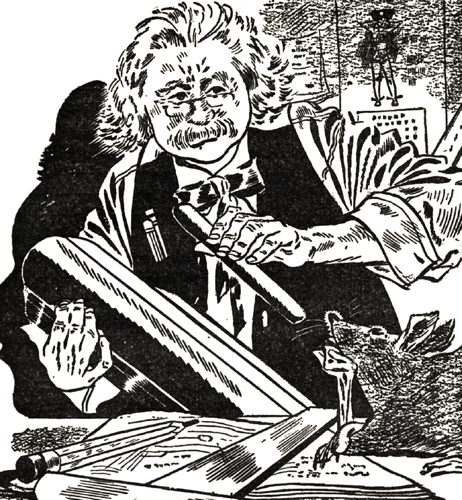
Professor Oberburger and Mitkey
When Mitkey arrives on Prxl, he gets the red carpet treatment, including a brain boost and implanted vocal cords. Suddenly Mitkey is as intelligent as a human and can tell the people of Prxl all about current events on Earth, most importantly, Professor Oberburger's rocketry work.

Concerned that humans might soon travel into space and discover Prxl, Mitkey is returned to Earth with a device that Mitkey can use to boost the intelligence of all the mice on Earth. This is intended to disrupt human civilization, giving the residents of Prxl several thousand more years of peace and quiet. However, when Mitkey returns to Earth his boosted intelligence goes away and so there is no war between intelligent mice and humans. Whew!

aliens from Xandor
Another early Sci Fi story by Brown (possibly his first) was "Not Yet the End", published in the Winter 1941 issue of Captain Future. This is an alien invasion story in which one-eyed Evil Aliens™ are in search of slaves. Brown's evil aliens are the Borg Xandor horde and they prowl the universe in their cube-shaped spacecraft, looking for slaves.

When a Xandorian spaceship arrives on Earth, they enter a city and abduct two monkeys from a zoo. Thinking that the monkeys are the degenerate remnants of the city-builders, they decide that there are no primates on Earth intelligent enough to serve as slaves and the Xandorian's depart from Earth. Thus, humans avoid being enslaved.

image source
Not expecting to find a science fiction story, but trying to understand how Brown came to write science fiction, I read "Armageddon" which was published in the August 1941 issue of Unknown Fantasy Fiction.

For "Armageddon", Brown sends readers off to Cincinnati for a performance by Gerber the Great (a magician) at the Bijou theater. The story is about young Herbie, who just got a new water pistol before Gerber the Great's stage show. Herbie's dad gives him a whipping for misbehavior: filling his water pistol with Holy Water during a stop at the Cathedral.

Although Herbie gets whipped, he actually saved the world from destruction by the Devil: a squirt of some Holy Water from his pistol dispatched the Devil and saves Humanity.

interior art for "Armageddon"
The Devil suddenly shows up during Gerber the Great's magic act because at that moment, on the other side of the planet, an ancient prayer wheel stopped turning, releasing the Devil from some sort of captivity.

When Gerber the Great is transformed into the Devil, flames appear, particularly on the magic pigeon box being held by Herbie. Herbie draws his water pistol and tries to put out the flame, splashing Holy Water on the Devil and saving the world from Armageddon.

Now having read several stories by Fredric Brown, I've had my fill of mini-asteroidal aliens, Mitkey the talking mouse, the Devil and the rest of Brown's retinue of fantasy characters. Maybe Brown wrote some interesting science fiction in later decades?

cover art by Ed Emshwiller
The Spring 1942 issue of Planet Stories also held "Black Fiar of the Flame", by Isaac Asimov. Asimov tried to get that story published in 1939, but it was repeatedly rejected by editor John Campbell. Asimov had a strong interest in history and had he not established a working relationship with Campbell, Asimov might never have written his famous positronic robot and Foundation stories. I don't enjoy fictional politics, so "Black Fiar of the Flame" is a tough slog for me, just as reading his earliest Foundation stories was. Similarly, I find Asimov's first robot story, "Robbie", to be almost unreadable. Only after years of mentoring by Campbell did Asimov begin writing the types of science fiction stories that appeal to me.

I have to wonder if Fredric Brown also got better at writing science fiction with practice. 

interior art for "Earthmen Bearing Gifts"
Such was the case with Jack Vance who began publishing stories such as "The Star King" in the 1960s. Thus, I could not resist sampling Brown's 1960 story "Earthmen Bearing Gifts". I'm a sucker for telepathy stories, so how does "Earthmen Bearing Gifts" measure up? The story involves telepathic Martians, but I'll hold my nose and try to focus on the telepathy.

I've seen Brown praised as a master of the very short story. "Earthmen Bearing Gifts" is very short. It recycles the same plot device that is found in "What Mad Universe": using a powerful burst of energy to probe the composition of a distant planetary body. In this case, an atomic bomb is sent to Mars from Earth in order to learn about Mars and its atmosphere. 

In the Ekcolir Reality.
The Last Martian. At the same time, the telepaths of Mars are eagerly awaiting the imminent arrival of Earthlings on Mars. Sadly, Brown provides no explanation of the physical basis of the telepathy that allows the Martians to "read the thoughts" of Earthlings who are millions of miles away. 😢

The Martian's are anticipating good relations with humans. The Martians are experts in social science and they hope to get help from Earthlings for rebuilding the infrastructure of their ancient civilization. 

Only one Martian city remains with about 1,000 residents. The atomic bomb from Earth accidentally and improbably lands on the last remaining Martian city, putting an end to the telepathic Martians.

cover art by Tim White
So there we have it. I should not have gotten my hopes up thinking that maybe Brown would have something interesting to say about telepathic aliens. I suppose some people might view "Earthmen Bearing Gifts" as "clever" and enjoy the sudden "twist" at the end, but I was not amused. 

This (above) is the third of a set of blog posts about Fredric Brown and the "stuff" that he published in Sci Fi magazines and how Sci Fi fans reacted. How would I characterize his "stuff"? When science fiction was assembling as a distinct literary genre it had a core set of plot elements that were frequently included in stories: space travel, time travel, alternate dimensions or parallel universes, space aliens, the ingenious scientist/inventor, the heroic spaceship captain, etc. 

In the Ekcolir Reality
Brown was able to treat the already-existing plot elements of science fiction in much the same way that a child uses a set of building blocks, pushing them around into new configurations. I suspect that Brown was more comfortable when writing in the domain of detective/crime fiction where he did not have to worry about science or technological details. 

At a young age, Isaac Asimov's father did not want his son wasting time with trash magazines. Isaac created the idea that if a magazine had the word "science" in the title then it must be educational. With the mentoring of John Campbell, Asimov was pushed towards making his own stories more than just entertaining pulp "stuff". When pushed to invent new Sci Fi plot elements such as the Laws of Robotics and the fictional science of Psychohistory, Asimov was able to make interesting additions to the science fiction genre. 

everything is animated
Brown's humor was a welcomed contribution to Sci Fi, a genre where far too many stories are dreadfully dull and relentlessly serious. However, with no connection to the domains of science and technology, Brown was not going to come up with interesting new fictional science or future technology. When I read the science fiction stories of Fredric Brown I get the uneasy sensation that he was more interested in mocking the science fiction genre than expanding it. If anyone has a copy of "The Robot, the Girl, the Poet, and the Android", I'd be interest to know what it was about.

Related Reading: an entire website devoted to old fantasies about life in our Solar System -  and "Sinister Barrier", published in the first issue of Unknown

Next: even crystal skulls are animated; the 2021 SIHA awards

visit the Gallery of Movies, Book and Magazine Covers or Planetoid 787.


Dec 23, 2018

Heisenberg's Eyes

cover by Paul Lehr?
I'm fascinated when non-scientists attempt to write science fiction stories about biology. Frank Herbert published such a story, called "Heisenberg's Eyes", in the June and August 1966 issues of Galaxy magazine. 1966 was an interesting year for Herbert because his Dune saga was bursting upon the world. In the wider world of biology research, the "coding problem" was rapidly being solved. Sadly, there is no indication in the text of "Heisenberg's Eyes" that Herbert had any understanding of DNA or the concept of a nucleic acid sequence. In the absence of having anything sensible to say about genetic engineering, Herbert went ahead and wrote a story about genetic engineering imaginary future politics and the human struggle against tyranny.

see the original cover
You can download the magazine issues that contain "Heisenberg's Eyes" from online archives of science fiction magazines such as the Internet Archive.

June 1966 Galaxy with Heisenberg's Eyes Part 1 - Download
August 1966 Galaxy with Heisenberg's Eyes Part 2 - Download

"Heisenberg's Eyes" is set in the far future, at a time when surgeons have long been doing genetic surgery on early human embryos. The imaginary setting of "Heisenberg's Eyes" reminds me of the futuristic world described by Stanley G. Weinbaum in his 1939 story "The Black Flame". A small "ruling class" of immortals (called "Optimen") uses advanced reproductive technology to control society.

Herbert tells us that this brave new world of the future is full of sterile worker drones who lead a "troglodyte existence". A typical lifespan is 200 years, so most people never get to have children. However, there are some fertile members of society who occasionally get to be parents. "Heisenberg's Eyes" begins with genetic surgery on a newly formed embryo. Herbert skips over the in vitro fertilization process and begins the story by introducing readers to the morula stage embryo of Lizbeth and Harvey Durant.

Svengaard's nurse
illustrated by Dan Adkins
Don't let the name "Optimen" fool you: some of the Optimen are women, such as the cult figure Calapine, who is worshiped as a fertility goddess by some members of the underclass. Other political factions of the future include the Cybermen and the Parents Underground. The god-like Optimen reside in Central, a headquarters from which they dispatch special agents such as Dr. Potter.

And don't let the illustration (to the left on this page) fool you. Dr. Svengaard uses the ultra-modern meson microscope to examine the Durant embryo's genes.

The renowned Dr. Potter has been called upon to perform genetic surgery on the Durant embryo because it is a special embryo with high-potential genes. Dr. Svengaard has detected indications that this embryo might have the mystical capacity to develop into one of the rare, immortal Optimen. Peering through his meson microscope, Svengaard sees a "triple spiral", an indication that there are Optimen genes in this embryo! I suppose if mere mortals have a double helical DNA then (by Herbert-logic) the god-like Optimen should have a triple helix.

Calapine; 50,000 years old
Herbert tells us that the Optimen are perfect, but for some reason they are sterile (except possibly our dear old Calapine). Well, as they say, perfection is not all its cracked up to be. Herbert drops an endless stream of little hi-tech bomb shells on the reader. For example, we are casually informed that there is danger in using the meson microscope to examine DNA: the danger of Heisenberg interference. Then, for only the 9th time in the long history of genetic engineering, Dr. Svengaard witnesses a molecular miracle. A rod of sperm protamine appears inside a cell of the embryo, causing the ADP-ATP exchange system to suddenly become more complex and “resistant” to gene surgery.

the Third Doctor
What is this mumbo-jumbo supposed to mean? The miraculously appearing microscopic rod of sperm protamine represents an "outside adjustment" to the embryo. There is an unseen resistance movement ("led" by the Cyborgs) with secret underground bases and secret doors in walls and the magical means (never really explained) to divert some precious embryos away from developing into Optimen towards becoming freemen, people who can live free from Optimen-imposed system of global control and world domination. Were this story being written in our millennium then we would get some incoherent sciency backstory about a "Spartan virus". Since "Heisenberg's Eyes" was written in the previous millennium, Dr. Kildare Dr. Potter proceeds to perform delicate molecular surgery, bringing baby morula back from the brink of death, but only by means of the risky use of mutagens!

cover by Terry Oakes
Legend has it that Herbert spent years researching topics like ecology while writing Dune. There is no indication that he put similar effort into "Heisenberg's Eyes". Readers are subjected to page after page of seemingly random biochemistry terms that describe and "explain" the gene surgery process.

The super-hi-tek genetic surgery of 1966 requires spinning reels of "computer tapes". After Dr. Potter's miraculous surgery is complete, the computer tech "accidentally" erases the computer tape evidence obtained during the surgery which would reveal that this embryo can survive without the life-giving enzyme supplements provided to the people of the world by the Optimen of Central. The data erasure is initially attributed to "solenoid failure", but the Optimen have no difficulty deducing that the erasure was deliberate.

Reflecting on the events surrounding his surgery on the Durant embryo, Dr. Potter has a brilliant flash of insight: he realizes that a simple chemical treatment can render other human embryos free of any need for the artificial enzyme treatments that are the technological basis of how the Optimen maintain control over the world's population. I suspect that Herbert never understood what an enzyme is, but who cares? He just needed a hi-tech plot device with a sciency name.
1987 edition

Part 2
After thousands of years of world domination by the Optimen, the simmering revolutionary movement of the Cybermen and the Parents Underground turns into open warfare against the Optimen.

The revolutionaries wish to be free of the Optimen: free to live without the restrictions imposed by the Optimen.

Herbert declined to show us the source of the egg cell that gave rise to the Durant embryo, but when circumstances (require?) that the embryo be implanted into Lizbeth, she suddenly has painful stitches in her abdomen. Okay, Herbert was writing a decade before Louise Brown, but successful uterine implantation of a rabbit embryo (created through in vitro fertilization) had been achieved in 1959. Women now routinely have their early embryos put into their uterus using a thin tube that goes through the cervix. Maybe the abdominal stitches are what we should expect from having a gene surgeon, old Doc Potter, perform an embryo implantation. After all, in Herbert's brave new world, it has been thousands of years since women actually went through pregnancy; now the embryos develop inside hi-tek artificial vats.

Fearing the Durant embryo and what might be learned from it, the the ruling Optimen triumvirate decides to ruthlessly kill everyone in the area, millions of residents. The rebel Cyborgs and the Durant family (embryo makes three) are hunted down, captured and brought to Central for interrogation. You'll have to read the "stunning conclusion" of "Heisenberg's Eyes" for yourself; I can't explain it. I have the feeling that when Herbert reached the page limit for Galaxy, he stopped writing.

I like to imagine that a young Frank Herbert read "The Black Flame" and then later wrote "Heisenberg's Eyes" as a kind of re-imagining of that Stanley G. Weinbaum story. I can't decide which is less biologically plausible: 1)  spore-drive space travel powered by spice-generating sandworms or 2) the magical degenerating-Optimen ending of "Heisenberg's Eyes". While shaking my head sadly in dismay, I'll slap the label "biofantasy" on "Heisenberg's Eyes". The story almost qualifies for the additional label of "anti-science fiction".

1966 cover
In his comments on The Eyes of Heisenberg, Rob Weber emphasizes the point that "Heisenberg's Eyes" deals with the collapse of an imaginary society in which an attempt had been made to control the evolution of the human species and lock human society into an artificially-constrained social system.

I believe that this imaginary society of the future was able to last about 70,000 years because at some time in the far past the Optimen granted the Cyborgs permission to form a secretive underground movement where it was possible to experiment with human embryos, dream of alternatives to the Optimen-controlled world and thus provide an outlet for the restless human spirit.

Revolt against the immortals
The Optimen kept a close watch over the world using a sophisticated surveillance system, and they retained the ability to "put their foot down" if the revolutionaries ever got too uppity. However, it was only a matter of time (about 70,000 years) before the immortal Optimen became too lazy and incompetent to keep a firm grip on affairs. Finally there was an opening for development of a new kind of society and that opening is described in "Heisenberg's Eyes".

recycle those covers!
For me, "Heisenberg's Eyes" seems like a mostly sterile exercise of the imagination. Herbert never managed to make me believe that his imaginary world of the future is possible and "Heisenberg's Eyes" certainly is not fun or entertaining. I suspect that even Herbert grew tired of writing this story and could not be bothered to write a sensible ending.

The End of Eternity
What interests me most about "Heisenberg's Eyes" is that it deals with an imagined future society where a "technological singularity" is never allowed to occur. This kind of technological stasis is also found in Isaac Asimov's Foundation saga and the stories of Jack Vance that are set in a future galaxy where humans have spread to many worlds, but people still live essentially as we do right now here on Earth. In The End of Eternity, Asimov imagined how time travel technology could be used to create a static future for Humanity. In "Heisenberg's Eyes", Herbert gives us an imaginary dystopian static society of the future that is built upon genetic engineering. As a biologist, I don't find such a future to be either plausible or entertaining. I can't stop myself from believing that Herbert borrowed the plot and never really cared about the story he was telling. I suspect that "Heisenberg's Eyes" was written during the time when Herbert was trying to walk away from having a 9-5 job and transition to being able to survive as a full-time fiction writer.

Fru'wu: Our Alien Prometheus
"Heisenberg's Eyes" strikes me as being just another story that Herbert could crank out for a paycheck. Given the power to alter human genes, I doubt if people would simply use that power to make a dead-end dystopian society full of sterile worker drones who lead a "troglodyte existence". That is an anti-science plot that seems stuck in the far past along with the Frankenstein monster and I'm not sure why a reader of science fiction would enjoy such a story. It is sad that such dystopia-themed stories represent one of the established roads to publication and financial success in our world.

Related Reading: "Methuselah's Children" and Herbert's 1965 artificial intelligence story

Next: another resistance movement
Visit the Gallery of Book and Magazine Covers.

Oct 30, 2016

Men of Steel

source
I first came across a "man of steel" in the 1960s. After 1965, episodes from the 1950s Superman television show were finally shown in color, but I don't think I saw any in color until the 1970s when my family got a color television set. Some time in the late 1960s I saw "bad guys" (in black and white) shooting at Superman and the bullets bounced off of the "man of steel". I don't recall that I ever saw the first episode of that television show, so I don't think I ever took seriously the idea that Superman came to Earth from another planet.

able to leap over tall buildings
I've never read a Superman comic book or seen a Superman movie. The days of Superman radio broadcasts were before my time. My interest in Superman does not extend far beyond a mild curiosity about the possible influence of Superman on Isaac Asimov.

1949 Avon edition
Biofantasy
I've seen it suggested that Gladiator was a possible source of inspiration for the comic book idea of a "man of steel". In Philip Wylie's 1930 story, the titular "gladiator" is a man (Hugo Danner) who was given super-human physiology by his father. Abednego Danner worked as a biology professor at a small college and in his spare time he experimented in his home laboratory. One day he discovers how to magically endow animals with great strength and epidermal toughness. By injecting his pregnant wife with a magic potion, Abednego transforms his son into a superman who can jump over buildings and whose skin deflects bullets.

cover art by Frank Paul
Imagine the young Isaac Asimov, going off to the public library where he could voraciously consume the literature of the world. In his family's store, there were pulp magazines, some of which he got permission to read because they had the word "science" on the cover (and he argued to his father, they must be educational). In 1930, who might have guessed that such a nerdy little boy would help create a new literary genre?

cover by David Bergen
Before Gladiator, a slightly earlier tale of amazing magical chemistry was "Crystals of Growth". Another biologist, professor Brontley, discovers the perfect food that can make people grow to great size. Such non-scientific ideas were certainly "in the air" when Asimov was a boy, having been spread to the world by many fantasy stories including that of Wells in his The Food of the Gods and How It Came to Earth.

Telespectroscope
cover art by Howard Brown
We must look to the influence of science fiction pioneers such as Hugo Gernsbeck, David Lesser and John W. Campbell if we want to understand how Asimov managed to become a revolutionary science fiction writer (and not a fantasy author) after growing up in a world full of biofantasy stories. Asimov wanted to study biology and become a doctor, but he was deflected into the study of chemistry.

Asimov apparently read every 1930s science fiction story that was published in the pulp magazines. "Cosmic Quest" by Edmond Hamilton provides an example of the kind of science fiction story available to the young Asimov, and it is an example of a story that had its roots in physical science.

Telespectroscope
Astronomers had long made use of spectroscopy to study the composition of stars, but Hamilton extrapolated to a super telescope that could be used to identify exoplanets with Earth-like atmospheres.

Now, after 80 years, here in 2016, science fact is starting to catch up with Hamilton's imagination.

pulp magazine ad
Also in those 1930s pulp magazines were advertisements such as the one shown to the left. Such was the environment that Isaac Asimov was educated within.

biofantasy
Hugo Gernsback had called for a new type of fiction and he designed new pulp magazines to market science fiction stories, but creating a new fiction genre that was firmly rooted in science was no easy task.

Gernsback made use of the available talent, but writers from Gernsback's generation, such as David Keller, were trapped in the past. A new generation of writers was needed.
The Time Projector

Hugo Gernsback and David Lasser
When it was Asimov's turn to walk upon the science fiction stage, he knew enough about biology so that he could mostly avoid dabbling in absurd biofantasy. Under the mentor-ship of Campbell (who was trained in physical science), Asimov often centered his stories on physical science topics. It is easy to imagine Asimov being amused by magical plot devices such as the "Time Projector", a device with all the sophistication of a "gargantuan watch". When Asimov wrote his own time travel novel, he could harness the power of imaginary electronic computers to power his time machine.

cover art by Ralph McQuarrie
Similarly, Asimov's "men of steel" were robots with positronic brains.

What were writers such as H. G. Wells and Philip Wylie thinking when they imagined a science of biology that could control and re-shape the human body?

film
Both Food of the Gods and Gladiator only tangentially touch on science. Philip Wylie may have taken science classes before he dropped out of college (I've seen it claimed that he studied physics), but the biology in Gladiator seems like a joke. The film that was "inspired" by Gladiator certainly went with the joke angle.

I can't really imagine a place for Gladiator in the science fiction genre. Wells and Wylie were more interested in politics than science. What kind of retro-configuring would be required to bring Wylie's tale into the realm of science fiction?

Openly adapted as a comic book story
after Wylie's death

Perhaps we should imagine that Abednego Danner was a time traveler, sent back from the future in order to make sure that Germany lost World War I. Imagine that a time traveling Abednego Danner came into the past equipped with nanotechnology: a swarm of nanobots that could replace some of the cells of the human body, providing artificial muscles with great power and a thin, protective epidermal layer that was as strong as steel. Or, it seems far easier to just go along with the folks at Avon books and declare Gladiator to be a story about the "lusty and uninhibited life of a superman".

I'll always be grateful that a few scientifically-literate authors such as Asimov were able to give us a some thoughtful stories about robotic men of steel. That is a rare gift to hold on to; something other than the absurd and endlessly rehashed pop culture super-heroes.

Gertrude Mabel Barrows
 Related Reading:  "The Curious Experience of Thomas Dunbar" by G. M. Barrows (1904). A man named Dunbar had the mysterious "new element" called stellarite forced into his body during a freak accident and he attains incredible strength. You can read the story here.

Next: the scientific novel

Philip Wylie's Gladiator re-imagined with the Vietnam War taking the place of World War I.