Showing posts with label Cellular Civilization. Show all posts

Mar 12, 2012

Plato's Cave

I previously mentioned that Isaac Asimov was heavily influenced by the science fiction stories he read in his youth (the "pulps", like the one shown in the image to the right....gee, I wonder why so many people give similar reports of alien abductions?).
Similarly, I enjoyed watching Star Trek re-runs when I was young. The Star Trek episode "For the World is Hollow and I Have Touched the Sky" reminds me of the image to the right. During the past couple of centuries, it has been possible for humans to generate a detailed understanding of our place in the universe, but a persistent science fiction theme explores the possibility that reality as we know it is just an illusion.

Might you be in some kind of computer simulation that tricks you into thinking that you are more than just software in a computer? Probably the most hyped version of this sort of "simulated reality" fantasy is The Matrix. A modern philosophical version of this topic is the "brain in a vat", but this is an age old idea. In our "Western" philosophical tradition, some Platonists long ago imagined that reality as we experience it is an illusion while the only things that are truly real are the imaginary "ideal forms" invented by philosophers. In Cellular Civilization, Thomas is a haunted host for alien nanites and his thought processes are so muddled that he has trouble recognizing what is real. There are endless ways to explore and question the nature of reality in science fiction stories.

I've previously imagined a disease called "reality assignment disorder" that would involve confusion in the brain about which experiences are due to an external reality revealed to us by our senses and which are imagined fantasies. In Capgras syndrome, patients have the feeling that an acquaintance has been replaced by an imposter. In alien hand syndrome, patients feel like someone else is in control of a limb. All kinds of strange perceptions can be caused by brain damage. We need a healthy brain in order to have a normal sense of what constitutes reality.

I've never been plagued by doubts about the reality of the world that my sensory organs and my brain allow me to experience: I can't take seriously the idea that we should not trust our brains.....hundreds of millions of years of evolution went into making the (healthy) human nervous system a reliable way to experience the world around us. However, I do like science fiction stories that explore the possibility that conventional beliefs about the nature of reality might be wrong because those beliefs are built upon imperfect knowledge of the universe. I love the idea that a simple scientific discovery can "change everything" and radically reshape human beliefs about the universe.

Newton did not literally "penetrate the sky" and so perceive reality in a new way, but he was able to imagine that a single force, gravity, both makes apples fall off of trees and holds the Moon in the sky. That conceptual leap once-and-for-all allows us to stop wondering what holds the Moon and planets in their positions in the sky. There need be no aetherial "celestial spheres" or other fantasy explanations for the motions of celestial objects.....gravitation does the work of a thousand imagined epicycles.

Here is another example of how a scientific discovery can suddenly change our understanding of the universe: during most of human existence on Earth, people wondered about the composition of celestial objects. Even after the science of astronomy had begun it was tempting to believe that people might never know what stars are made of because of their great distance from us. However, spectroscopy revealed that stars are made of the same types of atoms that we find in our own bodies. For centuries it was possible for philosophers to imagine that celestial objects might be composed of some mystical and ethereal substance not found on Earth. I love that science can overturn such beliefs and allow us to realize that the material of our bodies was formed inside stars that long ago exploded and scattered our atoms through space...only to be formed into new planets and stars.....and us.

I suspect that we are the one remaining member of the Homo genus because of our special cognitive abilities. Humans have the ability to play with ideas and create stories that meander back and forth between the objective reality that we all experience using our structurally similar brains and imagined variations of reality that we can each invent as extensions of what we see in the world.

I've never been very good at pushing my imagination towards the more hardcore domains of fantasy, but it is easy for me to play around with imagined science.

What distinction am I making between "hardcore domains of fantasy" and "imagined science"? The boundary that is of interest to me was discussed by Veronica Hollinger in "The Vampire and the Alien: Variations on the Outsider". Dr. Hollinger discussed "domestication of the fantastic" in the context of vampires. There have been many science fiction stories about aliens who could suck vital essences from humans, so why not imagine that horror story vampires might be space aliens? For me, the main reason is that there are so many vampire stories where no attempt is made to give a rationalization for the existence of vampires...they are simply presented as a magical element of a fantasy story.

source

I've never been intrigued by the idea of vampires, but I can imagine how it might be possible to portray Overseers as vampire-like "aliens". I enjoy having some deep-rooted antagonism between humans and Overseers, but I've never tried to portray Overseers as evil creatures. I've never read "The Space Vampires" and, as a biologist, I have little patience for plots that involve beings with magical "life force"-sucking powers. I can imagine an Overseer using nanite probes to take away memories from Franny (rather than give up her memories, Franny leaves Earth) or those nanites taking away the ability of Judy's motor neurons to control her muscles (this happens in Exodemic), but I've never taken seriously stories like "Day of the Dove" in which alien creatures feed off of humans (or humanoids).


In the image to the right, the boys defeat such an alien (it has an appetite for fear) with laughter. I like to think that I have a good imagination, but I can't imagine how anyone would think that it makes sense for a life form to feed off of fear....or think that people would enjoy science fiction stories about such imagined life forms. Yet, Star Trek had several episodes based on this premise including "Wolf in the Fold".

A large part of my problem with stories like Day of the Dove and Wolf in the Fold is that they strike me as horror stories or murder mysteries dressed up to be passed off as science fiction. These stories try to "domesticate the fantastic" and ask us to say, "Gee wiz, an alien like that could explain so much of the evil from human history," but even as a 12-year-old I was not buying it, or the idea that dinosaurs died in the biblical flood.

What I like most about science fiction and Star Trek is adventure...going to new places and seeing wonderful things. Expanding our mental horizons. For the past 100 years it has been popular to imagine space aliens suddenly showing up and turning our view of the universe up-side-down. Of course, after a while, that can grow old. For me, the Fermi Paradox is a like a big wet blanket draped over SciFi First Contact stories.

Aliens should not show up on Earth next week, they should have been here millions of years ago. Maybe Earth was so boring that the aliens came and then left, but that does not make for a good science fiction story. Maybe we are looking at shadows on the wall of Plato's cave. Maybe we all do see the shadows of aliens who long ago came to Earth, but we just do not recognize the meaning of those shadows.

It took the genius of Newton to start with something that many other people had seen (a falling object and the Moon in the sky) and conceptualize it in a new way (universal gravity). What if evidence for space aliens is right here in front of our eyes every day?

One of my favorite parts of the Exodemic Fictional Universe is that it is escapist literature depicting the human condition as being such that we are all just one small step away from a kind of personal First Contact that would win us a ticket off this rock and set us on a grand adventure among the stars. We don't need to be the brilliant (or lucky) scientist who can build a space ship in the garage. We don't need to depend on a slime dripping alien to show up looking for a planet to plunder. We don't need to imagine a government conspiracy with aliens hidden at Area 51.

In Exodemic, Franny lives her whole life never even giving a thought to space aliens or travel between the stars, but suddenly she finds herself seated across a table from someone who can take her away from Earth and open up for her a new life of adventure. All she has to do is say, "Take me away". If we are chained up in Plato's Cave, wouldn't we all say "Take me away"? Apologies to Martie Maguire and Marcus Hummon.....

touch the earth
break it in my hands
take me away
fly as high as you can
wrap me in a blanket of stars
take me away

Images. Top: Edgar Rice Burroughs on the pulps, "people were paid for writing rot such as I read in some of those magazines.....I could write stories just as rotten." colored modification of the Flammarion Woodcut. Genus Homo chart.

Music. In Exodemic, the Overseer who takes Franny away speaks with an accent...people in England think she is from Eastern Europe.....something like in the music video below: (http://www.youtube.com/watch?v=SYMk6ifkHiY)

Jul 5, 2010

Does Anyone Care?

image
A wormhole, by CorvinZahn
Are there any aliens "out there" who care about Earth and humanity? Many science fiction stories are built around the idea that aliens might travel vast distances to Earth and attack the technologically-inferior humans. I think there are more interesting ways to write science fiction stories about aliens who visit Earth.

In his novel Contact, Carl Sagan imagined that the galaxy was teaming with alien life forms. In an effort to get to know the primates of Earth, those aliens sent a radio message to Earth and explained how to construct a device (some kind of transport pod that could travel through wormholes) that would allow humans to travel across the galaxy and visit the alien beings. This made a fun adventure for Ellie Arroway, but for the most part the aliens were not very interested in primitive primates.

Similarly, Arthur C. Clarke wrote some science fiction stories in which advanced aliens did not seem particularly interested in humans. The question was asked in Contact: Would we be interested in some random ant hill? Why should aliens be particularly interested in Earth?

In the Ekcolir Reality
In his story Homo Sol, Isaac Asimov imagined that the galaxy contained aliens who ignored Earth until humans were able to develop the technology needed to reach another star (alpha Centauri).

One answer to the Fermi Paradox is that extraterrestrial civilizations do not reveal themselves to primitive creatures like us. If there are alien life forms watching Earth, what level of technologically advancement might they expect us to achieve before they bother making contact with Earth?

In Cellular Civilization it is imagined that aliens came to Earth long ago, but they did not want to reveal themselves to Earthlings. However, the aliens are interested in Earth and they can't resist performing a bit of genetic engineering on Earthly life forms. The aliens also collect samples of Earthly life and take those samples away to be "cultured" on distant worlds.

Eventually some troublesome primates (us) develop a technologically advanced civilization on Earth. The aliens find this problematical. Humans are making a mess on Earth. The aliens develop a plan for removing humans from Earth and returning the planet to the status of a peaceful garden, free of the technological excesses of humanity.

In 2008, Part I of Cellular Civilization was written. I'm now starting to develop Part II, which shows what happens to Charlie Parker after he is taken off of Earth. Charlie learns that there are humans who live at colonies scattered around the Solar System. Charlie gets a tour of the Solar System, including visits to the moons of Jupiter, but he is frustrated by the fact that nobody has ever met an alien.

Cellular Civilization is set in the Exodemic Fictional Universe. In Homo Sol, Asimov explored the idea that there are psychological rules that govern humanity. In the Exodemic Fictional Universe I imagine that there is a basic rule saying something like: no good can come from contact between species with widely different levels of technology. Rather than interact directly with primitive Earthlings, the aliens surround Earth in layers of Genesaunts, life forms that trace their origins back to Earth, but which have various levels of technological development.

Charlie has climbed up one level from Earthly technology to the level that characterizes the Genesaunts who live out in the Solar System beyond Earth. In Part II of Cellular Civilization, Charlie will journey out of the Solar System to a nearby star and climb up another Genesaunt level. At that third level, he will find Interventionists who are ready to reveal themselves to Earthlings and start the process of removing all humans from Earth.

Part II of Cellular Civilization is under construction. Collaborating authors are welcome.

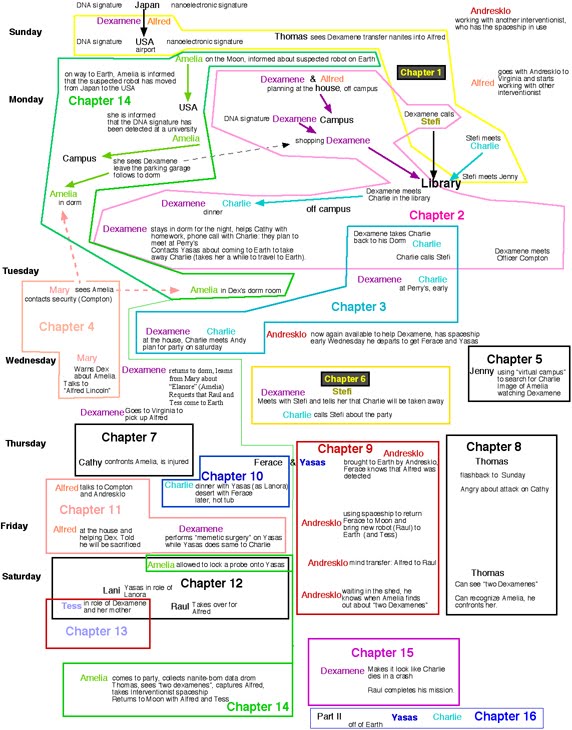
Image. The image above is my concept map for Part I of Cellular Civilization.
visit the Gallery of Posters

Jun 28, 2010

The Moon in Science Fiction

In 2009, the Lunar Crater Observation and Sensing Satellite (LCROSS) mission took place as part of on-going efforts to search the Moon for water. In what some have called the first work of science fiction (Somnium by Johannes Kepler) it was imagined that creatures living on the Moon made use of large bodies of liquid water.

These days, it is hard to imagine natural reservoirs of liquid water near the surface of the Moon, but if there were large deposits of water ice then it would become easier for human colonists to survive on the Moon.

Like many science fiction writers (see this list) I often find it convenient to make use of the Moon as a location for a human outpost. In The Search for Kalid, one of the main characters visits the Moon and explores an outpost where a small group of humans hide their little colony behind tunnels that are flooded with water. The residents of the colony are hiding because they have unusual brains that give them a kind of telepathic ability.

In Foundation and Earth, Isaac Asimov described a secret base, hidden under the lunar surface, where the positronic robot Daneel had worked for 20,000 years to guide humanity towards a safe future. Of course, Daneel is not your typical robot since he has telepathic abilities. Still, Daneel does not want to attract attention, so he works hard to make sure that the location of his lunar base is secret. In The Start of Eternity, Asimov appears as a character who goes to the Moon and learns that alien beings from a distant Galaxy long ago established a hidden base of operations on the Moon.

Predestination Moon
In 2009 I wrote Moon Hammer, a science fiction ghost story. In Moon Hammer, I imagine that Heinrich Kramer, a famous witch hunter, was taken to the Moon and his mind transferred into a robotic body. Kramer lives on and is present on the Moon when the LCROSS rocket booster strikes the surface of the Moon. It is rather chilling to note that Kepler's fanciful story about a trip to the Moon apparently resulted in accusations of witchcraft against Kepler's own mother. That's a rather appalling welcome from our Demon-Haunted World to the newly emerging science fiction genre.

In 2008 I started a novel, Cellular Civilization. Cellular Civilization is a story set in what I call the Exodemic Fictional Universe. There is a secret base on the Moon where hidden Observers collect data about the development of Earth's human civilization. Earthlings go about their affairs, unaware of the fact that some people (the Observers) are living on the Moon. Observer Base is also home for the Overseers, descendants of Neanderthals. The Overseers are a kind of police force who keep the Observers in line and cover up any evidence that might suggest to Earthlings that they are being observed.

X-Phile Moon
Having made a good start on Cellular Civilization back in 2008 and getting some collaborative help, particularly with the 'Thomas' character, I recently returned to the story. The first part of the story (written in 2008) mostly takes place on Earth. Two of the characters (Charlie and Lanora) depart from Earth and begin a new adventure in the outer Solar System. Not only are there humans living on the Moon, there are also other human colonies scattered around the rest of the Solar System. My plan is to show some of those other colonies and then Charlie (an Earthling) and Lanora (by the way, 'Lanora' is not her real name) will get to travel out of the Solar System.

Nicotiana Intervention
In Cellular Civilization there is no space travel at faster-than-light speeds. I'm still thinking about the issue of how to depict the years-long journey of Charlie and Lanora to another star. Maybe they will just treat the cruise as their honeymoon. If you have ideas, feel free to join the fun.

Related Reading: science fiction stories set on the Moon

Jun 27, 2010

Most Gentle Stream

In Isaac Asimov's time travel novel, The End of Eternity, the crafty Noÿs Lambent looks into her own future and sees that she will fall in love with Andrew Harlan. Of course, that happy future is only one of an infinity of possible futures, but she makes it her own. Andrew Harlan is helpless to avoid the fate that Noÿs selects for them.

In Cellular Civilization the crafty Dexamene Gregores is not so lucky. Of course, poor Dexamene does not have access to time travel technology and other wonders from 10,000,000 years in the future. But all is not lost! Dexamene does have access to technology from the past, a past in which nanorobotic alien life forms came to Earth and stirred up trouble.

What kind of trouble? Humans.

Ancient myths are sprinkled with stories about god-like beings who have the magical ability to play with human emotions. The star-crossed lover is an age old literary concept. Arthur C. Clarke noted that advanced technology might seem like magic or the work of a god-like being.

I've long wondered what technological tricks were used by Noÿs to manipulate Andrew's behavior. What kinds of chemicals were in the drink she gave to Andrew when she seduced him? Did Noÿs (or, possibly, some lurking positronic robot) use telepathy to put ideas into Andrew's head? Or did that only require a revealing wardrobe from the 482nd Century?

Dexamene does not hesitate to use every weapon in her arsenal to make Charlie fall in love, but Dexamene is a busy Interventionist and does not have time for romance. However, Dexamene does have seven spare clones, her sisters, who can be called upon to do her dirty work.

So Dexamene brings her sister, Yasas, to Earth and arranges that Charlie and Yasas fall in love with each other....all it takes is tight pants, pheromones and some minor brain surgery...well, that and the fact that Yasas can amuse Charlie by casually discussing theoretical physics and spaceship propulsion systems. In the end, both Charlie and Yasas are content to find themselves together, splashing around in love's most gentle stream.

True, we do not usually think of brain surgery as a means of making someone fall in love with us, but Yasas is not limited to bear skins and stone knives, as Bones once described the high technology of our primitive times. Yasas is a product of Genesaunt culture and the beneficiary of cultural artifacts arising from alien life forms that brought advanced nanotechnology to Earth millions of years ago.

In the skilled hands of Yasas, brain surgery means memetic surgery, a technique that allows individually identified synaptic connections to be trimmed and pruned. Charlie's brain is putty in her hands, but shaping someone's emotions it is delicate work and while she's busy making Charlie fall in love the crafty Dexamene is making Yasas fall in love with Charlie.

Charlie and Yasas eventually figure out what happened to them, but they are resigned to their fate and offer few objections. Anyhow, they soon find themselves caught up in a larger mystery and on their way to the stars.

Image. Apologies to Domingo Alvarez Enciso.

Jan 23, 2010

Realism in Science Fiction

Annalee Newitz recently asked "Why Is Hard Science Fiction So Unrealistic?". Newitz is interested in the tradition of literary realism and she says: "realism in fiction and film has generally been an effort to represent the experiences of ordinary people". Is there a shortage of "ordinary people" in hard science fiction stories?

The definition of "hard science fiction" is problematical because it is at risk of changing in response to evolving conceptualizations of science. We live in the age of science, an age characterized by cultural change that is due to science and technology. As recently as 30 years ago science fiction was a much simpler part of human culture than it is today. In 1978, William Bainbridge and Murray Dalziel were able to comfortably divide science fiction into three parts: hard science fiction, fantasy, and new-wave. (see: "The Shape of Science Fiction as Perceived by the Fans") Today, there is a much broader collection of well-recognized sub-genres in science fiction.

In the data set analyzed by Bainbridge and Dalziel, Isaac Asimov was ranked as the most distinctive hard science fiction author. In 1978, Asimov was one of the iconic figures of the Golden Age of Science Fiction. Larry Niven is a good example of the next generation of hard science fiction authors. Science fiction is "hard science fiction" to the extent that it concerns itself with scientific advance and technological change and does so in a way that respects the nature of the universe and how science allows us to understand the universe. In my experience, authors with a personal interest in science and an understanding of how science works are the most likely to write interesting hard science fiction.

There are two common misconceptions about hard science fiction. Bainbridge and Dalziel explicitly stated one of these misconceptions. They wrote that hard science fiction: "refers to stories built around certain facts or speculations concerning the 'exact' or 'hard' sciences". It is true that the exact sciences dominate research expenditures, press coverage and popular concepts of what constitutes science. It is true that icons of hard science fiction such as Asimov and Niven were trained in mathematics and "hard science". Those truths are a consequence of the fact that the historical development of science is shaped by working scientists who tend to "divide and conquer". Scientific problems are sorted according to ease of progress and many physical science problems are the easiest and so have been tackled first. Simple problems like how to describe the nature of electromagnetism were studied first. More complex and challenging biological and social science topics are only now starting to receive adequate attention from scientists. Thus, identifying hard science fiction is not a matter of distinguishing between fiction that involves "hard science" or "soft science". Hard science fiction can certainly involve "soft science"; what is important is only that science and technology elements be present as a core aspect of the fiction.

Annalee Newitz raised (in her article) a second major misconception about hard science fiction. In discussing hard science fiction she equates hard science fiction with scientifically-accurate storytelling. This is simply wrong. There are sub-genres of science fiction within which scientific realism is prized highly. For example, the restricted comfort zone of mundane science fiction never pushes us beyond the current facts of science. However, both Asimov and Niven often extrapolated far beyond the "facts" as currently known to science. Two examples are Niven's stasis field and Asimov's Eternity. These two imagined technologies are "space/time bubbles" within which the known laws of physics explicitly do not apply. Science can tell us nothing about Niven's stasis field or Asimov's time travel device, yet they are both plot devices that exist comfortably within the genre of hard science fiction. They are depicted as the products of future science and technology and they are incorporated in their respective stories in a scientific (if entirely speculative) way.

Realism in science fiction is not to be confused with scientific realism.

Having raised the red herring of "scientifically-accurate storytelling", Annalee Newitz turns to another issue that seems to be her main concern: the types of characters and plots that we find in hard science fiction. Newitz constructs a dichotomy between science fiction with

1) "rebel heroes and extraordinary leaders" and "unrealistic megabeings with superpowers" and "alternate realities...focusing on technologies"

and fiction with

2) "ordinary people" and the "regular guy" and "building up social worlds" by showing "everyday life".

Newitz is asking: can't there be a better mix of realism and hard science fiction? We can ask, why does hard science fiction tend to be divorced from realism? These questions only make sense if you adopt a conventional definition of literary realism, and for the moment we can do so.

I think the fundamental source of the perceived split between realism and hard science fiction is that there are two fundamental directions from which science is approached in literature, a split that has variously been characterized as involving The Two Cultures or Culture Wars or postmodernity. This split involves a "glass half empty?" argument about the nature of science and its impact. Hard science fiction was born as a genre that was often "optimistic about the value of scientific and technological progress" and it remains so optimistic that its great works often depict dramatic transformations of human culture and human existence. In contrast, much of what counts as literary realism in science fiction is pessimistic and depicts imagined worlds where science and technology are powerless to change human existence for the better.

Hard science fiction stories traditionally extrapolate a scientific idea or technological power in such a way that we are transported to an imagined culture where the ordinary has been transformed into the extraordinary by science or technology. That is often the whole point of the story: science changes everything. Newitz is suffering from her misconceptions if she imagines that it makes sense to hope that hard science fiction will become more realistic in the literary sense. It would be paradoxical and self-defeating for a hard science fiction author to imagine a wonderful bit of technology and then write a story in which that technology changes nothing and people simply remain as the "ordinary people" of our everyday experience.

I sympathize with Newitz when she complains about science fiction television programs that strive to deliver realism. Most of these television shows are produced by people who think that they can cash in on the popularity of science fiction by putting a spaceship or a cloned human or some other "wiz-bang" plot device into a story and have it constitute interesting science fiction. Such television shows tend to be mind-numbingly "realistic" by endlessly showing people who are unable to change themselves for the better no matter what wonderful technologies are available to them. These programs depict conventional literary realism but the methods and workings of science are almost never realistically depicted.

Transformation of the ordinary into the extraordinary is often a central part of hard science fiction. The typical protagonist of hard science fiction is an ordinary guy, but that guy often does something great or is transformed into something great by the application of science and technology. That is why hard science fiction is often so unrealistic...if you define "realism" as a depiction of current everyday existence. Hard science fiction is often about showing the ways by which science can lift us out of our current reality. Newitz specifically mentioned Asimov and she claimed that he was a failure at realistically depicting everyday life. Some of his science fiction was set in the 20th century and I'd challenge Newitz to explain how those stories (particularly many of his robot stories) failed to be realistic.

Hard science fiction authors such as Asimov are probably best known for taking readers into strange new lands where the ordinary is transformed into the extraordinary and that probably takes some people out of their comfort zones, particularly television executives. If hard science fiction is done well, then even a world in which the ordinary has become extraordinary can be realistic about the nitty-gritty of everyday existence. Literary realism may have originated among non-science fiction writers and it may have originally been restricted to realistic depictions of current-day existence. There is nothing preventing science fiction authors from bringing realism to imagined cultures where everyday life is extraordinary if viewed from our perspective. Some types of hard science fiction can certainly seem unrealistic if you restrict your concept of realism to the perspective of one culture at one point in time. Science fiction is very much concerned with challenging those kinds of conceptual limitations. I'm willing to redefine and broaden the meaning of "realism" in the context of science fiction.

It is fun to follow hard science fiction authors like Asimov to distant imagined cultures. While doing so, we can be transported to places where everyday events are far from ordinary (according to our standards) and ordinary people (according to the standards of the imagined culture) get to do extraordinary things (measured by our standards). In The Start of Eternity, Gohrlay is an ordinary person in her culture. She just happens to be a Neanderthal who lives on the Moon. It is still possible to write about her life with realism. Cellular Civilization is set more within our everyday reality, but it is still possible for even the most ordinary characters like Charlie Parker to be transformed into something extraordinary by technology. In such stories I do not feel any conflict between hard science fiction and realism. Of course, I don't feel the need to adopt a restrictive view of realism.

Nor do I expect most people (including Newitz) to understand and appreciate hard science fiction. The narrowness of the Golden Age of Science Fiction provoked the "new wave" struggles to broaden the scope of science fiction. That led to the current popularity and diversity of science fiction and a state of affairs where we have hoards of "experts" on science fiction who do not understand science. Most of what passes for science fiction in popular culture is parasitic on the genre and endlessly tells us the same boring story: people living in the age of science who do not understand science are like deer standing transfixed by the head lights of an on-rushing car. I suspect that hard science fiction is a sub-genre that can only be understood and appreciated by people who are part of the scientific sub-culture. People familiar with science are comfortable with imagining alternate realities and can develop a flexible conceptualization of "realism". Once you make those moves, you are not left in the past with a narrow view of literary realism and you will become aware of the large amounts of realism that does exist within hard science fiction.

Image. Cover image for Cellular Civilization. Image credits.

Dec 31, 2009

Wearable Technology in Fiction

Maybe the decade from 2000 to 2009 could be called the Dick Tracy decade. Mobile phone technology finally caught up with the Dick Tracy science fiction wrist phone of the early 1940s.

I suspect that when our grand children look back, they will view these times as a series of Digital Decades that will have come to comprise a Computing Century. I think computer miniaturization and mobility are the number one digital development for the past decade, but Web 2.0 technologies like wikis, blogs, Facebook and Twitter come in a close second.

Another piece of wearable technology from the golden age of science fiction is Isaac Asimov's "temporal field generator", which is a plot device used in Asimov's time travel story, The End of Eternity.

For Asimov's imagined time travel technology, most paradoxes are avoided by supposing that a new Reality is created if you go back in time and change the course of events. As long as you wear your "physiotime field generator" you will not be erased from existence by killing your own grandparent.

Noÿs asks: "And what if they make the Change while you’re there?”

Andrew replies: “It won’t catch me...my wrist generator keeps me in physiotime so that a Change can’t affect me, you see.”

We still have a long way to go in order to have a real "physiotime field generator", but wearable technology already includes some devices for monitoring and controlling physiological processes. Some people wear heart rate and blood pressure monitors.

In The Start of Eternity, during the early days of time travel there are no personal physiotime field generators. R. Nahan travels back in time to save Gohrlay, but he is "caught" in the Reality Change and erased from existence. Asimov imagined time travel technology coming into existence several centuries in our future, but he also played around with the idea of taking knowledge of time travel into the past in order to speed the development of time travel technology. Why did Nahan never get help from his future self? I blame the Huaoshy.

If time travel is possible, what would keep the past from being over-run by meddling time travelers? Asimov imagined a future time in which humans decided that time travel was a BIG MISTAKE, so they eliminated the technology. But if a technology is discovered once, can you really prevent it from being discovered a second time? A "sure fire" way to make time travel impossible is explored in The Start of Eternity.

Images. 1) The Dick Tracy "wrist radio". 2) A modern wrist phone. 3) Wearable heart rate and blood pressure monitor. 4) Time travel kettle (for image credits click here).

Apr 8, 2009

Multimedia and videos for stories


Wiki technology began as a tool that facilitates collaborative authoring of webpages. We can go beyond text and add images and sounds to our webpages. I just created a short video for some dialog from the story Cellular Civilization. I used the xtranormal website to make the video clip. You can arrange to have your video creations uploaded to YouTube.

The Xtranormal video making system is still being developed, but it is easy to use and fun. There are some problems with their test-to-speech, but it is not too bad for the price (free). Since it is hard to understand some of the spoken words, I used the YouTube feature for adding captions. This is easy to do using a word processor, saving the captions as a text file and using the .sub file format (see the online instructions).

In this scene, Dexamene Gregores and Charles Parker are chatting. Dexamene is on a secret mission and Charlie is baffled by Dex and is trying hard to figure out who Dexamene is and what she us up to.

Related link: fiction wikia media project

Apr 4, 2009

Fiction Wikia

A space station near Mars
From an animation I did for "The Search for Kalid".
Image licensing: public domain.
I have been exploring collaborative fiction writing at the fiction wikia (also known as "Novelas") since 2005. This blog will allow me to reflect on what I am learning about how to use blogs and wiki technology to support online collaborations.

Here is a link to my user page at Novelas where there is information about the collaborative fiction writing projects I have been involved with during the past few years.

I tried to call this blog "Collaborative Fiction" but while trying to do so I discovered this other blog already existed.

The proximal stimulus for starting this blog came from my investigation of Twitter. I followed a link from Twitter to a blog called The Multiverse According to Ben where I was entertained by the post about a female mad scientist. That reminded me of my character Dexamene Gregores in the story Cellular Civilization.

"Cellular Civilization" is now over 50,000 words but it is still under construction and in search of more collaborating authors. On my To-Do list is developing the alien-inspired religious beliefs of the Thomas character. The idea is that his religious thought has grown out of the alien nanites that infect his mind. Poor guy. We have been having some discussions about religion as a theme in our fiction at the wikia-fiction IRC chat channel. It would be nice if there were some good way to integrate wiki, blogs, microblogs and chat. Another task for Stefiz. Get busy, girl. 

Related: the end of Twitter.

Future collaborations...

visit the Gallery of Posters AND the Gallery of Book and Magazine Covers

my blog